

Take Action: We just launched our 2026 State of GTM AI survey. We want to know how GTM leaders in Sales, Marketing, Sales Development, and RevOps are leveraging AI today. Take our 8-minute survey.
The content contained in this post is based on the playbook, Launching out of Stealth, developed by Sydney Sloan, CMO Exec-in-Residence at Scale Venture Partners.
Let’s do a vision exercise together. Close your eyes.
It’s the day of your startup’s launch out of stealth. You hit publish on a LinkedIn post. Within that first hour, hundreds of people are sharing, commenting, and reacting to your post. Business journalists reach out. Peers congratulate you. Prospects are already in your DMs asking for demos. Investors are in your inbox.
How did you get here? It definitely wasn’t based on your company page, which has 7 followers, one of whom may or may not be your mom.
It’s because of the founder-led brand you’ve built over the previous 8 weeks (or longer) and the 1,000+ followers you’ve accrued by sharing what you’re building.
In this issue we’re covering the system you can apply to get there: what to do with your profile, the content mix you need, how to build it into a habit, and a daily engagement routine that will show near-real-time results.
We’re going to focus on LinkedIn, because we know it works for building credibility with B2B audiences. Many of these principles also apply across channels like Reddit, X, YouTube, and Substack, too.
Why the founder, not the company
Your first post on the company page will tank, and that’s totally expected. Early on, audiences want a strong anchor to trust your brand. Putting the founder’s face front and center and talking about ICP problems will get you more eyeballs and trust points than churning out content through a corporate account. People want to hear from people.
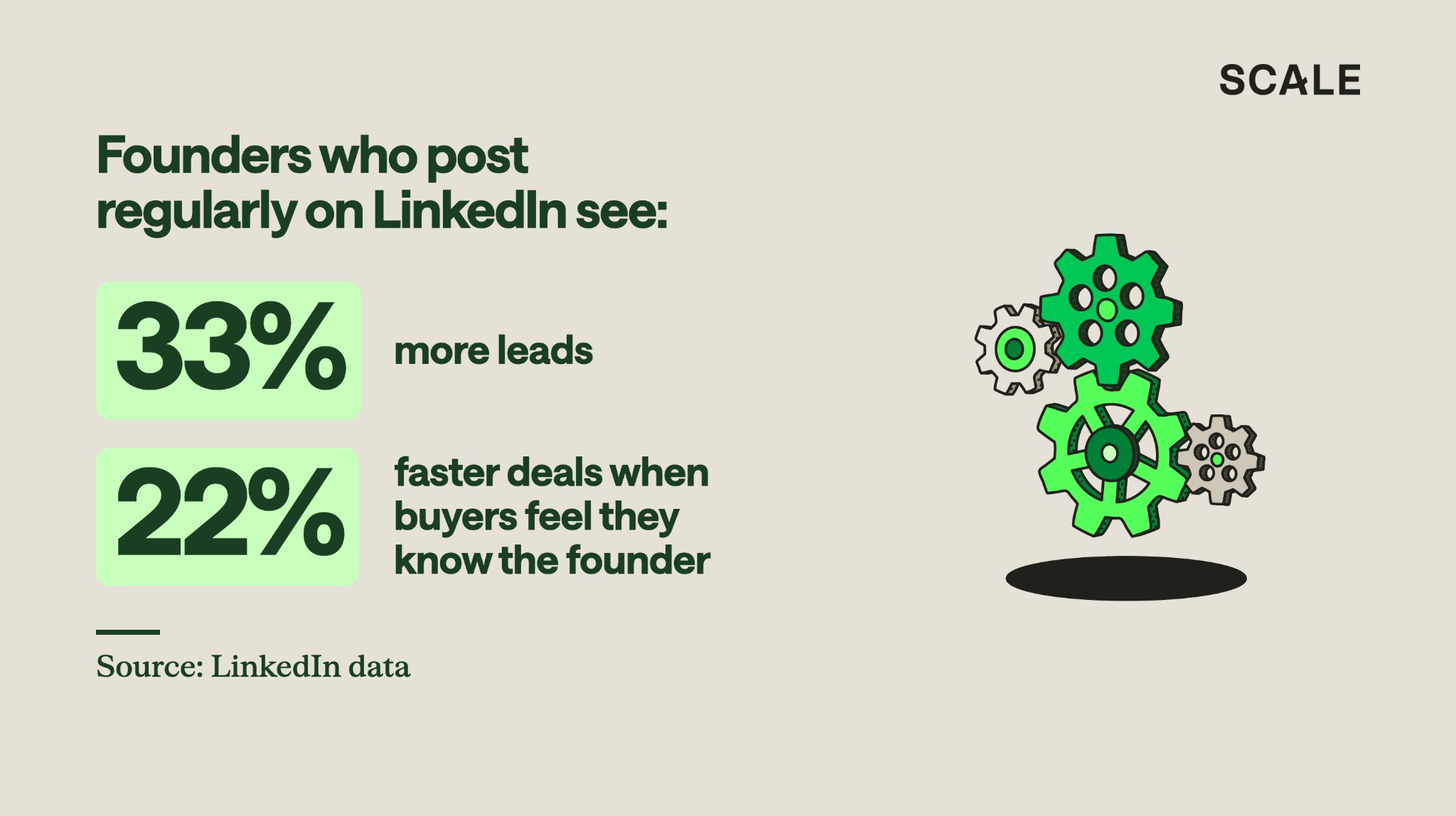
Ruby James and Alex Kapp of LinkedIn joined a Scale Marketing Council and gave a similar verdict: founders who show up on LinkedIn consistently have a clear advantage. A study by LinkedIn and Edelman shows that almost 90% of buyers are more likely to request a demo after seeing thought leadership from someone inside the company. And research from FTI Consulting shows 92% of professionals say they are more likely to trust a company whose senior executives use social media.
Exec thought leadership is also a big driver of what gets LinkedIn content cited in LLMs, as Scale EIR Sydney Sloan preaches. (Check out her AEO Playbook for B2B SaaS companies.)
When Prime Security came out of stealth, co-founder and CEO Michael Nov’s post racked up 326+ reactions and thousands of impressions, compared to the company page announcement which earned 72 reactions. Michael had been building in public for months prior to the launch, and he remains a steady voice of the company. When Prime announced its $20M Series A, Michael led the announcement again, which resulted in 400+ likes and hundreds of comments, including from people in their ICP.
Setting up your profile & content mix
Building a founder brand doesn’t mean your profile becomes a hype account. The goal is to build trust by sharing the perspective and expertise behind your company.
Your profile has to answer one question: why should I pay attention to this person?
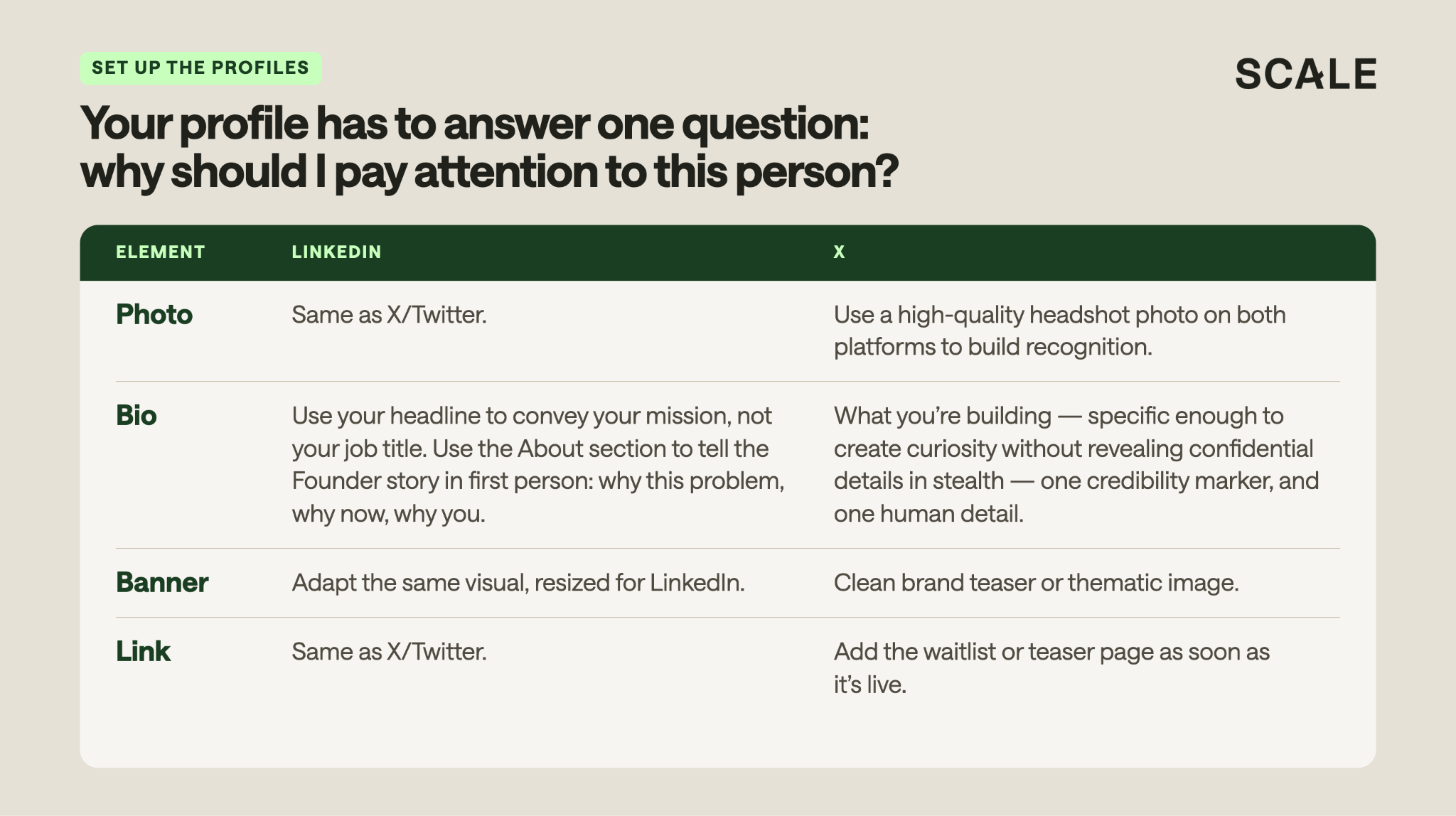
Your profile acts as a mini landing page, so be sure that it reflects what you want your ICP to see.
While founder brand should be top priority, your company page should still reflect the company messaging and recent updates.
“When a startup starts running paid ads on LinkedIn, about 50% of ad clicks go to the company page. If a prospect is unfamiliar with your brand and sees your ad, they’ll click your logo and go to your company page,” says Ruby James. “Treat it like a second website.”
Ruby also recommends activating other senior team members to post on LinkedIn. If you’re a measurement tool, someone with a marketing background is a natural face. If you’re in cybersecurity, your CISO should be active. Match the executive to the buyer you’re trying to reach.
Every C‑suite leader should attack the same central customer problem from their own angle. From there, Sales tracks who engages. Marketing spins up events and offers for people who fit the ICP, and the execs personally invite them. The whole team creates a flywheel of engagement that boosts everyone.
How to generate engagement & followers who care
LinkedIn is a business platform, but it’s also a social network. So treat it like one. Be helpful, respond to people, share your best stories, and have a little fun.
1. Post 2–5 times a week.
If you’re new to posting, you should start at the lower end and increase frequency as you develop your voice. If you want to go all in, two to three times a day is the max before diminishing returns kick in.
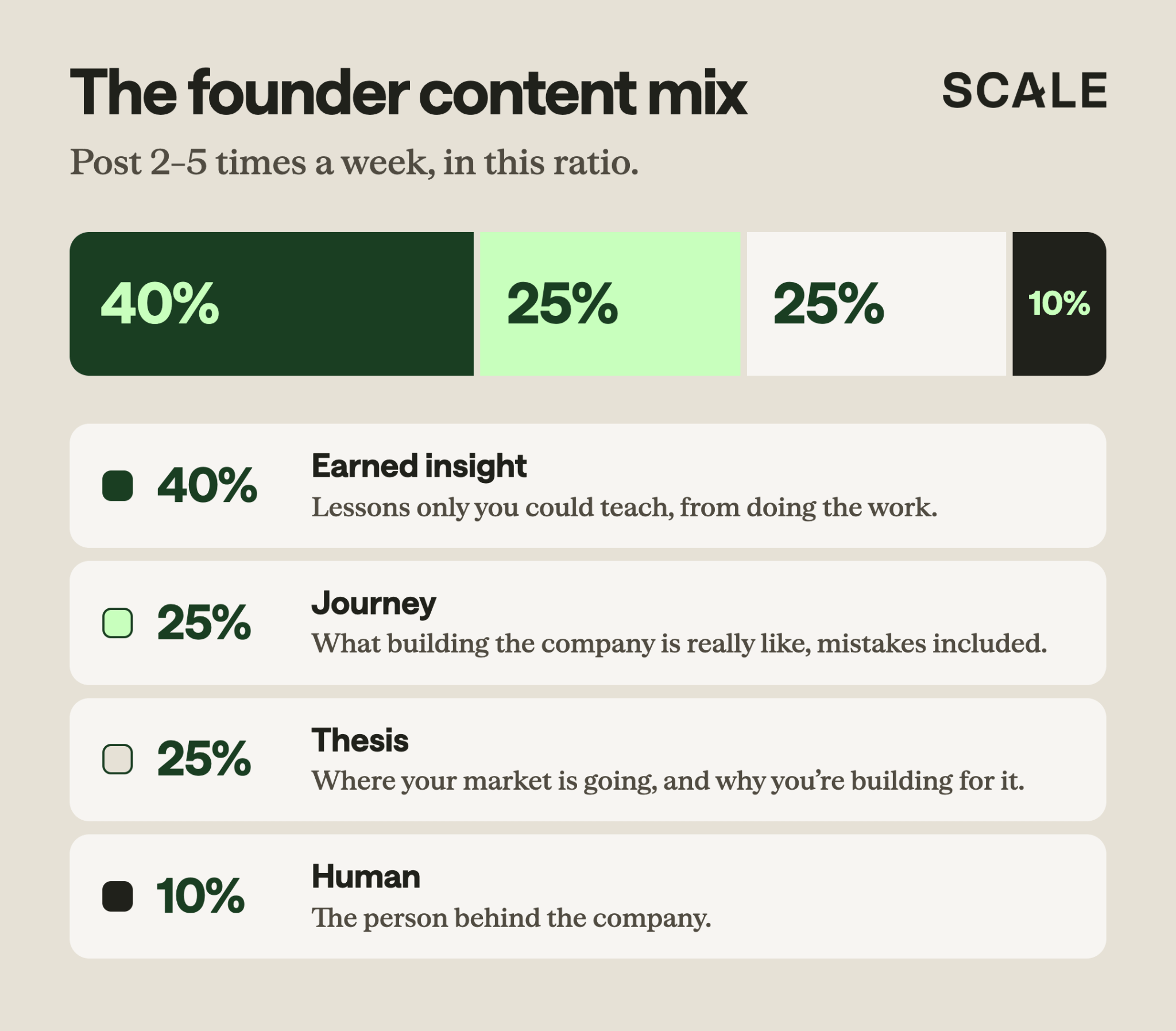
2. Distribute posts across four content types.
40% Earned insight: Industry observations and opinions from firsthand experience. This is the perspective you’ve earned by working on your customer’s problem. GC AI CEO Cecilia Ziniti’s post on why relying on Claude for legal work is a bad idea is a perfect example.
25% Journey: This is your building-in-public content. Difficult decisions, technical trade-offs, hiring lessons, mistakes, and small wins all make compelling content. Adam Robinson, CEO of RB2B, shared a post admitting how they ended the year with churn and what they’re planning to do about it next. Sharing missteps helps build trust; explaining how you’re improving builds authority in the space.
25% Thesis: Your POV on where the market is heading and why this problem matters now. Co-founder and CEO of Paraform John Kim’s post on the hiring scene in the tech world is an excellent source of inspiration.
10% Human: Personality, humor, hobbies, memes, and experiences outside the company. This content is for human-to-human connection. Scale Operating Partner Dale Chang is a pro at this. (Have you seen his 12 Days of BBQ series??) A good rule of thumb: if you’d be comfortable sharing it in an all-hands meeting, it’s ok for LinkedIn.
3. Reuse and repurpose content whenever you can
Vulnerable U Founder Matt Johansen has over 270K followers on social media, and his mantra is “Reuse and repurpose.” One anchor piece can become a dozen posts. Re-running your best ideas won’t wear out your audience because the overlap between people who see it the first and second time is tiny.
4. Use AI as an editor, not an author
Claude or ChatGPT can help you turn voice memos into rough drafts, mine Granola notes, sharpen hooks, or pressure-test structure. But don’t let it write your posts. Keep the thinking and the voice yours.
5. Don’t post and ghost
Set aside 20 minutes before and after posting to engage with ICP-related posts and reply to people engaging with your content. Once you see people pop up in your comments, don’t wait to start a conversation. Use Scott Albro’s strategy and request a no-strings-attached 30-60 minute feedback session, founder to executive. This is how you turn interest into pipeline.
A framework for posts
Nix the “I’m thrilled to announce” language. Think about telling stories, rather than corporate updates. Here are three story structures you can lean on.
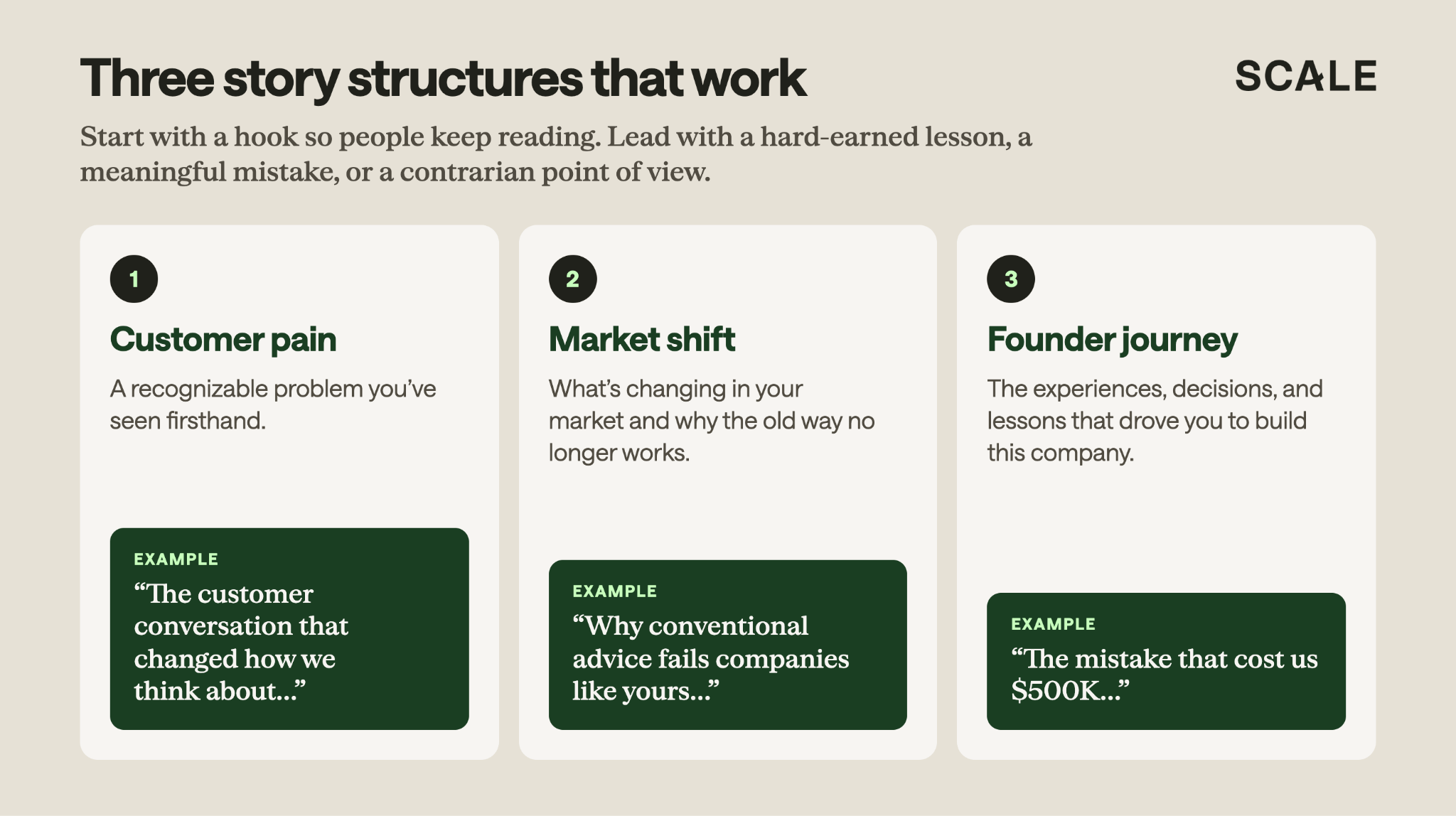
Before publishing, ask yourself: Will this make someone feel something, think differently, and want to respond? If the answer is no to all three, rewrite the hook.
After posting: Watch engagement for the first 15–30 minutes. Early activity often signals whether the message resonates. If a post gets no traction, try a different hook or framing next time.
Experiment with visuals. Candid shots (yes, even occasional selfies) of your face help people get to know you. Try out infographics, photos from your office, team shots, etc. If you can add in video, that’s a huge bonus.
Find inspo from your network. The time you spend engaging with your ICP pulls double duty: it boosts your engagement and gives you ideas for your own posts.
What to do next
How to get started this week on LinkedIn:
Update your headline and about section
Connect with 10 new people in your ICP
Comment on 3–5 posts per day from people in your network
Write and publish one post using one of the frameworks above
Respond to every comment and follow up with DMs
Download the full playbook: Launching out of Stealth.
Kristina McMillan is an Executive-in-Residence at Scale Venture Partners, where she works with portfolio companies on integrating AI in GTM strategy and execution. She is a long-time GTM thought leader, early-stage founder advisor, and advocate for female founders. Her work can be found at Hopelessly Ambitious.
The power of the Founder Brand is real. And that is overall...you need it forever. That said, company launch is no longer about getting a mention in a mainstream newsletter. You gotta follow the Lulu Cheng Mersey play: Own the Timeline. In order to get there, Founder Brand and following needs to be developed well before launch. Also, great title
The “don’t post and ghost” section is the part I’d underline twice. Everyone focuses on the posting. The real leverage is what happens after someone engages.
A founder’s comments section is a list of people who raised their hand. Early on, nobody owns following up with them. The founder is heads-down, and the first SDR (if there is one) is working a cold list instead. The founders who turn posts into pipeline treat engagement as a signal to act on within a day or two.
For founders reading this: who on your team owns following up with the people who engage with your posts?