

Take Action: We just launched our 2026 State of GTM AI survey. We want to know how GTM leaders in Sales, Marketing, Sales Development, and RevOps are leveraging AI today.
There are so many new AI workflows popping up that it’s easy to get decision fatigue just from glancing at your LinkedIn feed. Everything feels worth pursuing. There’s always someone seemingly far ahead of you, who has figured out THE best way to use AI for growth.
Each year, Scale surveys GTM leaders to cut through the AI hype and get to the bottom of what teams actually use and how. Last year, we teamed up with Benchmarkit to survey 278 GTM leaders and interviewed a dozen more to learn how teams are adopting AI and, more importantly, where it’s driving the biggest impact.
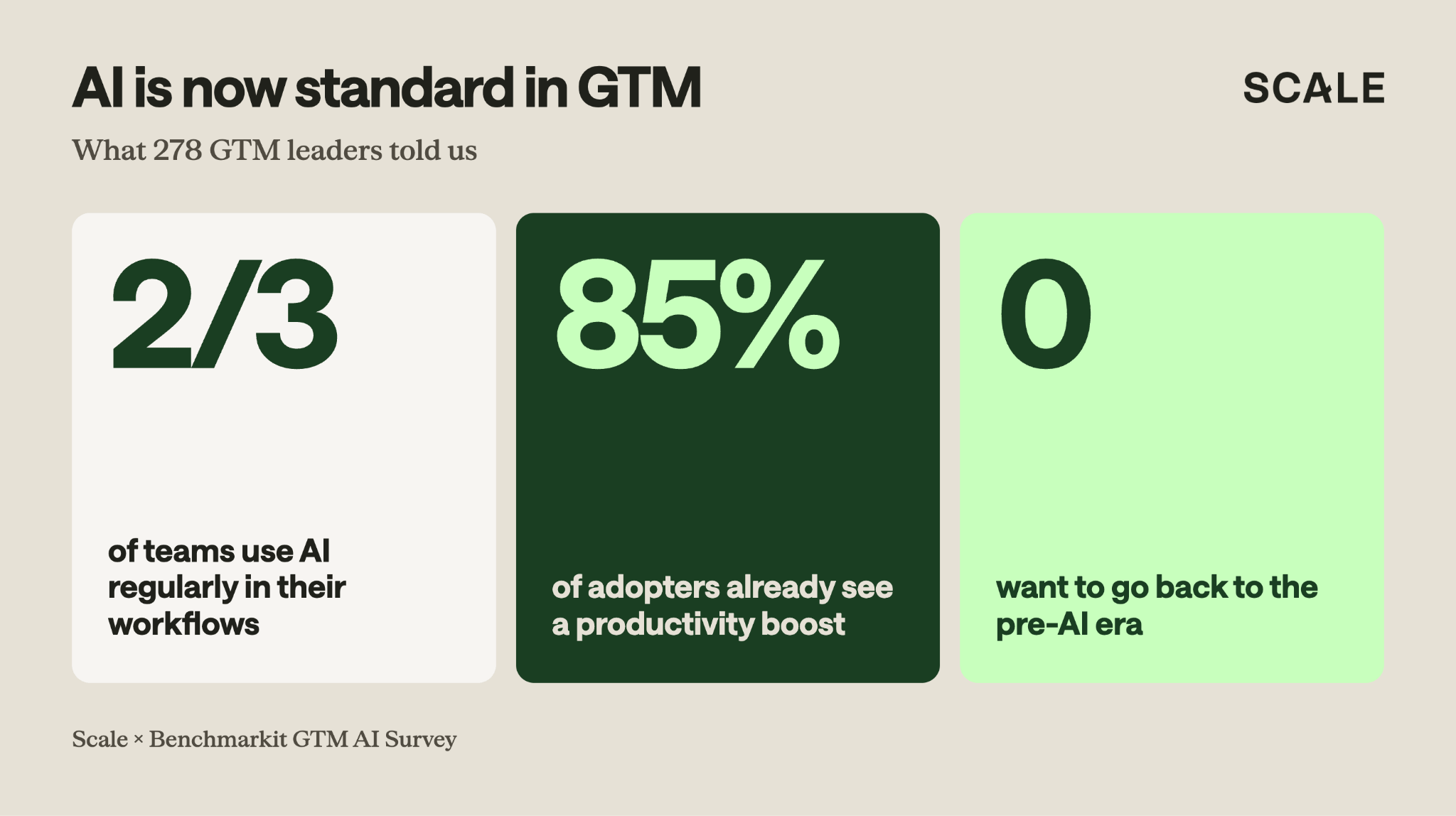
Around two-thirds of teams had given AI a prominent place in their arsenal, using it regularly in their workflows. And a whopping 85% of adopters were already seeing a productivity boost. When asked if they’d like to go back to the pre-AI era, not a single person said yes.
Scott Brinker, martech advisor and former VP of platform ecosystem at Hubspot, said, “In three years, GTM AI went from zero to ubiquitous. We’ve never seen a technology transform GTM work this quickly.”
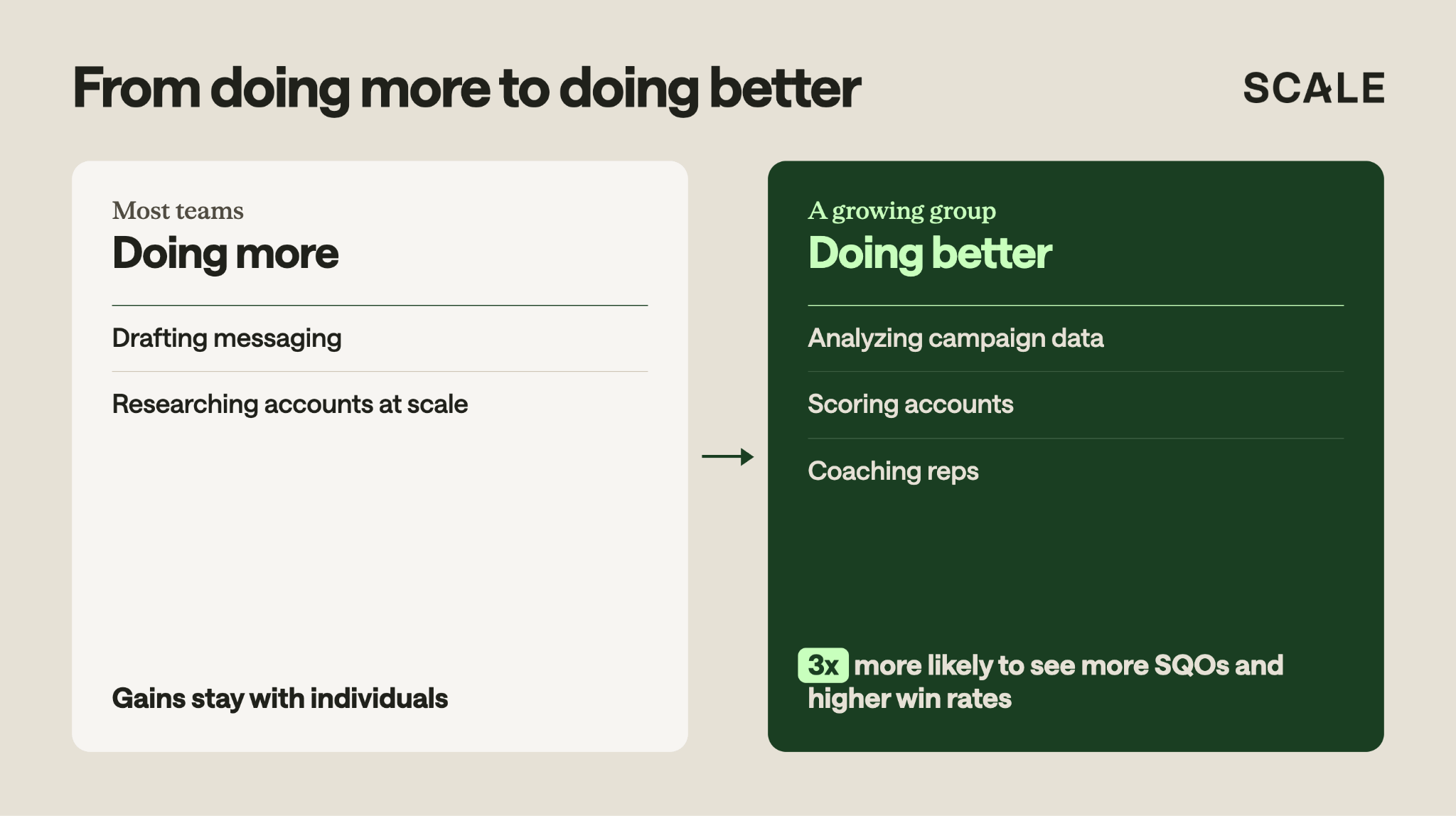
When we looked at where GTM teams stood, we saw a clear split. Most teams were using AI to do more: things like drafting messaging and researching accounts at greater scale. Those gains mostly stayed with individuals and rarely showed up in pipeline or win rates.
A growing group had started using AI to do better: things like analyzing campaign data, scoring accounts, coaching reps. Those teams were about 3x more likely to see more sales-qualified opportunities and higher win rates.
So how do you get from one to the other? That’s what the GTM AI Gameboards are for.
GTM AI gameboards
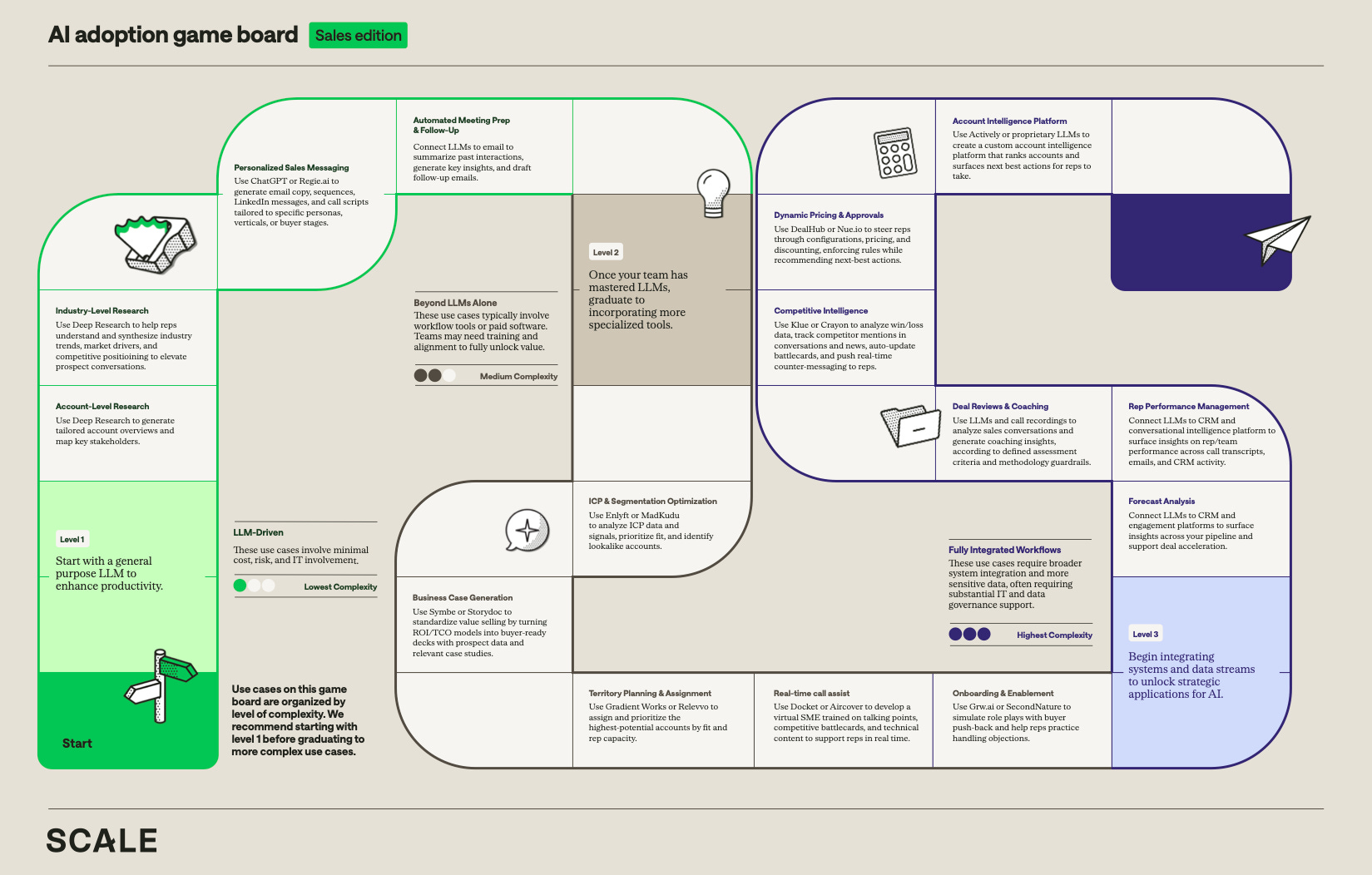
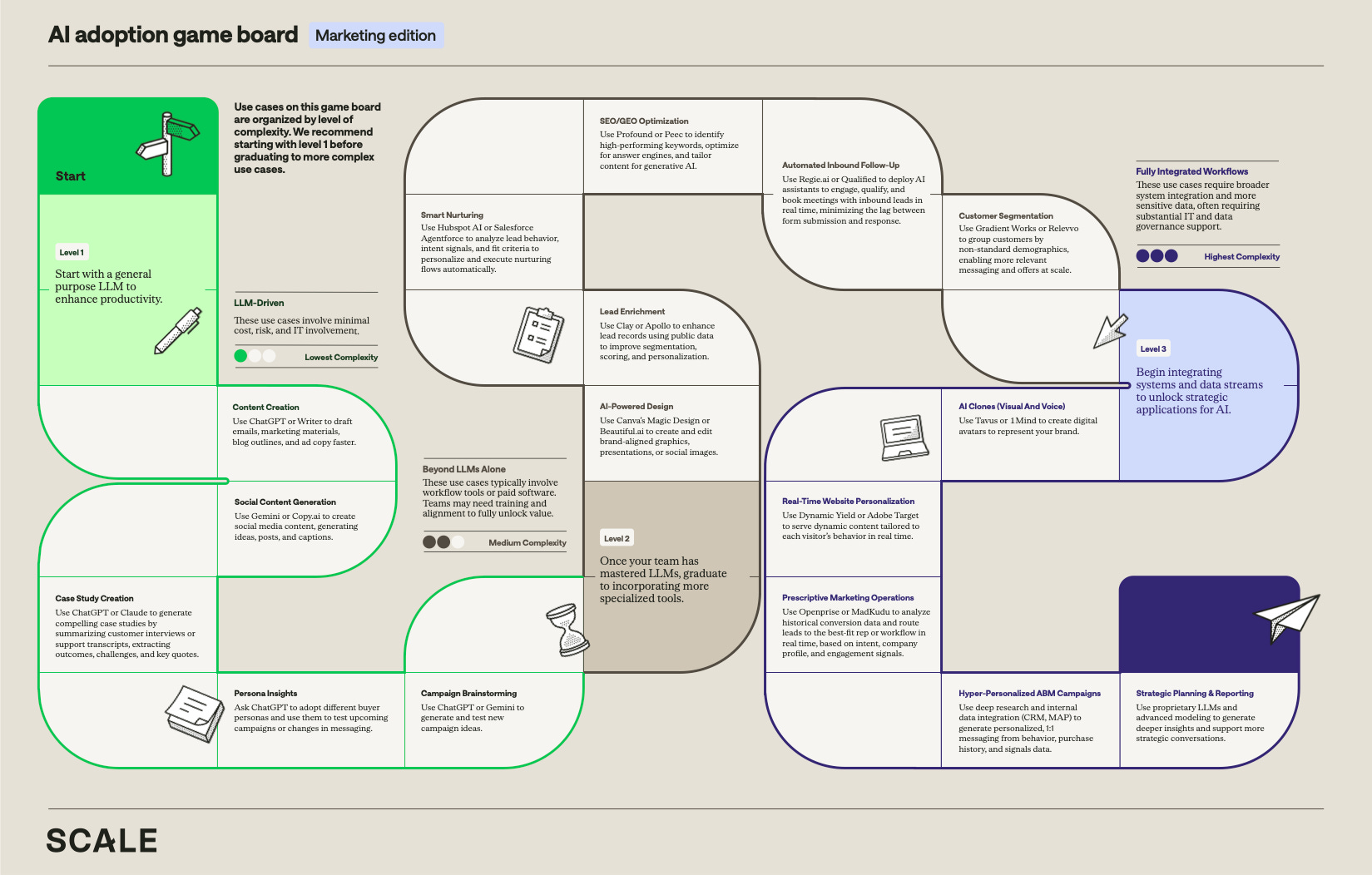
We distilled those insights from our survey results and conversations with founders into the simplest possible roadmap to help you move from doing more to doing better (while having a little fun). These boards feature a single path that snakes through three levels.
Whether you’re just starting to engage with AI or already partway down the path, they can help point you in the right direction. There’s one for Sales and one for Marketing.
First Level: Lowest Complexity
The first level is the lowest complexity, but also the lowest upside. For marketers, that might mean using Claude or Writer to draft emails and blog outlines faster, or using ChatGPT to turn transcripts into compelling case studies. Sales reps can use LLMs to research accounts and industries in seconds, or scan call transcripts and get messaging recommendations.
It’s entry-level prompting, but don’t skip over these steps. You’ll need to master them before taking on more complex use cases.
Second Level: Medium Complexity
At this level, you start thinking about AI as more than a productivity tool. Marketers can use it for smarter lead nurturing and enrichment.
Sales reps can give AI access to their sales tooling. A model with access to dozens of call transcripts, tagged by whether deals were won or lost, can produce surprisingly sharp analysis on what’s needed to move a deal forward. AI shifts from helping you do work faster to helping you make better decisions.
Third Level: Highest Complexity
This is where you fully lean into integrated workflows, often with substantial IT and data governance support. AI can help you build visual and voice clones that represent your brand, or power hyper-personalized ABM campaigns at scale.
For sales operators, this is where AI begins analyzing forecasts and pipeline health, identifying at-risk deals, tracking competitive mentions, and recommending next-best actions. The “workflow” aspect really comes into play here.
You can even set up systems like dynamic pricing approvals, complete with appropriate guardrails that allow reps to close deals faster without constantly pulling in the head of sales.
Download the game boards here:
Marketing AI Adoption Gameboard
Help us create version 2.0
For a lot of GTM teams, 2026 was the year they threw themselves into building tools they’d always wanted. We’d love to hear how you’re using AI in GTM, the impact it’s had on efficiency and productivity, and what changed compared to last year.
Add your perspective by participating in this 5-7-minute survey:
(More than 100 GTM leaders across marketing, sales, sales development and RevOps have already weighed in. Join the party!)
Kristina McMillan is an Executive-in-Residence at Scale Venture Partners, where she works with portfolio companies on integrating AI in GTM strategy and execution. She is a long-time GTM thought leader, early-stage founder advisor, and advocate for female founders. Her work can be found at Hopelessly Ambitious.
The ‘do more vs. do better’ split is the most useful framing I’ve seen on GTM AI. Teams using AI to make better decisions were about 3x more likely to see more SQOs and higher win rates. Love that the gameboards make that path concrete.
Really looking forward to learning whats happening now in GTM AI