

A Founder I advise recently pitched a room of potential buyers. He has a strong product and a clear view of where his market is going. Twenty minutes in, the room started asking very detailed questions, trying to figure out where he fits.
Afterward he told me what he had taken from it. “People want to put me in a box. Are you this? Are you that? I don’t want to live in that box.”
I get it. He has the right read on his product and on where his market is going. But I told him I was going to disagree with him a little.
He called it a box. I call it a category. Here’s the thing: most of what he built does what other products in that category already do. That’s not a ding. That’s just true of most startups.
You don’t get to refuse the category
You as a founder don’t get to tell people they can’t put you in a category when you share a lot in common with other members of that category. It’s like telling somebody how to feel or how to think. They’re just going to think that way. Buyers do it, analysts do it, and investors do it, in my experience within the first few minutes. So you meet them where they are.
A Founder who refuses the category leaves the listener to pick one alone. They usually pick the nearest crowded one, and then they compare you to the largest company in it.
Refusing also sounds like you are taking on too much. “We’re the full stack” with no category attached reads as a company still deciding what it is.
April Dunford, author of Obviously Awesome, argues that a startup should choose its own category. I agree you make the choice. My advice is to choose the category buyers already reach for, then win on the use case.
The customer decides what your value proposition is worth
Every value proposition belongs to a customer. Tell me who the customer is first, because their perception of value sets what your product is worth.
Take a business doing $10 million a year in revenue. It has nobody to run its data infrastructure and would rather someone else ran it. A big enterprise with a data engineering team cares a great deal about how that infrastructure runs. Same product. Completely different value. Your job is to pick the one that values what only you provide.
That’s why I say positioning is an act of choosing. You are choosing the customer you will go to market with. And you choose them because you know, not guess, that three things are true for them:
Highest. They value what you deliver more than anything the alternatives offer. The test: they would move budget from something else to pay for it.
Unique. They can’t get it from anyone else. The test: when you ask what they would do if you disappeared, they can’t name a substitute.
Preferred. It fits their specific requirements best: how they are organized, what they already run, what they must integrate with. The test: it works with what they already run, with no new integration project.
You get to enter a market because you solve a problem in a way no other vendor does. Right now, only a small group of customers values your approach enough to pay for it. Those are your early, early customers.
Put every customer on two axes
I draw this for Founders on two axes. Left to right runs from benefits every vendor provides to benefits only you provide. Bottom to top is how much a given customer values the benefit.
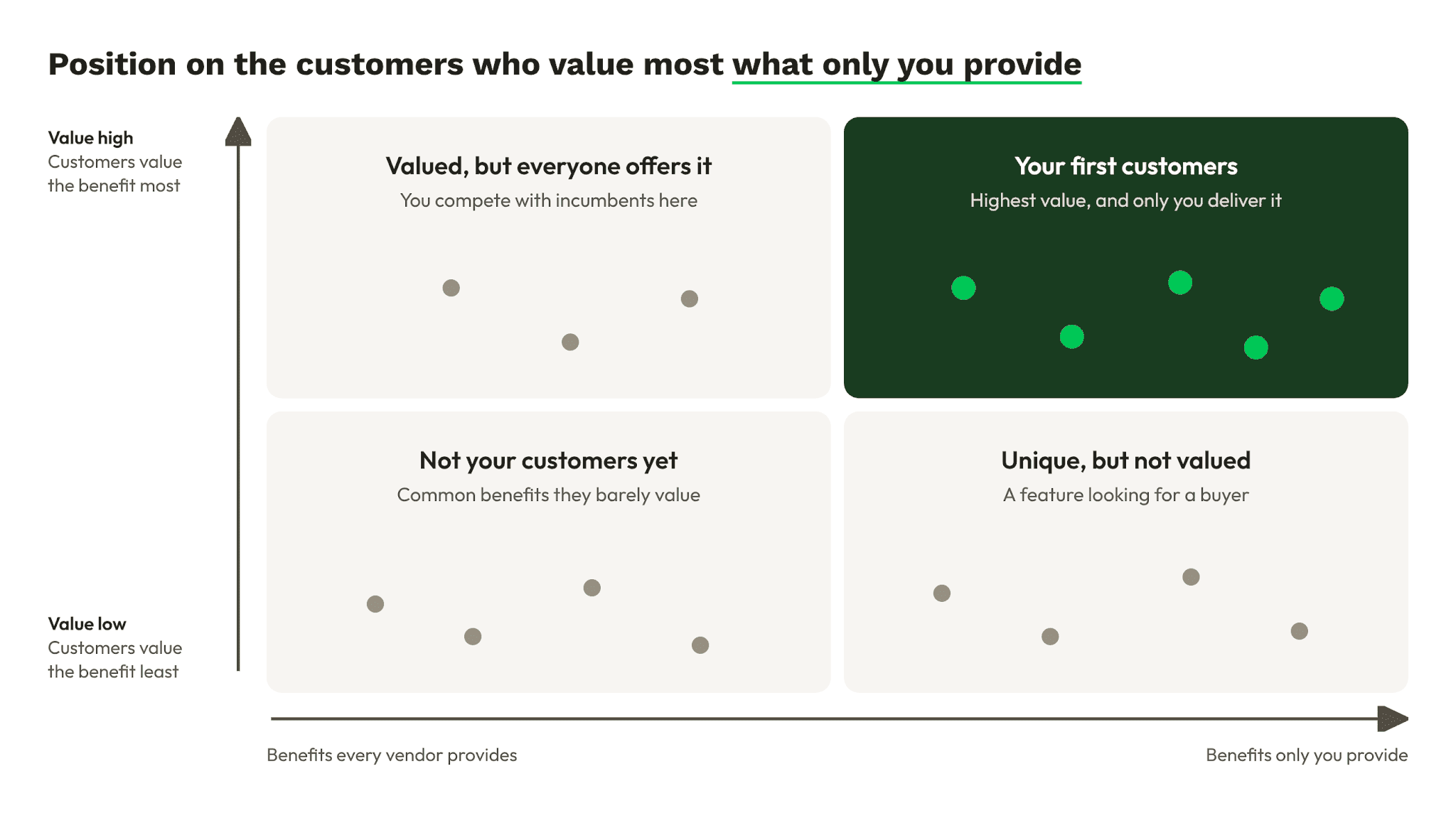
Every customer in the market sits somewhere on this map, placed by the benefit they value most. Your first customers are in the top right.
Most of what your product provides sits on the left, alongside the benefits other vendors in your category provide, which is why buyers put you in that category. Your edge is the small part on the right, and the customers who value it most.
The best Founders I’ve worked with start there on purpose. A focused customer lets you tailor the product until you alone meet that need. Once you own it, you add benefits for the next segment.
Say yes to the category, then add the use case
So what do you do when somebody asks, “What category are you in?” You do what improv does. Yes, and.
Which job inside your category do you win, and for whom?
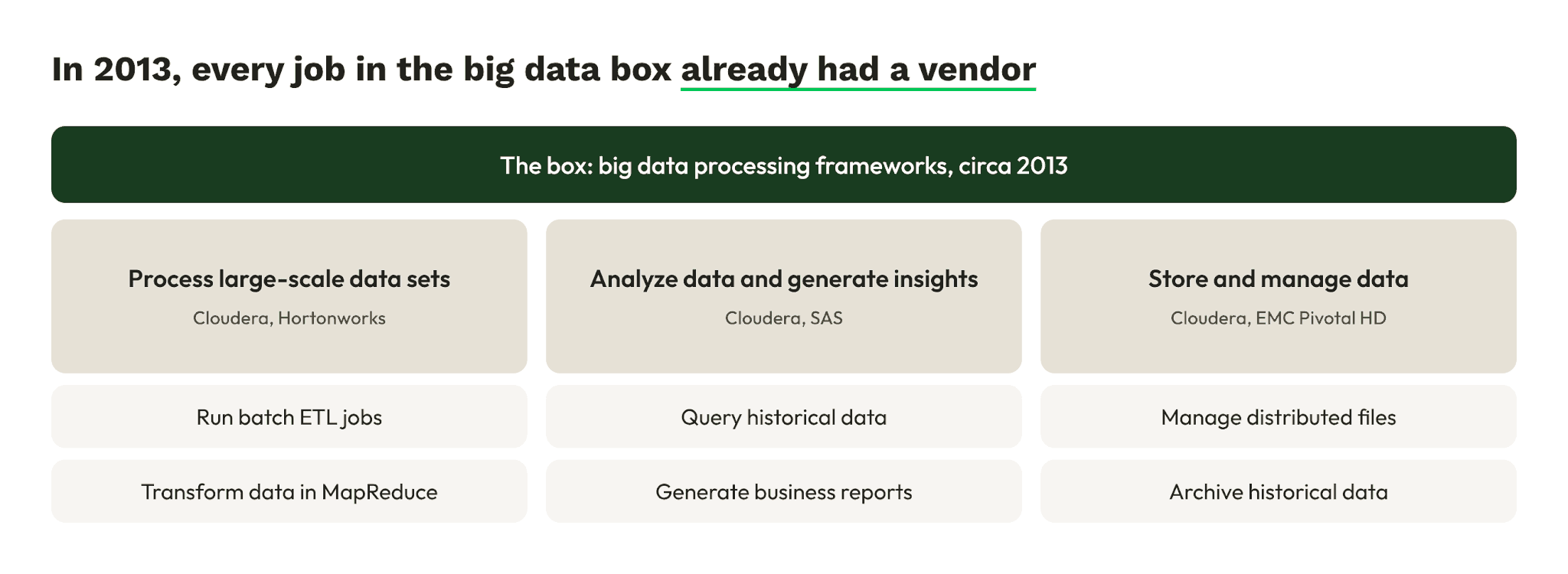
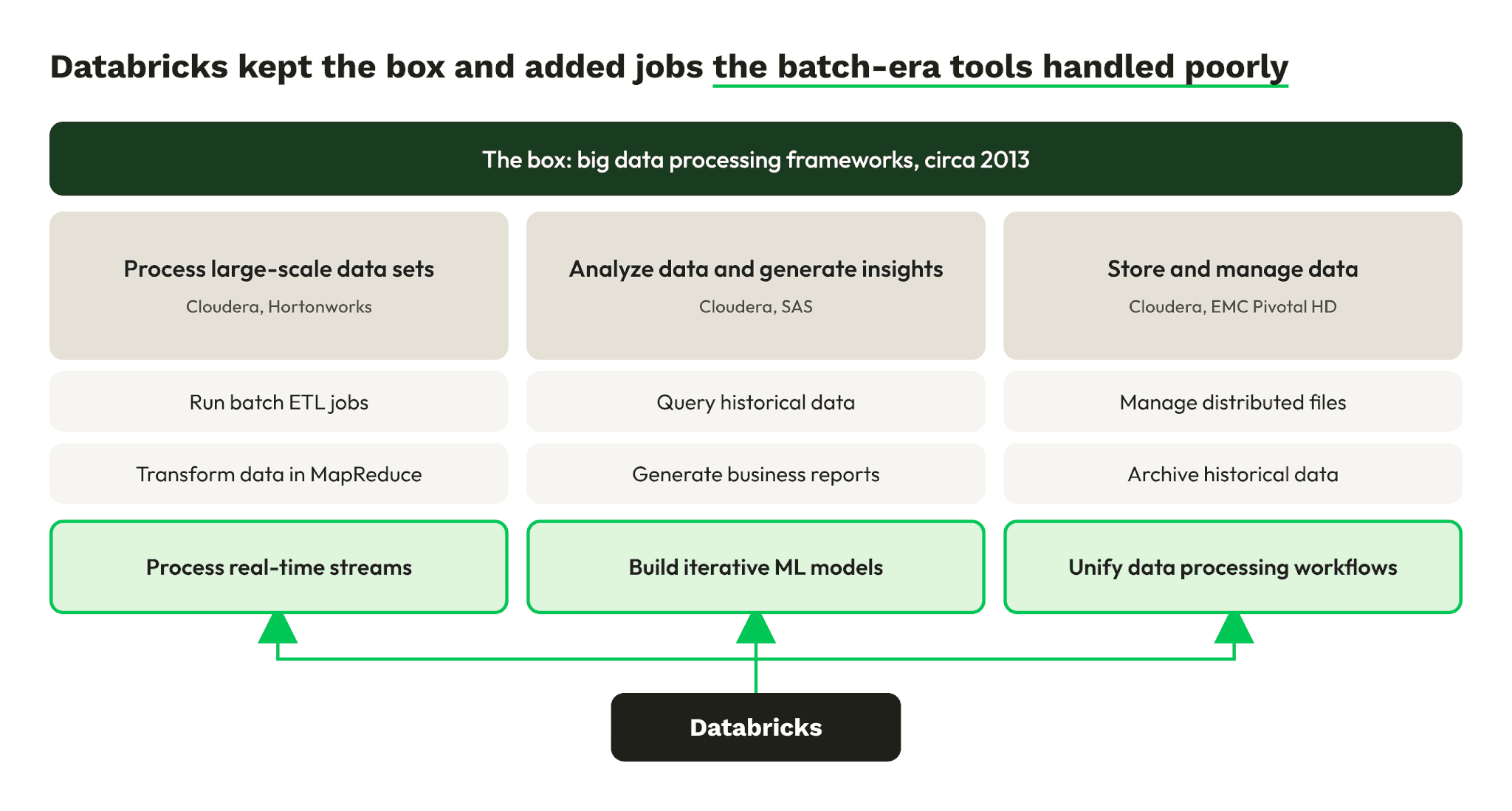
Look at Databricks, the company built on Apache Spark, around 2013. Think of its category as big data processing frameworks. Open that category as a buyer would have seen it then and every job appears to be taken. Processing large data sets, analyzing data and generating insights, storing and managing data: each one had established vendors behind it.
Databricks accepted the label and pointed at jobs inside it that the incumbents’ batch tools handled poorly, or only with a separate system: processing real-time streams, building iterative machine learning models, unifying data processing workflows. Those were new, high-value use cases for a specific kind of customer, and Databricks served them better than the batch tools most buyers already ran. Spark promised up to 100 times the speed of Hadoop MapReduce on data held in memory.
That gives the Founder’s answer two parts.
Yes. “We are an expense management tool.” The listener now knows which category you sit in.
And. “Companies that look like this have a new job to do, and we’re the only product in the category built for it.”
You can say the second part with confidence because you did the discovery. You talked to the customers who have this job, while the people in the room know only the category.
A new use case gets you in before incumbents react
There are two ways into an occupied market.
You can take on incumbents head-on, the way Uber eventually did. It started in 2010 with black luxury cars, hailed from a phone, at about one and a half times the price of a taxi. Once it owned that, it went after taxis directly with UberX in 2012, and by 2014 it faced taxi-driver protests, lawsuits, and bans in cities from Madrid to Portland. If you enter an existing market against incumbents, be prepared for a fierce competitive response, and have the product and the capital to outlast it.
Or you can serve customers the incumbents leave unserved or underserved, on a job they handle poorly. To incumbents your product looks like a side feature, so they usually respond late, and often by bundling a copy into what they already sell. By then, you own the use case and have the customers to prove it.
In 2013, Slack’s founder told his team they were setting out to define a new market. Buyers saw team chat, where HipChat, Campfire, and Yammer were already selling, and people already lived in email and instant messaging. Slack grew out of the IRC-based chat its own engineers used while building a video game. It found a better way to do a job people already had, won small tech teams first, and then spread from team to team inside each company. The “new market” line was written to rally a team. Buyers filed Slack under team chat.
Each path has a cost. If you go head-on, buyers compare you to incumbents job for job, so you need to be at least 10x better at something they care about. If you go in on a new use case, you face less competition early, but you have to teach the market why that job matters and is valuable. Either way, you choose which job inside the category you win.
What to do this week
Write down the category. Ask your last five prospects and your last five lost deals two questions: What category did you put us in? Who did you compare us to? Use their words, even if you dislike them.
List the jobs already taken. Under that category, write the use cases buyers already get from incumbents. Leave the word AI out. Describe what people do and what they care about.
Name the new job. Write the one or two use cases your customers have that nothing on that list covers.
Profile who has it. Describe the customers with that job closely enough that a salesperson could disqualify a prospect in one call.
Rewrite your first sentence. Category, then customer, then the new job: “We are a [category] for [customers like this], who need to [new job] and can’t get it from [alternatives].”
Here’s what I told him at the end, and it’s what I’d tell you. You’re probably not creating a new category. Say “yes” to the one you’re in, then show buyers the value you create that no other vendor can.
Pete Giordano is an Executive in Residence at Scale Venture Partners, where he works with Founders on positioning, pricing, and GTM. He advises startups, Berkeley SkyDeck companies, the Scale portfolio, and Fortune 500 companies, drawing on more than 25 years in software across engineering, product, sales, finance, and M&A.
