

As marketing master Jon Miller used to say: “Marketing channels used to be like gumball machines. Put money in, get leads out.” Now, you have to spend more to get the same results. Paid search isn’t delivering like it used to, and AEO is the “flavor of the day,” but you never know how long it’ll last or what will change next. The costs keep climbing, and the old playbook isn’t cutting it anymore.
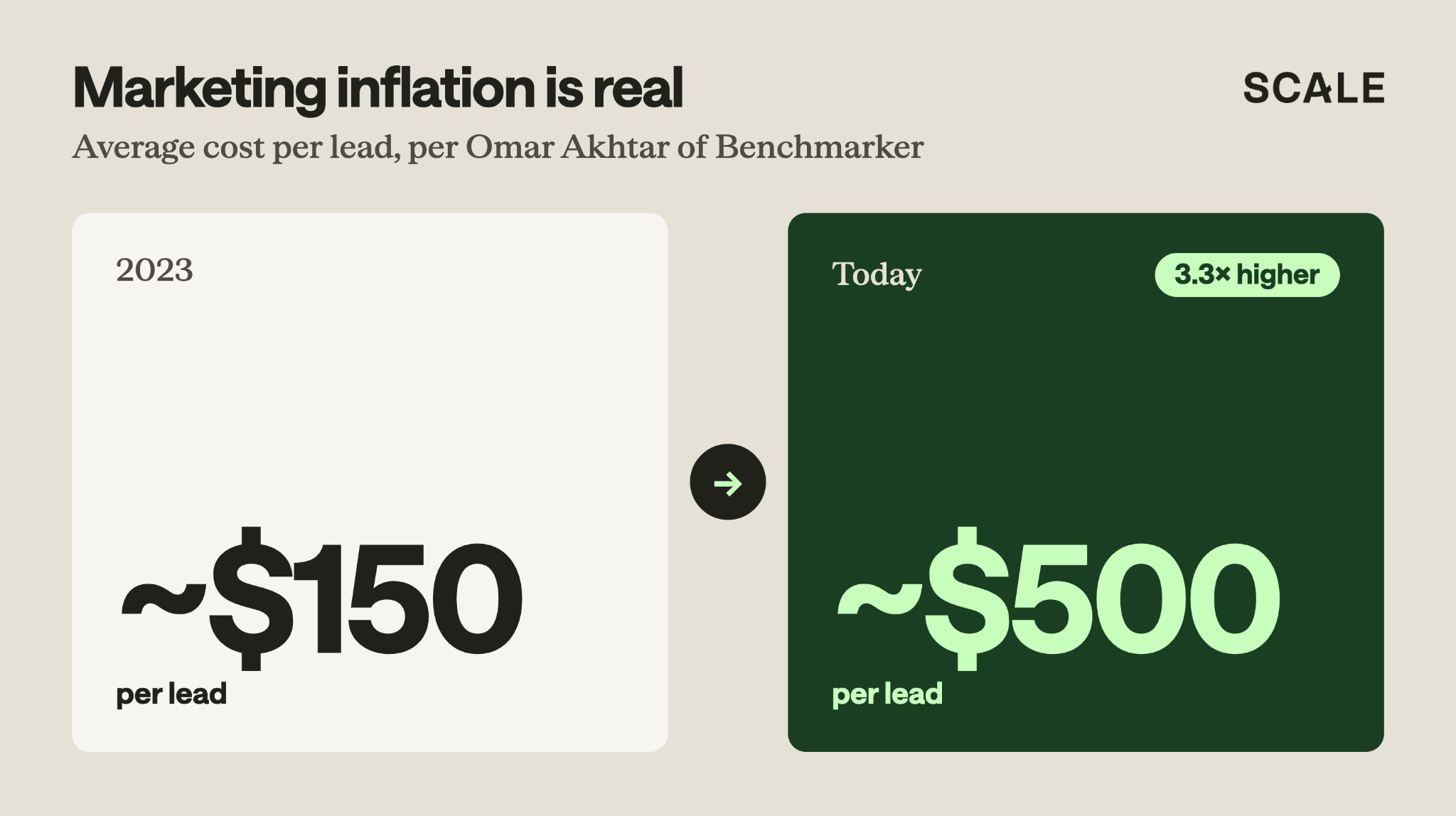
Omar Akhtar (Founder & Principal Analyst, Benchmarker) has the receipts to prove this: he has watched cost per lead climb from about $150 in 2023 to about $500 today. He came to our Scale Marketing Council with his latest benchmarking spanning everything from budgets, investments, and performance metrics to technology adoption, showing us where the rest of your segment is zagging so you can decide where to zig.
Reality check: Marketing budgets are down
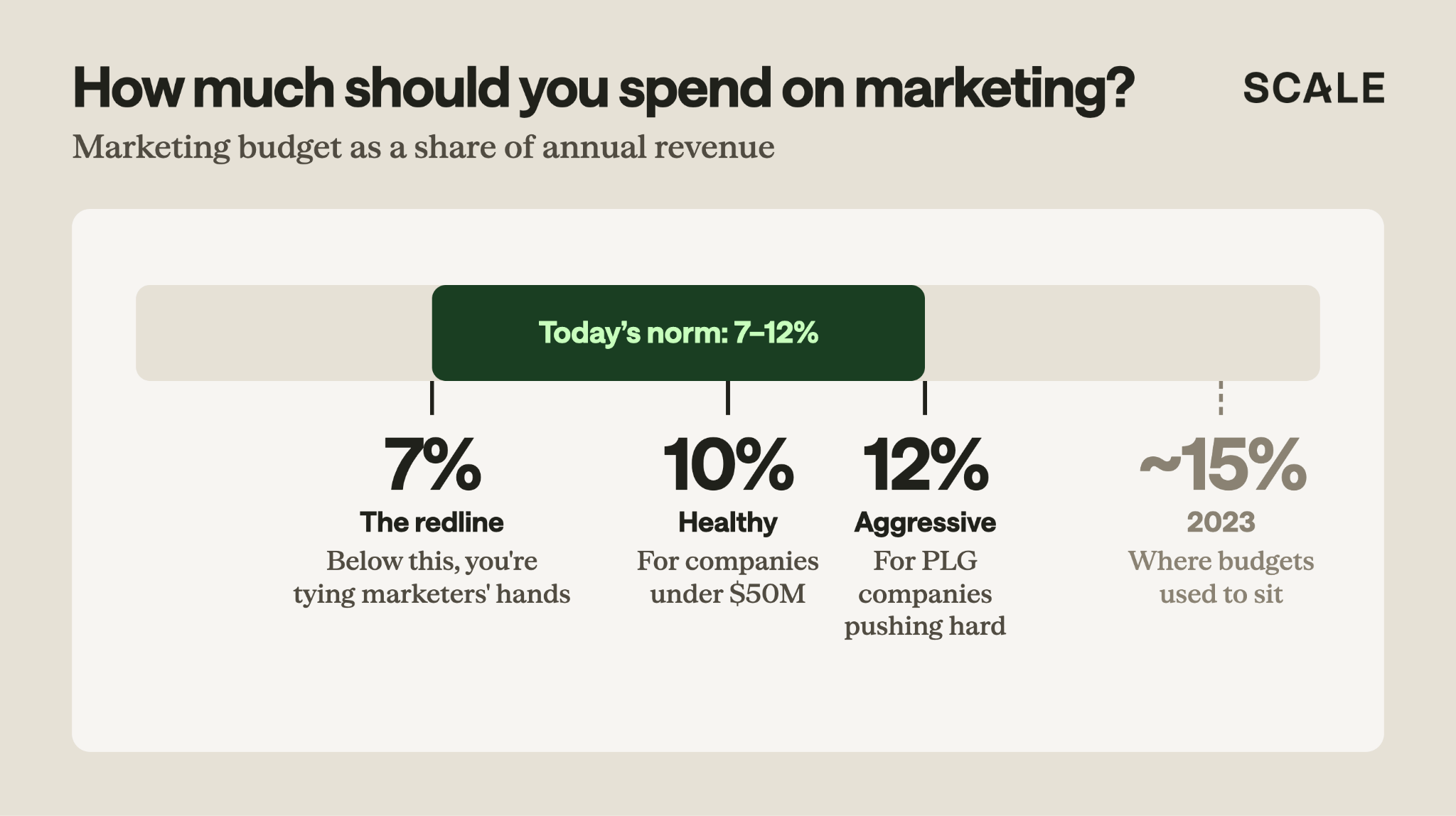
Omar kicked off the session by answering the biggest question of the season: how much should you be spending on marketing? Spending 7-12% of annual revenue on marketing is now the norm, down from almost 15% in 2023. For a company under $50M in revenue, 10% is a healthy benchmark. For a PLG company pushing aggressively, 12% is the number to aim for. The redline is 7%. Go below that, and marketing becomes, as he put it, a “one hand tied behind your back” job.
And when you build next year’s forecast, don’t stop at what’s in your CRM. Omar says brand and category awareness data, external market and competitive data, and finance forecast assumptions are about as important.
Welcome to the era of “marketing inflation”
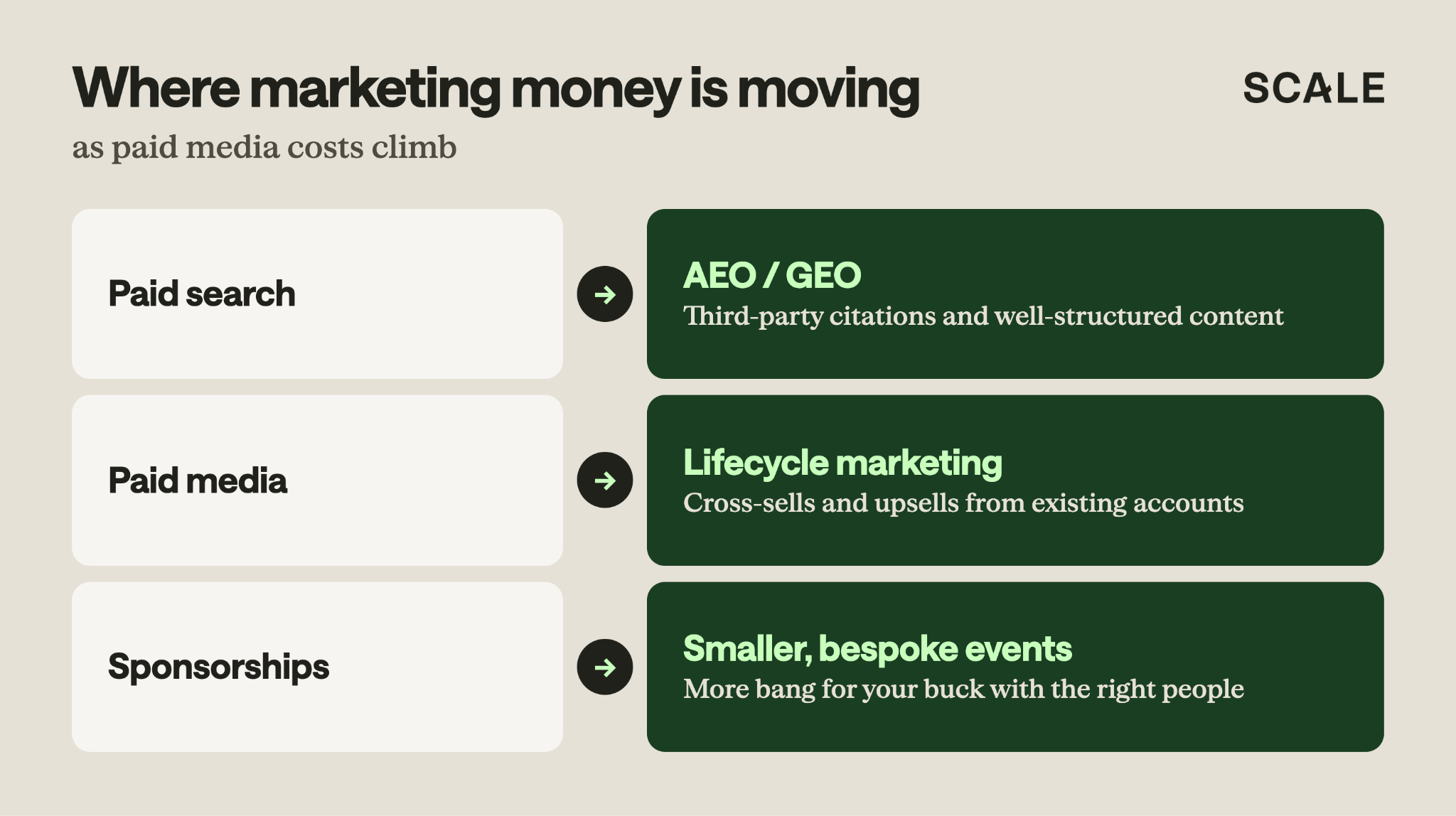
Rising paid media costs, or as Omar put it, “marketing inflation,” are pushing more spend toward lifecycle marketing to drive cross-sells and upsells from existing accounts. A chunk of paid search budgets is also shifting toward AEO/GEO, where third-party citations and well-structured content still do the heavy lifting. That shift is pulling content marketing closer to product marketing, with more investment in case studies, product content, comparisons, and FAQs.
AI is saving on manual work but we want more
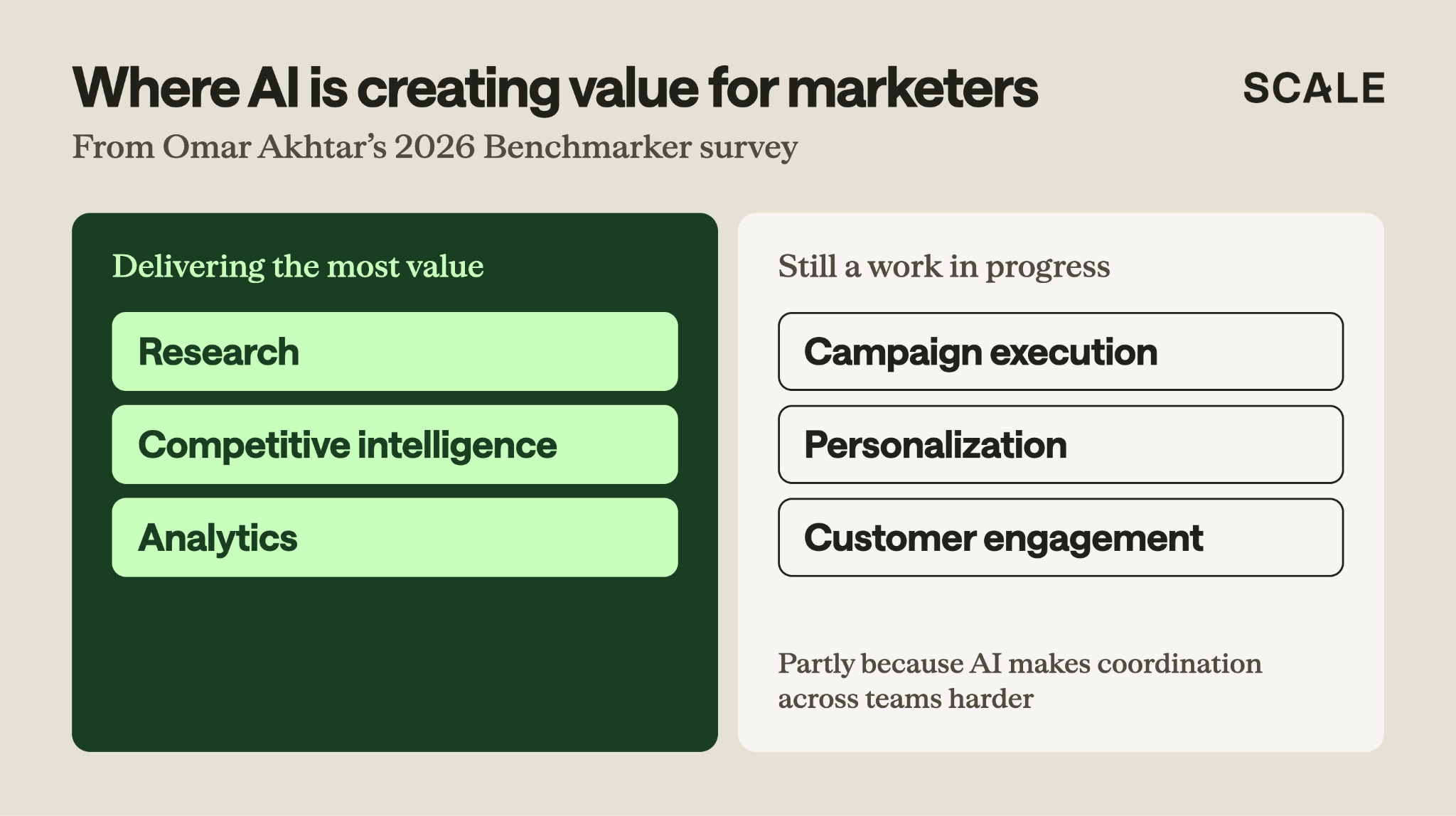
Omar asked companies where AI is creating the most value for their teams. Research, competitive intelligence, and analytics topped the list. Campaign execution, personalization, and customer engagement? Still works in progress, partly because AI makes coordination across teams harder.
When asked how they measure AI’s impact, the top answer was saving time on manual work, without formally quantifying the savings. Omar believes smaller companies are punching above their weight in outbound and messaging with AI. Teams are relying less on IT, agencies, and contractors, while 30% of companies are already consolidating their marketing tech stacks.
If you’ve ever thought, ‘God, I wish I could cut my CRM,’ you’re not alone. That’s the one tool people are most actively trying to rebuild with AI. That said, quantifying impact with claims like “I 2X’d my pipeline because of AI” is still rare. If AI is helping you speedrun ahead but you don’t know how to communicate that impact, don’t worry. That’s the norm, not the exception, right now.
Top performers spend 50/50 on brand and demand
Sydney Sloan asked which metrics help make the case for brand investment. Omar’s answer: “Yes, track your share of voice, yes, track your pipeline, but also track how many people within a certain category know who you are and what you do.” If category awareness isn’t growing, all the down-funnel activity won’t translate into pipeline. He calls it “the single biggest differentiator between companies that are making it and companies that are not.” Survey your category and use the numbers to make the case for investing in awareness before expecting everything else to follow. In last year’s survey, for example, companies splitting brand and demand 50/50 outperformed those spending 70/30 in favor of demand.
Less tech, more face time
For sub-$50 million companies, Omar observed tech spend is getting a little too heavy, especially with marketing costs going up. Some of that money would be better spent on programs. Events, even virtual ones, can deliver great ROI when it comes to qualified leads (as long as you actually follow up with attendees). His advice for CMOs at sub-$50 million companies under ROI pressure: cut back on sponsorships and put that money into smaller, more bespoke events. You get more bang for your buck and can get in front of the right people.
A few more nuggets of wisdom from Omar
1/ “Before, we over-indexed on top-of-funnel content: your thought leadership, your brand.” His advice: Don’t deprioritize those, but aim for “a more even distribution of content along the funnel.” Add mid-funnel content, like product content, case studies, comparisons, and FAQs, to the mix.
2/ “If you look at marketing and sales budgets, a 70/30 [sales/marketing] or 60/40 split is healthy.” Unless you’re in a sales- and events-heavy space like cybersecurity, allocating less than 30% to marketing puts you in the danger zone.
3/ “If you’re cutting brand and creative roles, you’re at a real risk of losing market presence at the time that you need it the most. Everybody’s on the same channels, everybody’s spending about the same on all those channels. The only way you can differentiate is by having something different to say, or having a product that’s truly differentiated, and communicating that.” Take notes!
4/ “If you’re sub-$50 million in annual revenue, your biggest problem is brand awareness. You can talk about product-market fit, messaging, and market conditions, but what you’re fighting against (which $1B+ incumbents aren’t) is brand awareness. Nothing else comes even close.” If you’re gearing up to defend brand investment in the next board meeting just say: “If I don’t do this, then everything else is dead in the water.”
Full session is live on YouTube:
Craig Rosenberg is the Chief Platform Officer at Scale Venture Partners, where he works with portfolio companies on GTM strategy and execution. He was the co-founder of TOPO, which was acquired by Gartner, and the host of The Transaction podcast.