

When people ask me what’s happening in venture, AI, and the broader technology market, I send them “The Mile Is Becoming the Marathon,” a memo from Max Abram, one of our up-and-coming partners at Scale Venture Partners.
It’s a great overview, and I’m especially attached to it because it saved me. I was preparing to speak at RevFest 2025. My team and I had just run some data on GTM AI and drafted our initial talking points for Jen Igartua, whose team at GoNimbly runs the event. She said, “This is good,” and then came the “but”: “I really want you to bring more of a VC perspective. People are dying to know what’s going on.” I told her I had it, but was actually freaking out. Even though I live in the startup world, the last few years have been so chaotic that I was still struggling to pull my thoughts into a coherent story.
Time was running out so we had to do something so we started piecing together wider VC market data to find our inspirations, and then, less than a week before the presentation, Max sent out his memo. It hit home. I walked into the conference room where the team was working on the deck, dropped a copy on the table, and said, “This is our story.” I’ll spare you the scramble that followed, but we got the presentation done, thanks to that memo.
It’s a great read and will give anyone a solid perspective on what’s happening out there.

Before LLMs, building software was slow and expensive. Duplicating a broad product cost millions, so product surface area was itself a moat. SaaS companies leaned on “running fast” to deter competition, accumulating enough product and share that entering the market as a copycat was unappealing. Durable moats like switching costs and network effects came later, layered on top of this early lead.
But LLMs spit out code and features at a pace that collapses the moats of any pre-AI company, and all SaaS companies are more vulnerable today than three years ago.
That has led application investors to panic, questioning the continued effectiveness of the “run-fast” playbook overall. Every run fast category, the nervous VC imagines, ultimately becomes a bloody mess of vendors who have all “solved” the problem. (A more grounded version of this fear: even where a winner emerges, pressure from the models, copycats, and bundlers erode pricing power.)
But the run-fast playbook isn’t doomed, nor is the application layer. The upshot of cheap code isn’t that running fast gets you nowhere; it’s that you’ll need to run a lot further before “running fast” can yield a compelling moat against the models or startup competition. And that distance requirement keeps stretching as models improve, cheapening the progress made to date.
The upshot of cheap code isn’t that running fast gets you nowhere; it’s that you’ll need to run a lot further before “running fast” can yield a compelling moat against the models or startup competition.
To run further for longer, companies have to claim bigger problem spaces than their SaaS counterparts did. The old midsize TAM is now a short-term-solveable problem and thus a larger category’s feature. So today’s application-layer winners often need to bundle, pulling together adjacent categories that share a buyer until the combined surface area is too wide to be fully solved soon.
The catch is that bundling cuts both ways, and the best defense against bundling is often offense, which has led to the proliferation of “kingmaking rounds.”
(This all has a portfolio construction upshot for the VC: since each bundled winner absorbs multiple former venture outcomes, the application layer still produces winners, and likely bigger ones, but certainly fewer.)
Better models also turn architecture into a moving target. An advanced architecture choice today puts a company ahead for the short term, but it may become obsolete over the course of months. And so winners will also need to regularly revisit what they have already built and reinvent themselves. Losers risk getting fiercely challenged when a new entrant gets to the new architecture faster.
None of this means the application layer is doomed. Running fast was always a first moat. Long-lived SaaS companies layered on more durable ones over time, like switching costs and network effects; application-layer winners will probably lean on those second-order moats even more heavily once they exist. But they take years of scaling to emerge, and a Series A investor won’t see them yet.
Which leaves the practical question for the early stage investor:
How do you diligence a “run fast” Series A today? I’d propose four criteria.

Demand: A ripping wedge on the current contemporary architecture
Many buyers just want AI for AI’s sake right now, and producing a magic demo has rarely been easier. That means the bar for demonstrating demand is higher.
The new floor for traction is $1M to $5M of ARR (or $0 to $1M in two quarters followed by $1M to $3M in the two after).
The “contemporary architecture” bit is maybe a throwaway line, but the point is to acknowledge that while AI is constantly shifting, the investor should ensure the startup’s technology is at least as up-to-date as it can be.
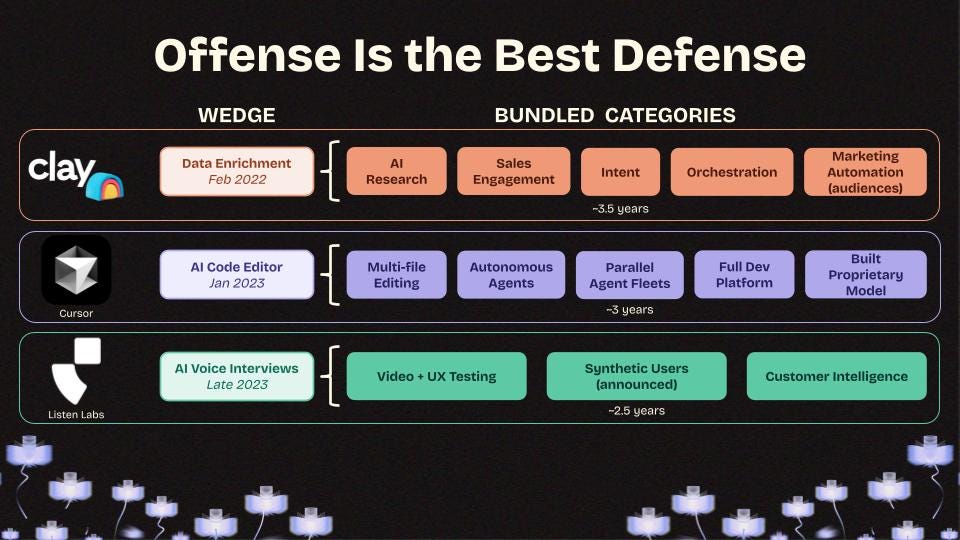
Category: Expansive product runway and the vision/aggression needed to win the bundling wars.
The startup must face lots and lots of runway ahead to build new stuff, and keep building new stuff. There is no greater horror than running out of runway for product roadmap.
And the investor must look to adjacent, bundle-able categories as direct competition. Bundling is a magnitude more common and compelling today than in SaaS, and it is easy to find out too late that what you are investing in is a subset of another category.
Offense is often the best defense against bundling. Aggressive bundlers recognize this game, raising capital and hiring ahead of revenue to ship into adjacent categories early, and prioritizing surface area over perfection.
Not all bundling makes sense
ElevenLabs is launching AI phone calling, which requires competing with a number of its customers. This seems like a much more challenging expansion to pull off than, say, Listen Labs bundling in simulation (a la Simile/Aaru) on the same data they have already collected for an existing customer.
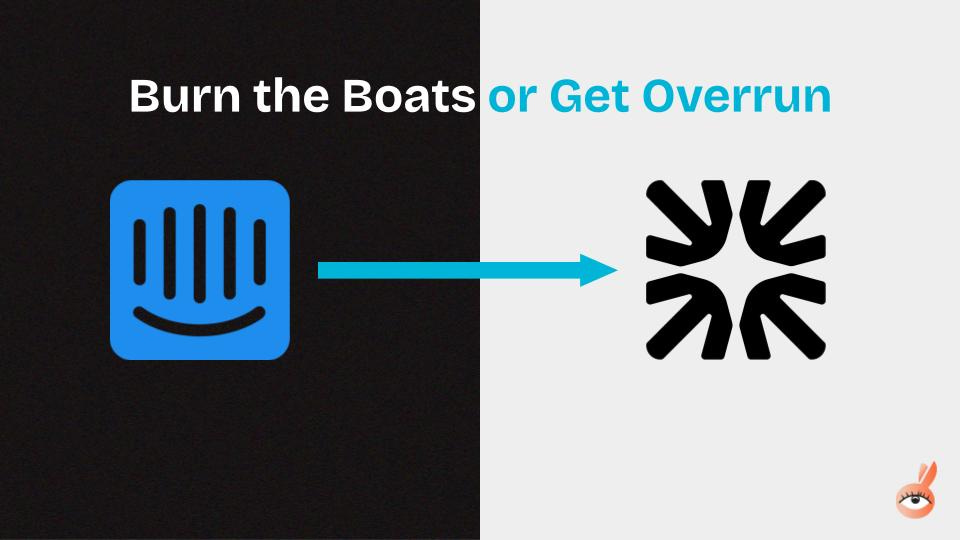
Winners: A team resilient enough to burn the boats of an old architecture and dynamic enough to see ahead of the technological curve
Model capabilities jump every twelve to eighteen months and reset what’s possible. “Set and forget” is the most dangerous founder posture in this era, and the team that won’t tear down and rebuild what they shipped last year is the team that gets overrun by the next entrant who will.
Founders who have already done a teardown are a bullish signal, but the sample is small. A diligence question that travels: what product decisions would you make differently if you were starting from scratch today?

Longevity: A credible path to a durable moat
Switching costs, data flywheels, network effects all accrue with adoption, so they won’t be visible at the Series A. What’s possible at the Series A is a plausible story for how the run-fast lead converts into one of these over time. It is worth noting that switching costs in AI probably look quite different from those in SaaS. Today’s switching costs are likely about business logic and processes living within the system, vs years of data in an existing database that will be hard to exfiltrate.
Example
Harvey, Legora, and Rogo seem well positioned as “AI transformation” partners to their industries, driven by strategic selling at the board room level. In the near term they will no doubt continue to run fast, and in the midterm they seem safe from “model company + FDE” disruption given that these firms seemingly don’t want to be tied to one lab. What I continue to wonder about, and would make a go-forward bet on, is the path to a longterm moat.
My best guess, from the outside, is that it might be found in encouraging bulge brackets and white shoe firms to encode their processes and ways of doing things into these platforms, which become the infrastructure of the industry. This plays into each firm’s belief that the way they do things is different and differentiated.
Competition with the labs
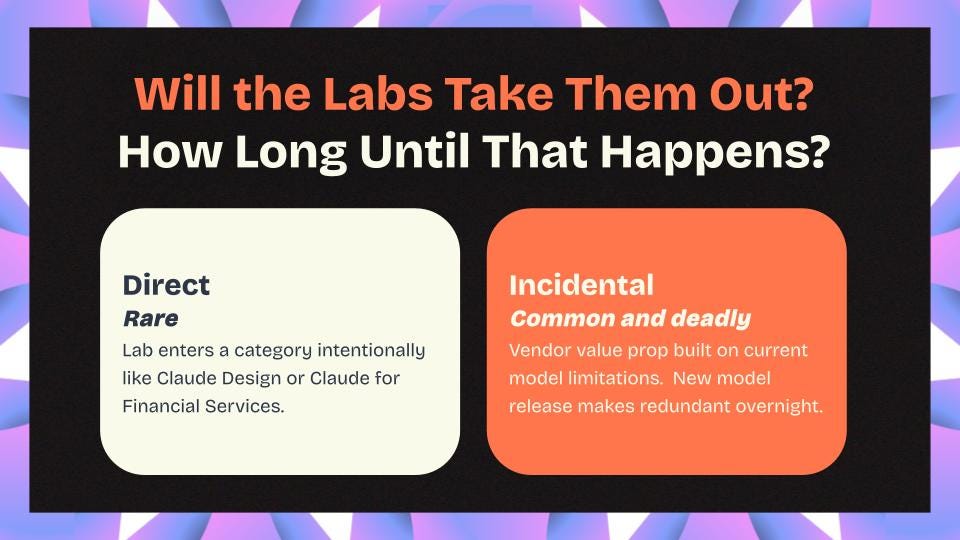
There’s a new dynamic to startup competition in the AI era, which is competition with the labs in addition to competition with other startups. Competition with the model labs comes in two forms.
The first is direct: occasionally a lab will enter a category with intention, like Anthropic’s Claude for Financial Services or Claude Design. This is rare and usually narrow.
The second is incidental and far more common: a startup picks positioning that sits in the path of the next model release, and the model itself becomes the competitor without anyone at the lab thinking about them.
Covering for model deficiencies can be a good wedge, but it cannot be the durable value prop. The companies that win position themselves for a future in which the models are much smarter, while winning today by compensating for current limitations with product they expect to be made redundant by the next release.
This offers us a fifth criterion for evaluating run-fast apps.
Model improvement: A value proposition that doesn’t bet against smarter models
Products that exist mostly to cover a current model shortfall (eg context length, reasoning depth) can show real traction today and still get washed out in the next cycle. This is not to say that covering model gaps cannot be a part of a winning strategy (in fact, it often is), but it should not be the strategy.

Max Abram, Partner
Max is an early-stage investor focused on AI applications, often partnering with founders at the first moments of product-market fit.
maxwell@scalevp.com
Watch Craig’s keynote here: