

You're leading sales in B2B, and lately, sales conversations are just going fine. In meetings with your prospects, they never say an outright no, but they also don't really say yes. If this feels familiar, your sales process is running on what Ted McKenna calls the "maybe machine." As in, "We get some degree of interest, and then it turns into a bunch of not-nos but not-yeses.”
Ted is the co-founder and CEO of SellingInnovations. He’s best known for The JOLT Effect, a book he co-wrote with Matt Dixon.
For the book, they studied 2.5 billion sales conversations. One of their major findings was that 40–60% of deals end in no decision. That is so important. Basically ,indecision is a bigger problem than the competition. Why is that happening? Ted came to Scale Venture Partners’ Sales Council to decode what’s going on with buyers in B2B, and how you can get them to confidently trust your products.
FOMO and FOMU
Humans are wired to avoid loss. Amos Tversky and Daniel Kahneman (Kahneman went on to write Thinking, Fast and Slow) proved this with their decades of experiments. They also found that the losses that hit us hardest break into two types:
1/ Error of Omission: When you miss out on doing something.
2/ Error of Commission: When you do end up doing something and it goes wrong, and you get the blame.
Then they made an even bigger discovery: People weigh commission errors more heavily.
In other words, we care more about avoiding loss than we do about the upside to gain potential in any given situation.
We’ve all heard of FOMO. Ted and his team came up with FOMU (Fear of Messing Up) to describe the fear connected with the error of commission.
(There’s also a not-safe-for-work version, FOFU, but we’re keeping it PG over here.)
FOMO can get people to buy, but in Ted’s research, FOMU crushes FOMO. When your reputation is on the line, you hardly care about a 10% discount you might miss out on.
Fears that are driving your buyers up the wall
Years of research have led Ted to identify three big sources of fear that hold buyers (execs, in our case) back from making confident purchases:
1/ Options overload: A buyer may start out wanting to change the status quo. But next comes what Ted calls a “sea of options and choices.” Which features to prioritize? Which tier or package to pick? What timeline? How to configure it? The more choices pile up, the higher the chances of a buyer backing out altogether.
2/ Information overload: Ted says this happens when the “buyer feels like they have to become an expert on everything.” Buyers spiral into analysis paralysis, worried that making the wrong call could make them look silly for not having thought to ask certain questions.
3/ Expectations overload: If you’re selling an AI feature (which every SaaS company and their grandmothers are doing right now), this is the one to watch. Even if the outcomes you’re pitching sound “sexy,” too many moving pieces can “drive up their perception that they can’t achieve the expectations that have been laid out.”
All of these factors make one voice resoundingly loud in the buyer’s head: What if the solution falls short of expectations? AKA, fear of messing up (FOMU). Even louder is the question: Who is then going to take the fall for it? If they’re the ones making the decision, they’re also the ones who’ll be held accountable if things go south. Suddenly, making no decision at all starts to sound like the safer bet.
Build a fearless case for change
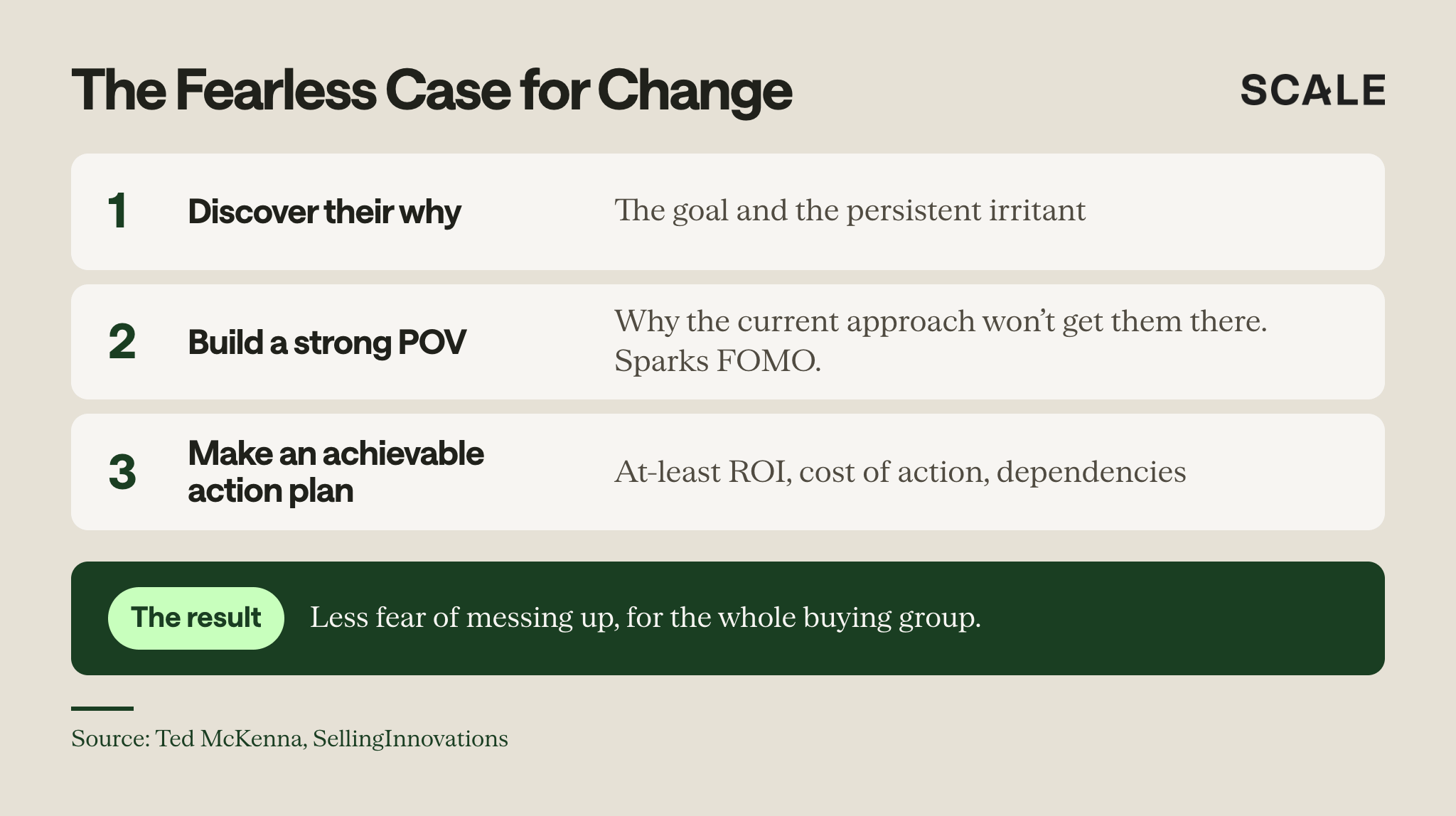
Ted’s answer to FOMU is what he calls the Fearless Case for Change. It comes in three parts:
1/ Discover their why: What are senior execs saying out loud? What’s their persistent irritant? Ted says to think of it as the pebble in their shoe or the check-engine light that’s been on for a while. They know something’s wrong, but haven’t quite figured out how to fix it.
2/ Build a strong POV: Now that you know what makes sense to your buyers, don’t walk up to them and blow up their world and perspectives. Unless, of course, you want to blow up your chances with them. Acknowledge it (maybe even appreciate it). Then show them why their current approach alone won’t get them where they want to go, and how your offer closes that gap. This is how you trigger FOMO.
Point to note: Ted says great recommendations are at least as much about what to avoid as what to do. So name the landmines. Set expectations for the road ahead. And tell them what you’d worry about “whether you buy from us or not.”
3/ Make an achievable action plan: Show them what Ted calls “At-least ROI”: the minimum outcome they can realistically count on. Keep the outcomes believable and achievable. As we saw with expectations overload, big promised outcomes can feel unachievable and raise the buyer’s fear. A believable floor (“at least this”) is easier to trust and defend internally.
Next, show them the cost of action, stakeholder by stakeholder. Spell out what getting there takes from each person: the resources they’ll need to bring and the work they’ll have to do. Then show them why it’s less than they think. Be explicit about dependencies, such as IT support or data access. As Ted put it, this is how you “start multi-threading this in a way that reduces not just the fear of messing up, but group fear of messing up.”
How do you turn buyers into fearless believers in your product?
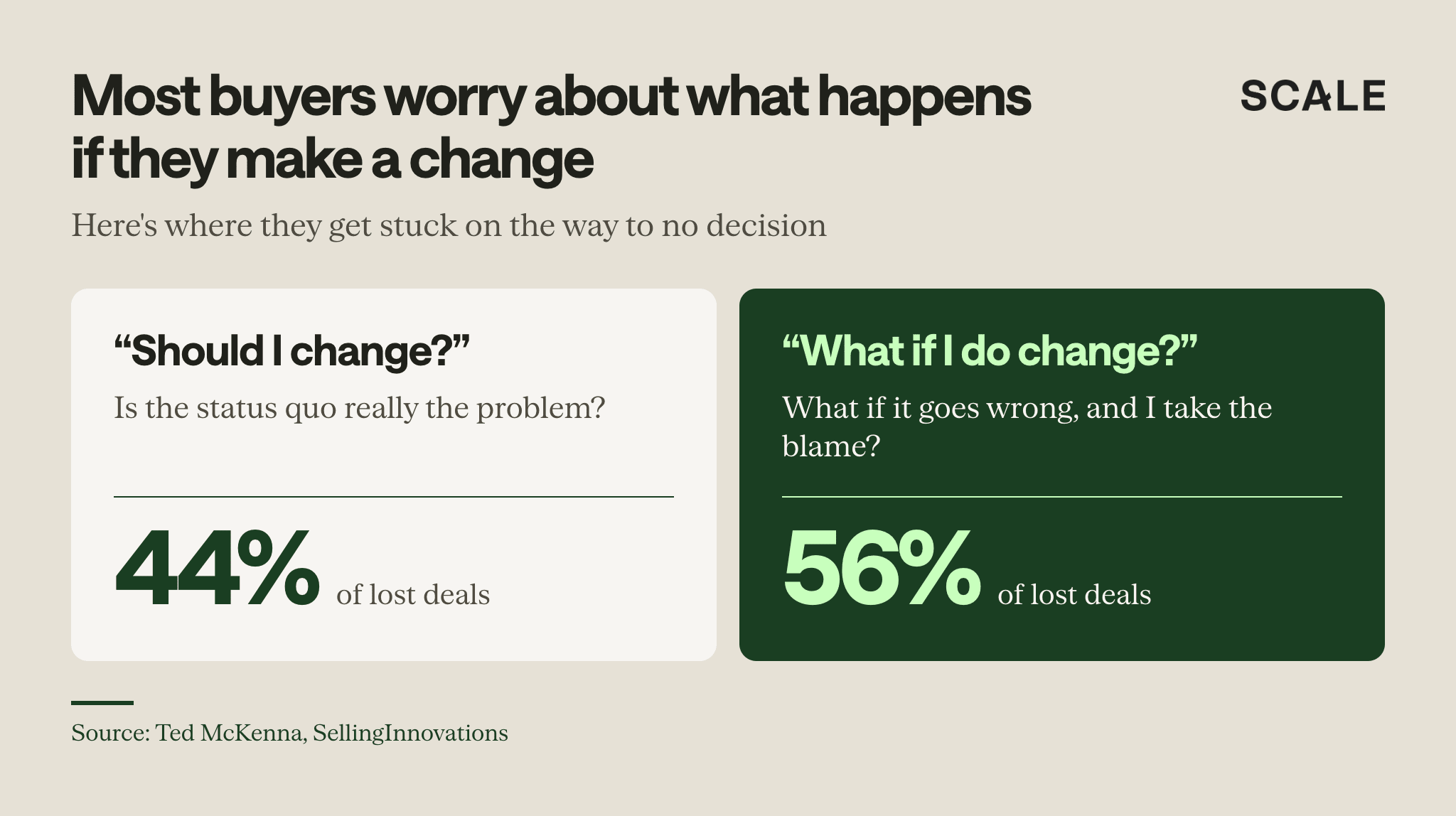
1. Most of your buyers have watched a change go wrong before, whether it was their own call or someone else’s. In Ted’s data, 56% of lost deals came down to the buyer asking “What if I do change?” and only 44% to “Should I change?”
So give them certainty. Walk them through what day 60, day 90 and beyond will actually look like. Buyers trust their own experience more than any number you show them, and no ROI calculator will change that. The closer you can bring them to that future during the sale, the safer the decision feels.
2. We’ve all led with the ROI calculator. Ted’s warning: we inflate the numbers until the buyer can’t picture hitting them, and the big promise ends up feeding their fear. Give them grounded, believable ROI. Period.
3. Make them feel fearless. You’ve been down this road with other customers and you know where it leads, so say so. Treat the outcome as shared: if they go down, you go down with them. Most of all, show them you’re the expert on this change. Bull’s eye!
Watch the full session here:
The stat that stuck with me: 56% of lost deals came down to ‘What if I do change?’ and only 44% to ‘Should I change?’ Most sales teams spend their time on the second question when buyers are stuck on the first.
I know one top seller who would facilitate a meeting with the buyer's key stakeholders to ensure that they agreed on the problem to be solved and whether it was worth solving. Little to no selling, just facilitating the conversation as a service so that the client was clear on what they were solving for and whether it was worth the effort. I thought it was a great way to proactively address both FOMO and FOMU.