

This article was previously published on Topline.
Speaking on stage with me at LinkedIn, Maya Spivak (founder, Marketing.fan) described the perfect founder-brand use case: a founder had just landed their biggest deal yet, and not only had they never spoken with the buyer, but the buyer had never visited the company website. They’d been following the founder’s content and reached out based on a peer recommendation.
This is founder-led growth working exactly as intended.
Pipeline is the issue I hear from nearly every founder and GTM leader I talk to. Cold email response rates dropped from 8.5% in 2019 to 3.43% in 2026. What worked three to five years ago is far less effective today.
At this point, I get to pretend I’m a Jedi Master and introduce the single most powerful and efficient GTM motion available to a startup: founder-led growth on LinkedIn.
This isn’t about becoming a LinkedIn influencer, though that may be a byproduct. It’s about getting your unique narrative in front of your target ecosystem and driving real revenue.
The data is hard to argue with: LinkedIn’s own research shows companies generate 33% more leads when founders post regularly, with deal sizes 3.7x higher when prospects follow your executive team and deals closing 22% faster when buyers feel like they already know the founder. Sendoso’s analysis goes further: deal sizes are 120% higher when buyers follow the executive, and win rates climb 11% from a single executive post viewed before close.
You don’t need a massive marketing team to pull it off. As Scott Albro (GTM advisor, founder brand expert, and my co-founder at TOPO) puts it, “LinkedIn is one of the few places where companies at every stage can punch above their weight.”
Founder Brand is More Than Just Personal Branding
At its core, founder-led growth is about having a human face for your company — one with the deepest understanding of the product and the problem, who can credibly speak to what your market cares about.
In a market saturated with AI-generated expertise, your original perspective is the one thing no competitor can replicate.
Done well, you become what Scott Albro calls “synonymous with the category.” Rather than posting company updates, you use your point of view to shape how your ICP thinks about their role, market, and key challenges.
Most teams optimize for reach and get lost in the noise. Founder-led growth optimizes for the audience that buys, refers, and stays.
After three years evangelizing founder brand on LinkedIn, I’ve heard every objection: “I don’t have time.” “It feels self-promotional.” “I tried it and nothing happened.” “I’m not a writer.”
But engaging on LinkedIn is a skill you can develop, not a talent you’re born with. Founders who commit see a consistent progression. The first few months feel like talking to yourself. Then something shifts: a buyer you didn’t know DMs you or a prospect mentions to a sales rep that they loved one of your posts. By month five, content-engaged opportunities are showing up in the forecast and closing faster. By month eight, candidates are citing your posts in job applications. The ones who quit before month three never find out.
Trust comes before interest in the product, not the other way around. Gal Aga (CEO, Aligned) describes the sequence: people listen, feel deeply connected, trust you, then check out what you do.
The discomfort of posting is real but temporary. The question is how to do it. Let’s focus on five key areas to launch your founder brand:
1. The audience ecosystem: who you’re writing for
Beyond defining the audience you’re writing for and their roles, the higher-leverage move is mapping the ecosystem your buyers already trust (i.e., the influencers, analysts, bloggers, etc.). Make a list of 50 to 100 and start consuming their content. Follow the trends shaping your market. The goal is to get them engaging with you.
One early-stage cyber security founder posted two to three times per week and commented selectively on independent analyst posts. Today, four of his top 10 influencers regularly engage with his content, one mentioned him in an article his sales reps now use as an icebreaker with target CISOs, and meetings have followed.
2. The narrative: what you’ll tell the audience
The single most common mistake founders make is talking only about their technology. Your audience wants insights, not product pitches.
To rise above the noise, you’ve got to deliver a big, differentiated idea. Marc Benioff took over CRM with his “no-software” narrative, and we know how the rest of that story went.
Here are three narrative types and how each has played in the market:
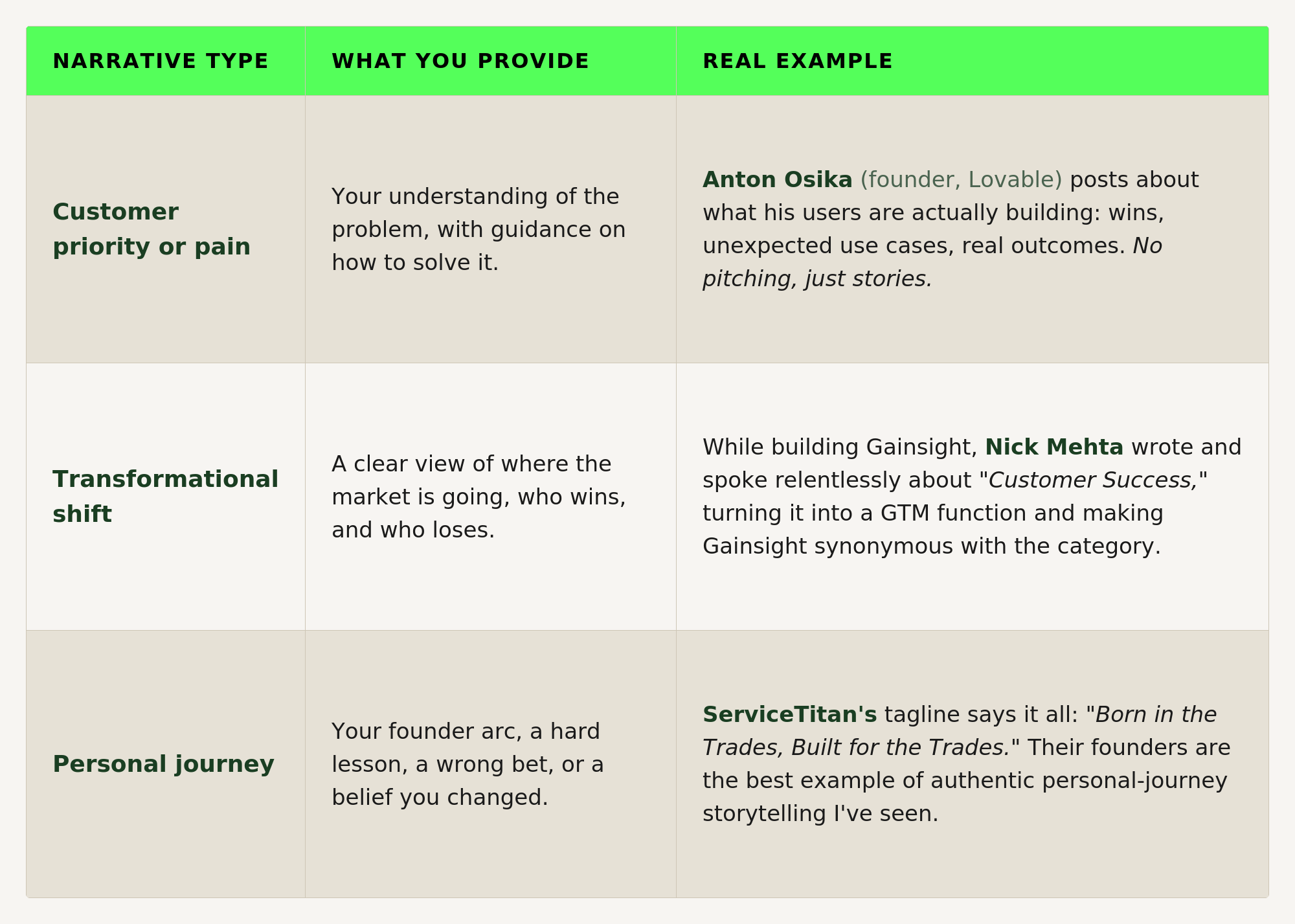
Keep in mind that these story types are not mutually exclusive — someone’s personal journey can lead to a transformational shift, and so on.
Your narrative evolves like a product: ship it, see what resonates, and adjust.
3. Execution: take your narrative to the market
Step 1: Create
A few tactical elements matter most:
Your hook — the first line — is your scroll-stopper. If it doesn’t make someone pause, the rest doesn’t matter. Treat every post as a market test: Gal Aga rewrites any post that isn’t pulling one to two Likes per minute within the first 15–30 minutes.
Don’t overthink length. LinkedIn data shows 400 to 800 words generates nearly 3x more engagement than posts under 50 words, but exceptions exist in both directions. The rule is depth of value, not word count.
Alec Paul (founder, SalesBrand) calls the sweet spot the “prolific zone” — the narrow band between obvious and crazy, where your content is authentic, polarizing, and relevant enough to make your ICP feel something. His benchmark: If less than 10% of comments are pushing back, you’re playing it too safe. A contrarian reply from your ideal buyer is worth a hundred “great post!” reactions.
One more lever: comments. Many current LinkedIn influencers built their following by commenting before they ever posted, and most still do. Same rules apply: add value to the “conversation,” don’t pitch.
Step 2: Distribute consistently
Consistency is often a design problem. The founders who do this well treat content creation like pipeline generation: they build a repeatable process and run it whether they feel like it or not.
You’re already generating the raw material every day: every customer call, sales conversation, and product decision is content waiting to happen. Some systems that work:
Voice memos after meetings. A 90-second voice memo, stockpiled, becomes a content bank of pain points and objections, hook ideas, and scar stories.
Batched writing. Gal Aga blocks Sunday mornings to write three posts for the week: one scar story, one contrarian take, one customer insight.
Prompts for when you’re stuck. A mistake you made, a recurring customer question, a belief you’ve changed, what most energized you. Each is a post.
On AI: Use it as an editor and pattern-finder, not a ghostwriter. Feed it your voice memos for post angles; feed it your past posts to surface recurring themes. Let it sharpen the hook, but don’t let it replace the first-person voice that makes the content worth reading.
Step 3: Amplify
Once your organic content is generating real engagement, amplify it. LinkedIn’s Thought Leader Ads (TLAs) let you promote posts from individuals rather than company pages, and they perform in ways standard ads don’t.
For startups specifically, TLAs drive 7.6x more engagement than other paid formats, with 1.5x higher click-through rates, 45% more demo requests, and 30% more efficient cost-per-click. The reason is simple: a post from a real person that your audience already recognizes reads less like an ad and more like what they were already engaging with.
Start by putting budget behind your highest-performing organic posts. Don’t guess what will resonate at scale — let the audience tell you first, then spend behind it.
4. Conversion: turn the founder brand into founder-led pipeline
When an ICP prospect engages with your post — Likes, comments, or follows — they’ve self-identified as interested. Act immediately: send a connection request with a short note referencing the post, opening with a feedback ask rather than a pitch. Not “Can I show you a demo?” but “Would you be open to a 30-minute conversation on what you think about [topic]? I’d love your take.”
One founder I work with generates six to eight meetings per week from this play; others report roughly 40% conversion to meetings — a rate no cold outreach tactic touches. The content warms them up and the DM closes the gap.
For top accounts and key influencers, the DM should come from the founder. A founder reaching out to an engaged VP or C-suite prospect is a fundamentally different conversation than an SDR cold sequence. For non-top tier accounts, hand the engaged prospect to your SDRs or AEs — the LinkedIn warmth still lifts conversion.
5. Measurement: the right metrics at the right time
Founder-led GTM is hard to measure. Trust, resonance, and reputation don’t fit on a dashboard. They show up in deal velocity, inbound DMs, and the way people talk about you when you’re not in the room.
Still, there’s a clear progression of indicators. If you track the right ones at each stage, you’ll be less likely to abandon something that’s actually working just because the pipeline number hasn’t moved.
First 90 days: Track leading indicators (i.e., Likes, comments, and click-throughs to your profile). These are intent signals that become pipeline with consistency.
Next 90 days: Monitor your content-influenced pipeline, adding a “content-influenced” deal stage in your CRM, tagging every prospect who has engaged with your content, then measuring their deal velocity and win rate. Train sales to log when prospects mention your posts on calls.
Six months in: Measure direct pipeline impact. Inbound founder-brand leads come via your LinkedIn posts; outbound come from the DM play.
Plenty of tools handle the tagging. Factors.ai, Fibbler, Dreamdata, and Revsure come up most often in conversations with operators.
The numbers from founders who do this well are not incremental. In one month, Kacie Jenkins (former SVP Marketing at Sendoso, now Head of Marketing for Claude Code) drove six figures of qualified pipeline through DMs alone. At Wynter, Peep Laja attributes roughly 80% of new signups and demo requests to LinkedIn. Gal Aga’s rule is the clearest target I’ve heard: if 20% or more of your pipeline mentions your content, you’ve won.
Founder Brand Works Because People Buy From People
If brand is the market’s perception of you, founders have a strategic obligation to shape that perception in a way that drives revenue. The payoff compounds in ways nothing else in your GTM stack can match: Every public conversation with a customer creates a feedback loop that keeps you tied to the market, and as you scale, your founder brand and your company story reinforce each other — each one making the other more credible.
Founder-led growth is one of the most reliable and efficient levers available to any startup. Show up consistently with a real point of view, build the systems that drive it, and measure the right things at each stage.
Craig Rosenberg is the Chief Platform Officer at Scale Venture Partners, where he works with portfolio companies on GTM strategy and execution. He was the co-founder of TOPO, which was acquired by Gartner, and the host of The Transaction podcast.
An important point to emphasize: before you have awareness and audience for your message/products, they audience exists in places like LinkedIn. It’s a much lighter lift to gain awareness as an early stage company/founder there than by email and even first party website.
The part about the buyer following the founder’s content before ever visiting the website really stood out. I think that is where founder brand gets interesting, because people start recognizing the product through the person behind it instead of only knowing the person because of the product. If you keep contributing useful ideas to the market over time, that recognition can build quietly and eventually bring organic opportunities too. Do you think founders should think of their personal reputation as something they are building alongside the product, not just a way to promote it?