

I call Alec Paul (Founder, SalesBrand) the “LinkedIn Whisperer.” Why? He is the most humble, unassuming dude I know and literally is the uncredited advisor to some of the most insane LinkedIn founder brands out there. His biggest customer was probably the most effective LinkedIn persona I have ever seen, the late Adam Robinson.
When I first met Adam, I tried to pin him down on who he worked with. He wouldn’t say. Why? No one talks about the LinkedIn Whisperer. BTW, Alec eventually told me that Adam was his customer. Adam will likely be remembered as the GOAT of B2B social media and Alec was his behind-the-scenes muse. And a humble behind-the-scenes whisperer who’s helped them build it all.
I was so excited to bring Alec to the Scale Venture Partners Council to spill some of his secrets against the backdrop of LinkedIn’s current state of affairs. Now some of those secrets are yours.
1. Let the company page get weird
Company pages are where LinkedIn engagement goes to die. Except for a few companies. Exhibit A: Clay.
You’re not Clay, but you can still build a company account that crushes it on LinkedIn. Alec’s advice: “Give over the company page to some somewhat unhinged millennial or Gen Z person that can develop a very unique social voice.”
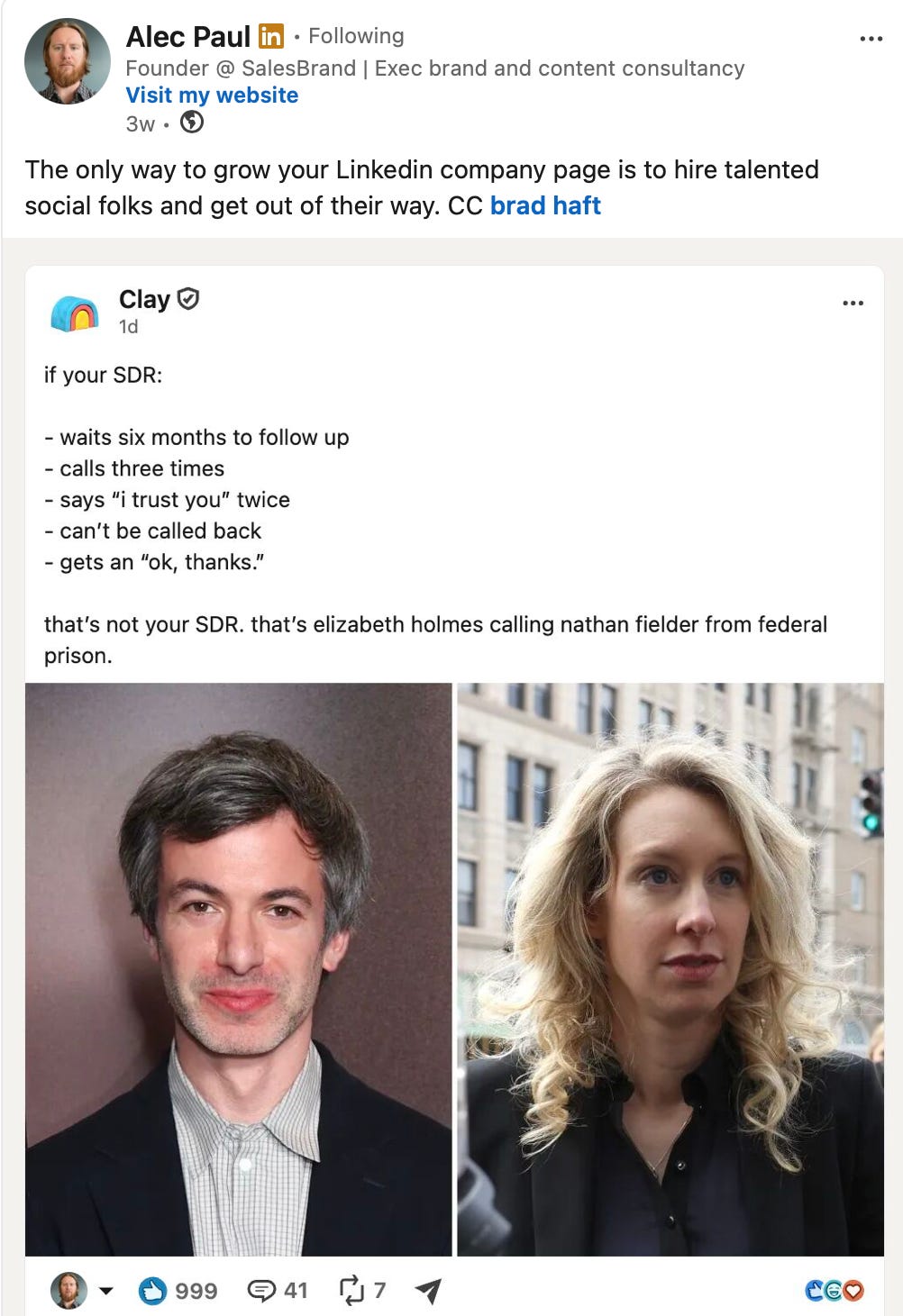
And by “give over,” he means GIVE OVER. Let them experiment. Let them have some fun. As long as they’re talking to your ICP, nobody’s going to die because the company page cracked a joke.
The alternative is to keep posting boring corporate announcements that only you, your CEO, and two loyal employees will like.
2. LinkedIn is a network game
Building a founder-led brand starts with one recurring task on your calendar: send 10-15 connection requests every day. RELIGIOUSLY. It’s a no-brainer. LinkedIn is network-driven, and your connections determine who sees your content, especially in that first wave of distribution. If you want your content to reach more people right out of the gate, you need to expand your network.
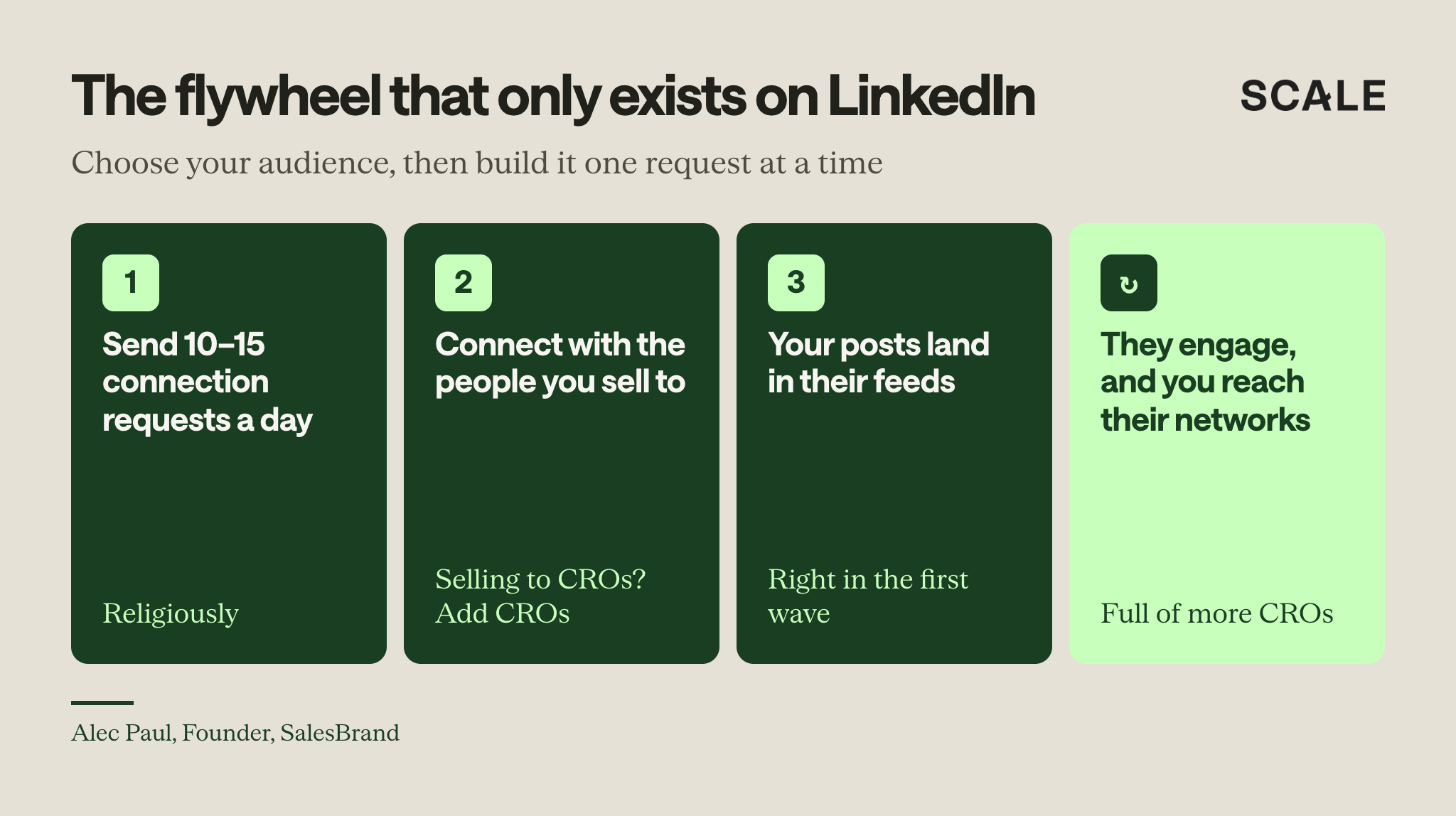
If you’re selling to CROs, go connect with CROs. You’ll gradually build a network packed with people who could buy from you. Your content will start showing up in their feeds.
When those CROs engage with your content, it reaches their networks too, which will likely include even more CROs.
Now you’ve built what Alec calls a “beautiful flywheel that only exists on LinkedIn,” where you can strategically choose your audience.
One of other network gaming best practices is to have your founder connect with the executives in the buying committee of your top deals. Brilliant.
3. “Clay” your way to LinkedIn fame
Let’s talk about the elephant in every B2B LinkedIn feed: Clay.
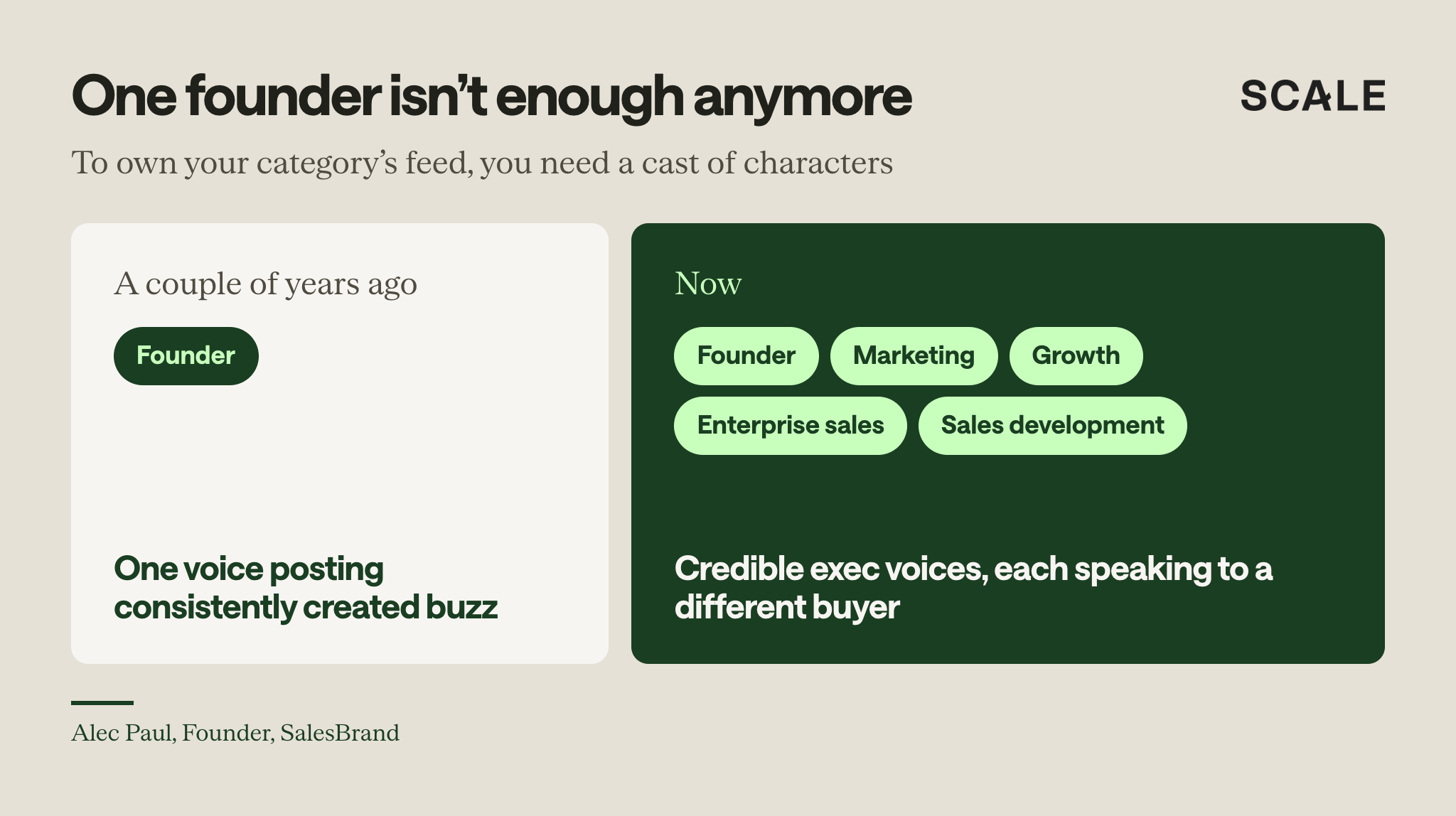
If you’re in B2B, there’s no way you haven’t come across their posts. If you want to build a LinkedIn motion like theirs, Alec says, “you gotta start at the top,” with a founder. At Clay, Varun Anand (Co-Founder, Clay) is holding down the fort. Then “go down a level to get your heads of marketing, your head of growth, your head of sales.” Any other team members want to get involved, too? That’s fantastic. Encourage and support them.
Each person speaks to a different buying persona. Bruno Estrella (Head of Marketing) talks to marketers, Davide Grieco (Head of Growth) to growth leaders, Todd Busler (Head of Enterprise Sales) to enterprise AEs, and Rob Cook (Head of Sales Development) to SDR leaders. As Alec puts it, “As you get bigger, it is very important that you have different credible voices at the executive level, talking to the different buying personas.”
A couple of years ago, one founder posting consistently could create a ton of buzz. Now, if you want to own your category’s LinkedIn feed, you need a whole cast of characters.
4. Be the human in front of AI slop
As much as we love LinkedIn, we’ve all seen the AI slop that says a whole lotta nothing wrapped up in corporate buzzwords. Alec’s counterpoint: “there is alpha in doing something very different.” If everyone’s going professional and too buttoned-up, you go goofy and bring some humanity into the mix.
I know, terrifying. We’ve spent years treating LinkedIn like a place where everyone must wear an invisible suit and tie. But your buyers exist outside their job titles, too.
Talk about your life. Post your pictures. Your connections will recognize you and know there’s a person behind all that good content, not a bot. Best case, they might even walk up to you at a conference to say hi.
5. Study the game
If you want to game LinkedIn, you have to study it like you’d study for an exam. Spend time dissecting what’s working, what’s not, why a post got 5,000 likes, and why another one took off. You need to form your own opinions about it. Create a swipe file of everything that’s working.
Between 65% and 70% of Gal’s pipeline comes from LinkedIn. Alec says he’s a perfect example of “what you put into it, you get out of it.” He was a student of the game. He put in long, obsessive hours every week studying the platform: seeing what works, critically examining why a post was trending, screenshotting it, and figuring out what made its hook work.
Eventually, he found the theme that worked best for him: buyer-led sales and the future of buyer enablement. Then, Alec says, he became “religious” about it. Like a movie where every scene serves the central idea, every post came back to it, even a story about an AE who makes a million dollars.
A few more lessons too good to leave out
1. You don’t always need a social media person for your execs. Sometimes all your execs really need is someone who can brainstorm ideas with them. With leaders like Kyle Porter (Co-Founder and Former CEO, Salesloft), the social team handled company content, while Sydney Sloan (Executive in Residence, Scale Venture Partners) worked directly with Kyle to find ideas that inspired him to post in his own voice.
2. Voice, story, and packaging matter, but they can’t compensate for an idea that isn’t fully formed. If you drop your thoughts into an LLM, “it kind of papers over the fact that you don’t have a complete idea,” Alec said. Instead find a collaborator who can pull ideas out of you, challenge your thinking, and help you develop them. Ideas are THE MOAT.
3. Don’t let the perfect post become the enemy of posting. You might only have a couple of great ideas a week. What I love about Alec’s content strategy is how he fills the gaps with reactive commentary and pre-validated ideas from platforms like Twitter, adding his own spin to them. You can do the same, then mix those posts with personal stories and bigger ideas to keep the content engine running.
4. Pete Giordano (Product and GTM Strategy Advisor, Scale Venture Partners) said thought leadership is about giving people a new way to look at something. Help people see an issue in a different light, and you’ll attract those who believe in your mission and the value you’re creating for customers. Building on that, Alec added, “Don’t do it in a lab. Do it in public.” A three-month content calendar can’t tell you what will land. Publish, watch what people respond to, and double down when an idea keeps coming back to you. LinkedIn’s feedback loop is one of the most powerful tools you have.
Watch the council recording here: