

Pricing is often an afterthought for founders. They’re pinpoint-focused on building an exceptional product and getting it in front of customers, and they worry about pricing at the very end of the GTM process.
AI has made that approach dangerous. AI-native SaaS companies are running gross margins of 55-70% due to compute-heavy inference costs, well below the 75%+ traditional SaaS benchmark, according to SaaSRise’s 2026 SaaS Benchmarks Report.
Usage-based pricing is all the rage (e.g., charging based on API calls, records process, or outputs generated), but without guardrails it’s painful for everyone; reps are selling something that changes all the time, and enterprise buyers are bracing for bills they can’t predict.
It’s messy. But luckily, there are people who know how to fix it, like Fynn Glover, CEO & Co-founder of Schematic, and Peter Giordano, EIR at Scale Venture Partners.
If you want to go even more in-depth, Fynn ran through his full practice at our Pricing Council:
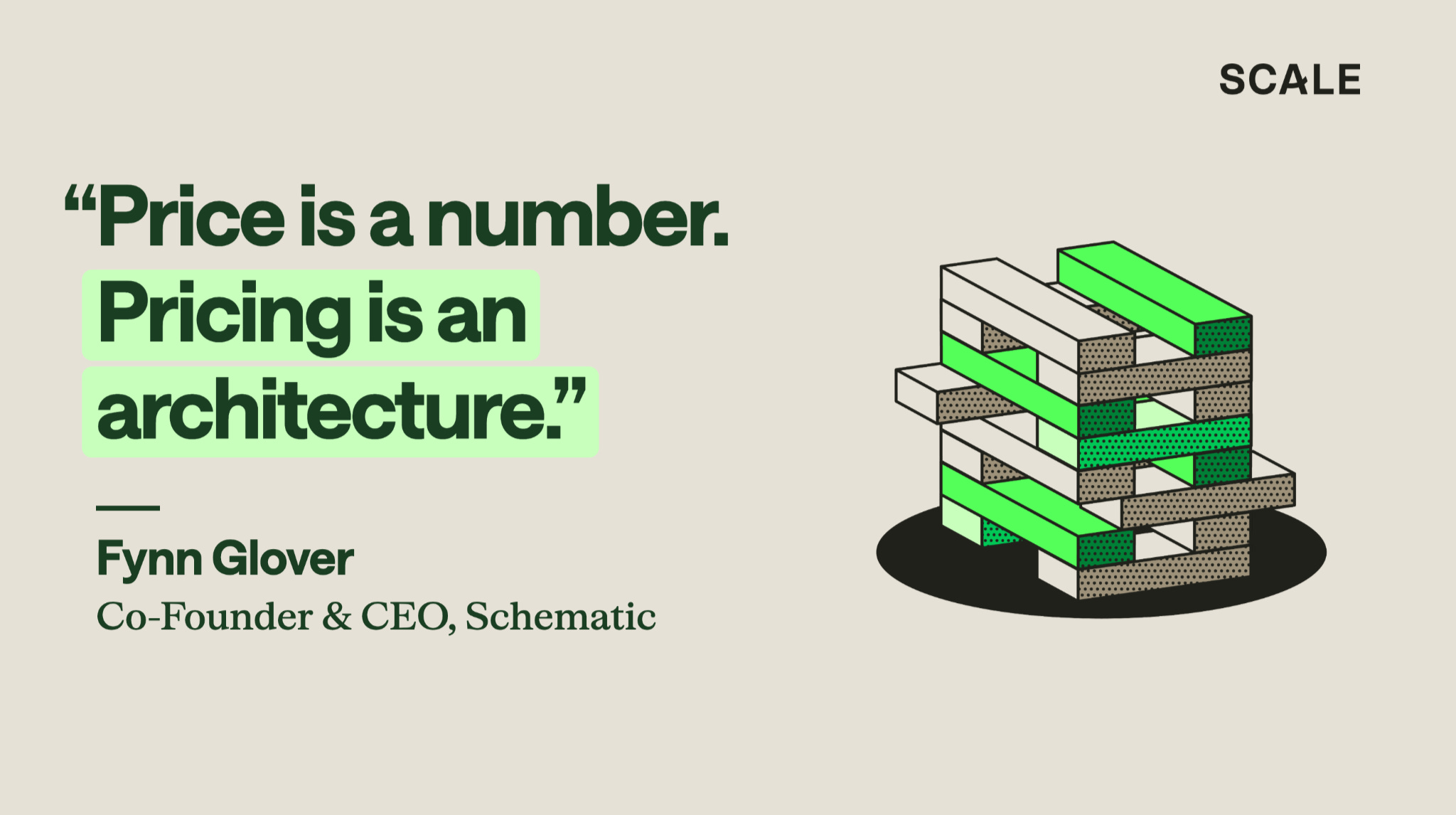
Fynn Glover wants you to treat pricing right
Fynn Glover learned from his own pricing mistakes on the way to becoming an expert. He founded and ran his first startup, RootsRatedMedia, in 2011. By his own admission, he “made a mess of pricing that ultimately cost us a lot of enterprise value at the sale of the business.”
Now as the co-founder & CEO of Schematic, a monetization platform for high-growth software and AI companies, Fynn’s built a business on helping founders and operators approach pricing like the strategic practice it should be.
We’re going to follow Fynn’s expertise to determine whether your pricing is setting you up for failure and what you can do to get it back on track:
Why most “pricing problems” are actually product-strategy problems
The principles to set before you touch a pricing model
How to turn pricing into an ongoing practice
The six questions to ask customers before you set a number
Pricing problems are usually product problems
If you think you have a pricing problem, take two steps back before touching anything. It could be deeper than that.
Pete Giordano has spent his career leading growth at companies like VMWare and Google. Now he advises our portfolio companies, helping them navigate GTM and pricing.
Across dozens of conversations with founders, Pete discovered that, “Most of the time, what looks like a pricing challenge is actually a product strategy problem in disguise.”
Product strategy should be derived from the problem you solve, and that value (and the subsequent pricing) can shift based on your customer. Here’s an example:
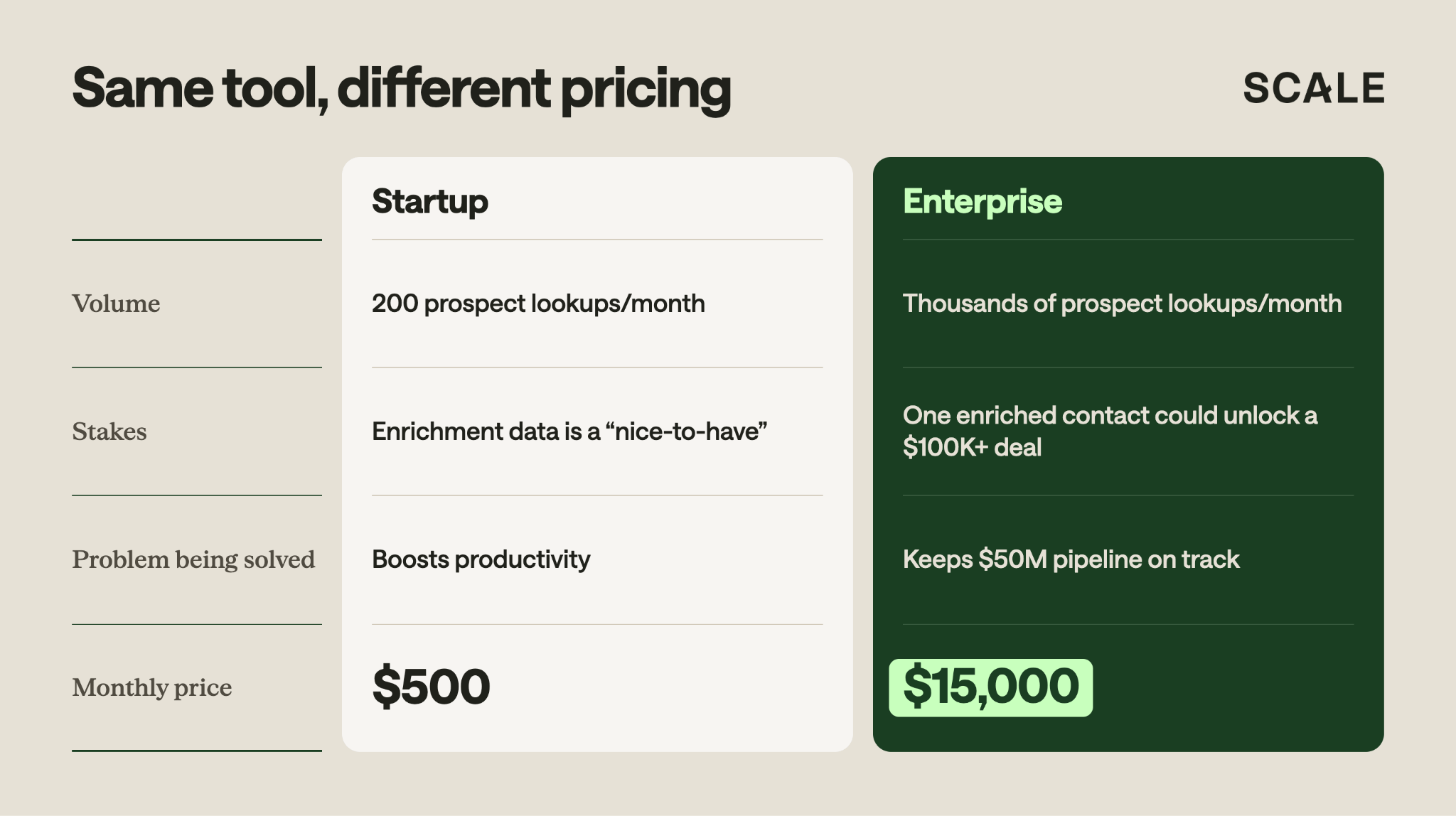
The problem you solve shapes three things:
The pricing model (seat vs. usage vs. outcome)
The value metric (what you charge for)
The price ceiling (the economic size of the problem sets willingness to pay)
Then you need to fit it to the buyer: how they budget, how procurement approves, and what they compare you to.
Get this connection right. Otherwise, pricing will keep sending you down a spiral of second-guessing. Are we too expensive? Too cheap? Too transparent? Should we revise the pricing model?
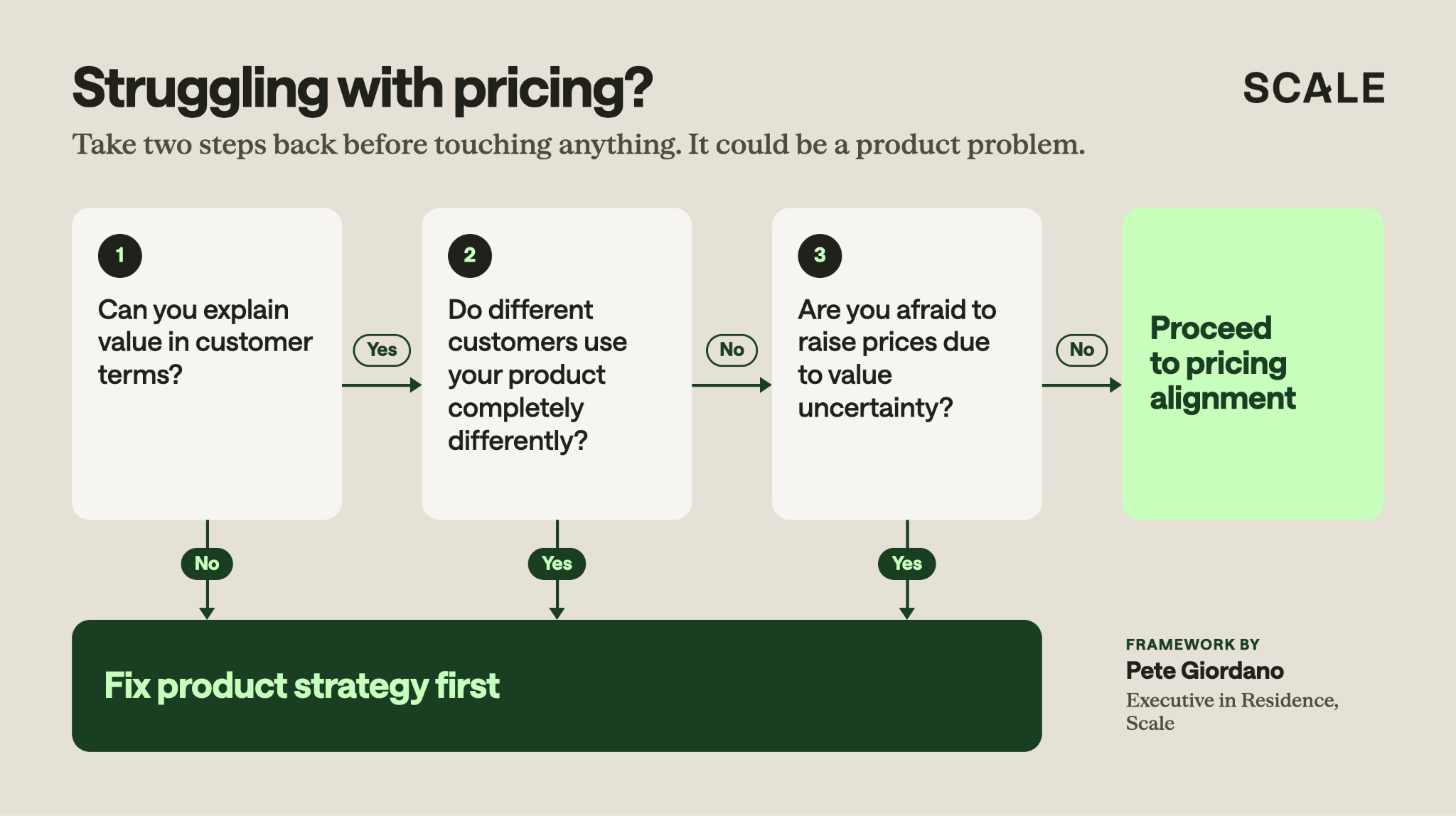
Here’s a quick exercise. Try to complete this sentence:
“[Economic buyer] pay us because we solve [specific problem], which saves/makes them [quantifiable outcome] through [clear mechanism].”
If you have to rack your brain to complete it, go back to the drawing board and fix your product strategy.
Set your company’s pricing principles before you set the strategy
Now you’re clear on product strategy. We’re still not ready to touch the pricing numbers (sorry).
You need to set pricing principles. Without them, every pricing discussion turns into a tug-of-war. The CRO is pushing discounts to hit the quarter. The CPO wants usage-based pricing. Growth wants fewer paywalls. Principles are decision rules that help you avoid this impasse.
Fynn runs Schematic’s pricing on these four core principles:
Be affordable early on.
Land and expand.
Share in the upside as you help customers grow and push usage-based charges later.
Avoid opaque coverage. Be extremely predictable for customers.
Principle #4 matters even more in the AI era. The margin squeeze and the unpredictable bills we started with usually have the same fix: hybrid pricing.
Charge a predictable base fee, add a variable component tied to the value customers get, and put guardrails around it (usage bands, caps, or prepaid drawdowns). Margins stay protected, and the buyer’s finance team knows what they’ll pay. Start predictable, then layer in usage-based charges as customers trust the value, which is exactly what Fynn’s principle #3 describes.
They work for Schematic, given its stage of growth. Yours might look completely different depending on your specific product or stage. The point is to have a set of principles every department can get behind without making life harder for customers.
Build a pricing practice that evolves with the product
Price × Quantity = Revenue
Pricing is just part of the revenue equation, yet companies put the majority of their effort into quantity. There’s one question Fynn likes to ask orgs: Is pricing as fleshed out as engineering or sales? Majority of the time, orgs don’t even have a dedicated pricing function, let alone one on par with other core functions.
Now that AI costs and customer value shift faster, pricing and packaging need to change more often than a once-every-few-years overhaul.
Imagine the downstream effects on revenue if you focused just 10% more on pricing. Here’s how you turn pricing into a practice that enables you to do that:
Find your “pricing czar”: Product teams can end up nickel-and-diming every feature because every PM thinks their baby is special. Pricing should only be owned by people who are trained in monetization, packaging, customer value, and the tradeoffs between them. Have one person on the team own pricing unilaterally. They’re the one taking the shots and making the calls, with a mandate from the CEO. The czar owns the decision; the monthly cross-functional meeting supplies the inputs and checks the bias..
Ownership by stage: According to Fynn, pricing ownership should evolve with the company.
Below $10M ARR, the CEO should own it, full stop.
From $10M to $50M ARR, hand it to product. They should be accountable to a roadmap that makes the company money.
Past $50M ARR, hire someone whose full-time job is pricing, reporting to product with a dotted line to finance and the CEO.
Split pricing work into two speeds: The big, infrequent stuff (a pricing overhaul twice a year) and the small, constant stuff (tweaking trial limits or testing a model in a single enterprise deal).
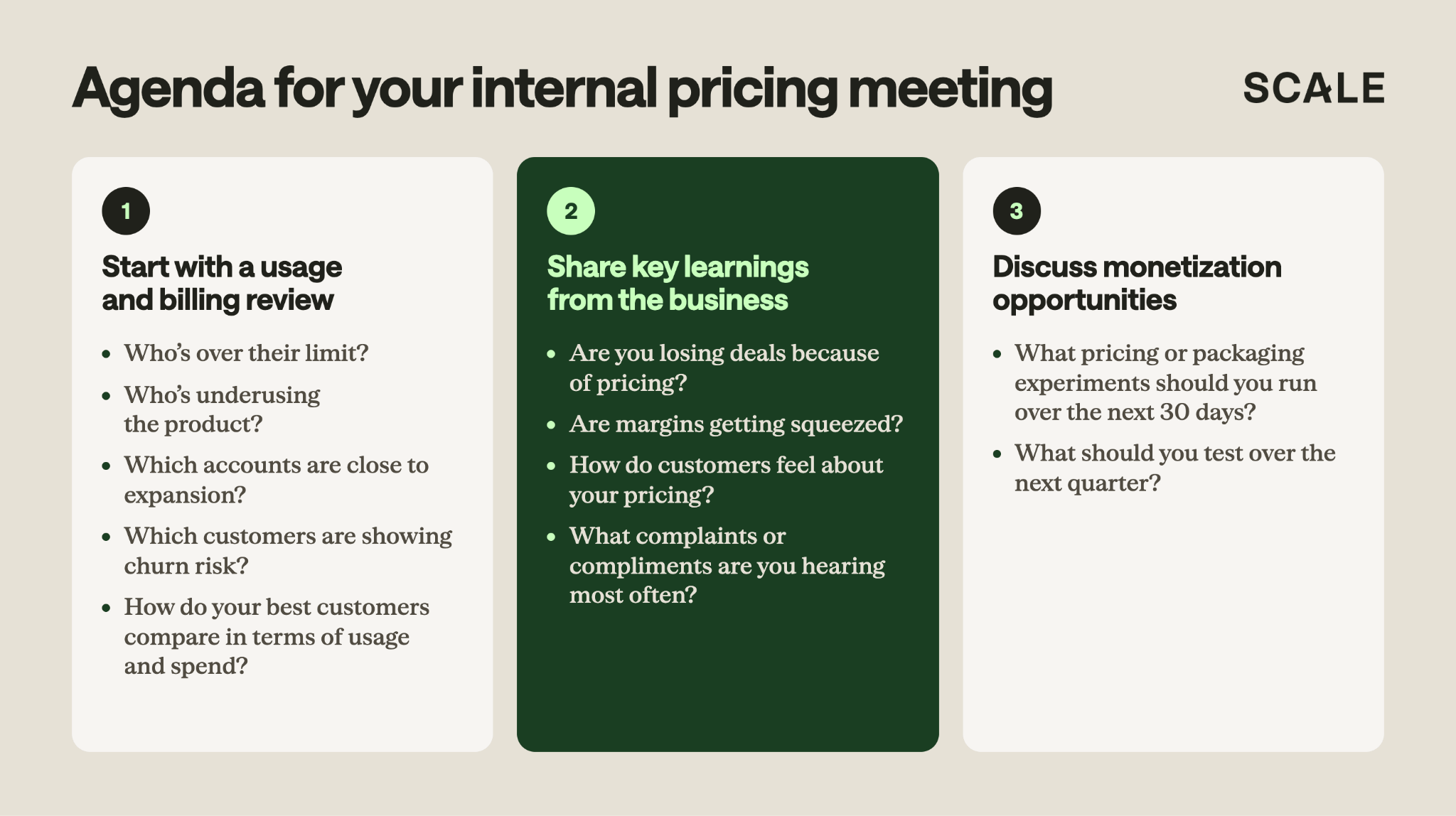
The mechanism: Every month (yes, monthly, not quarterly), pull together reps from sales, product, engineering, customer success, marketing, and the pricing czar. (If you don’t have all those departments yet, do your best to speak to each of those areas distinctly, even if they’re owned by a single person.) Give pricing two hours on the calendar. Pick 1-3 experiments to run over the next 30 days, assign owners, and come back with results at the next meeting.
Build your pricing research kit
Pricing research, AKA willingness-to-pay conversations, is necessary, ideally before you build the feature. Get your prospects or customers in a room and ask these six questions to gauge how valuable they believe your product is. Failing to do so makes it difficult to prioritize what to build, and you only learn whether customers will pay after launch. To set the conversation up for success:
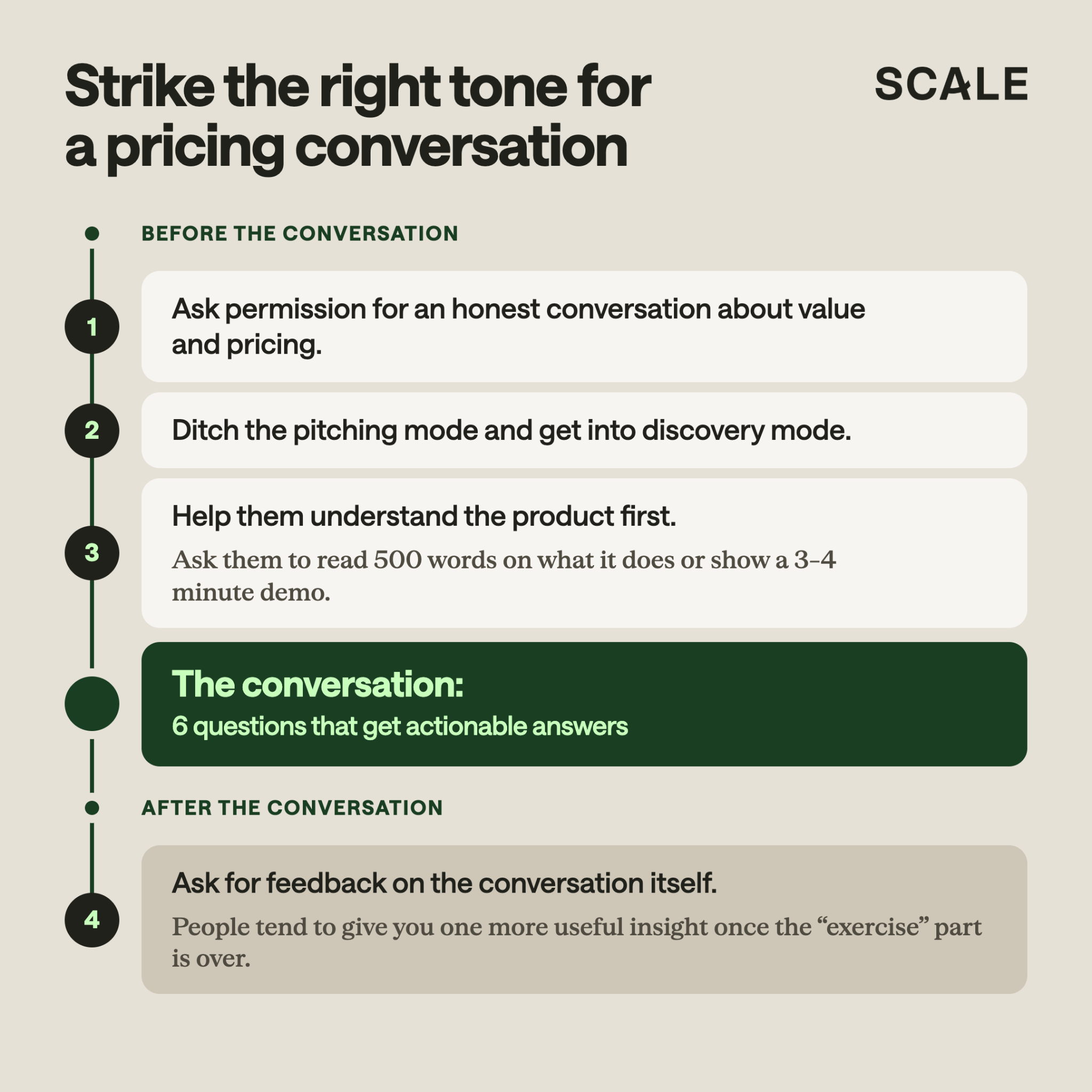
Below is a list of questions to ask your customers about pricing:
Value proposition: What specific challenge could this solve for you? Which features stood out? On a scale of 1 to 5, how likely are you to buy this at a fair price? Don’t mention the price. The goal is to understand perceived value, assuming you’re fairly priced. A two means back to the drawing board. A five is a great sign.
Relative value: How valuable is [product] relative to tools you’re already paying for? What budget would this come from? Have them summarize what they spend on other tools and rate your value against them. If they say you’re worth 50% of their $100K Salesforce contract, they’re telling you they see you as a $50K value. Bonus: you learn where they’re already spending money.
Price metric: Put several candidate metrics on the page and ask: Imagine you’re happy with the product a year into the contract and the price goes up 50-100%. What metric moved that made you believe I earned that increase? A clear answer points to your value metric. A blank stare means the metric isn’t intuitive.
Packaging schema: What do you like, what do you dislike, and which package would you choose? Bring your best packaging hypothesis. Put it into a good-better-best table without pricing. You’re trying to understand how customers expect the product to be packaged and purchased.
Max willingness to pay: At what price would this become totally prohibitive? What’s the most you can spend without needing someone else to approve it?? Later, introduce a price and use multiple-choice answers. “I’d buy immediately” signals underpriced. “I’d need significant internal approval” signals overpriced. You’re aiming for the middle.
Other influences: Besides pricing, what influences your decision to buy a product like this? Give them a list to react to. This helps you understand what drives the purchase and gives your champion ammunition if they aren’t the economic buyer.
Your next steps:
Complete the one-sentence value statement. If you can’t, fix product strategy before you touch price.
Pick five recent customers and run the willingness-to-pay conversation this month
Ask your team: is our pricing function as important to growth as engineering or sales? If not, why not?
Name a single pricing owner by stage (CEO under $10M ARR, product from $10-50M, a dedicated pricing lead above that) and write down 3-4 principles they’ll use to break ties
Put a monthly 2-hour pricing meeting on the calendar with sales, product, engineering, success, and marketing
Pitch your own pricing in the mirror, or replay your last enterprise close. Did it sound confident or fumbled?
Craig Rosenberg is the Chief Platform Officer at Scale Venture Partners, where he works with portfolio companies on GTM strategy and execution. He was the co-founder of TOPO, which was acquired by Gartner, and the host of The Transaction podcast.