

I’ve talked with a bunch of early-stage founders recently about launching into the market. They’ve been heads-down building their product for months and are finally ready to come out of stealth. Their tone is the same: pop the champagne, ring the bell, the hard part is done.
Yeah…no. Launching a product requires more than just building a product. Before you launch, you’ll need to develop a strong company narrative that articulates the problem you solve, how you solve it, and why customers should pay you to solve it. (Hopefully, you’ve talked to a bunch of customers before building to get a sense for the real problem and have built something customers want, but we’ll cover that another time).
Scale GTM advisor Sydney Sloan has advised dozens of startups on the journey from pre-seed to Series A and beyond, and she’s seen founders struggle to tell their own stories before they have a marketing team in place. But to get the runway to grow your company to the first million and more, they need to tell a compelling story that resonates in the market.
In order to help more founders at scale, Sydney created the playbook for launching out of stealth. It’s a step-by-step guide over the course of 8 weeks, designed to fit into your already-bonkers schedule, resulting in a clear, compelling narrative and a solid plan.to kickstart growth.
This post covers part of a playbook we developed for launching your company out of stealth, including:
→ Building anticipation before launch
→ Activating the people who can amplify your story
→ Directing attention into relationships you own
→ Extending momentum beyond launch day
There are four core beliefs that underpin the playbook:
Go direct. Founders are best positioned to shape the narrative because they hold the insight that sparked the company and can explain, defend, and evolve the idea in their own voice.
Own the timeline. Share your news on your terms, through channels you control. If news leaks, don’t just react to someone else’s narrative. Create a new conversation and guide it forward.
The story is the product. Treat your narrative as seriously as your engineering. The story is what convinces people to join your team, buy your product, invest in your company, or believe in your vision.
Launch again and again. A launch is a repeatable capability. After coming out of stealth, every major product milestone, market shift, or company evolution creates another opportunity to launch.
Craft your company story
No one will care about your product if they’re not invested in your story. Before you worry about a logo, visual identity, social presence, or even the website, you need to nail down a compelling narrative.
GTM expert and startup advisor Scott Albro joined one of Scale’s Founder Councils with a stark diagnosis: “Everything is downstream of attention.” Every startup enters the market in obscurity, and it’s noisier than ever. Product alone no longer creates separation. Attention is the bottleneck.
Albro’s answer is what he calls the Attention Engine, a system for “engineering pull” instead of relying on push. Most startups are running close to 99% push on day one (cold outbound, ads, founder-led sales) and only 1% pull (people coming to you). The goal is to flip that ratio as fast as possible, because that’s the only way to hit today’s growth expectations. Albro’s suggested benchmark is 80% pull, 20% push.
The Attention Engine breaks into three parts:
Narrative: what you want the market to believe
Distribution: how you spread that narrative
Network/market: where you spread it, through a network of high-leverage nodes you have to navigate
“Humans are wired to consume narratives, not information. Stories are essentially shortcuts for what matters, what has meaning, how you frame issues,” Albro told us.
And in the AI economy especially, narrative matters more than ever when product, content, strategy, and tactics are getting easier to replicate.
Here are the three questions you need to answer to write your story.
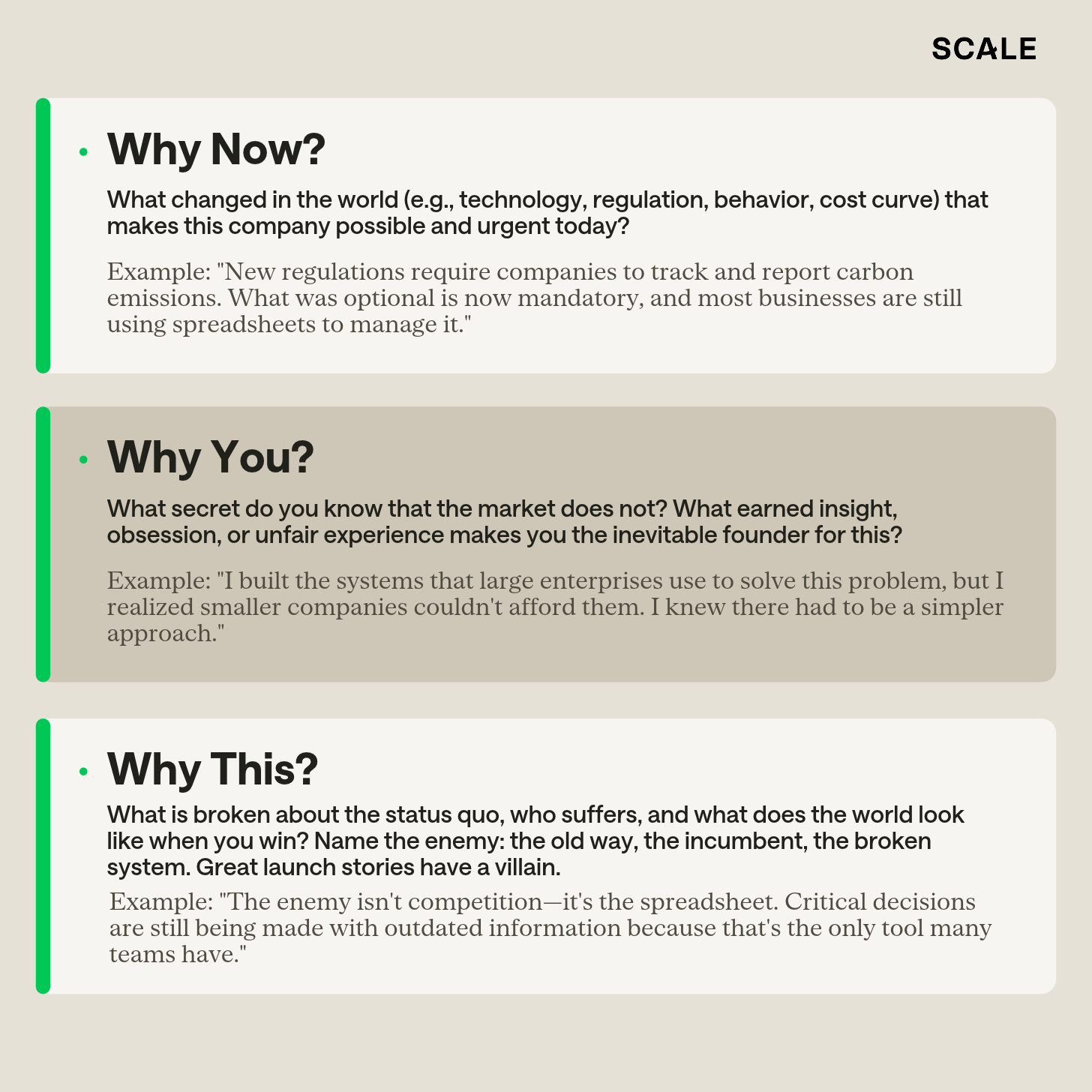
Think about explaining your answers to someone at a party who isn’t in your industry and has no idea what you do. In other words, be clear and more specific than you’d think is necessary.
Scale portfolio company Bland, an AI voice platform, hit all three of these questions square on the head when they launched out of stealth with a $16M Series A.
Why now?
Voice AI is finally advanced enough to hold complex, extended customer service conversations, beyond just answering Interactive Voice Response prompts
Why you?
Co-founder Sobhan Nejad was motivated by a personal experience; his aunt couldn’t get through to her insurance company on the phone and as a result was denied medical treatment.
Why this?
Everyone can relate to the frustration of waiting on hold for ages in elevator music purgatory, only to find that the person on the call can’t help you after all. For the enterprise, that pain manifests as paying employees to sit on the phone all day solving the same problems over and over. The enemy Bland is fighting against is the antiquated customer service phone system itself.
Once you’ve answered these questions, your next step is to filter through what communications strategist Lulu Cheng Meservey has coined the Three Circles of Authentic Positioning: Truth, Relevance, and Usefulness.
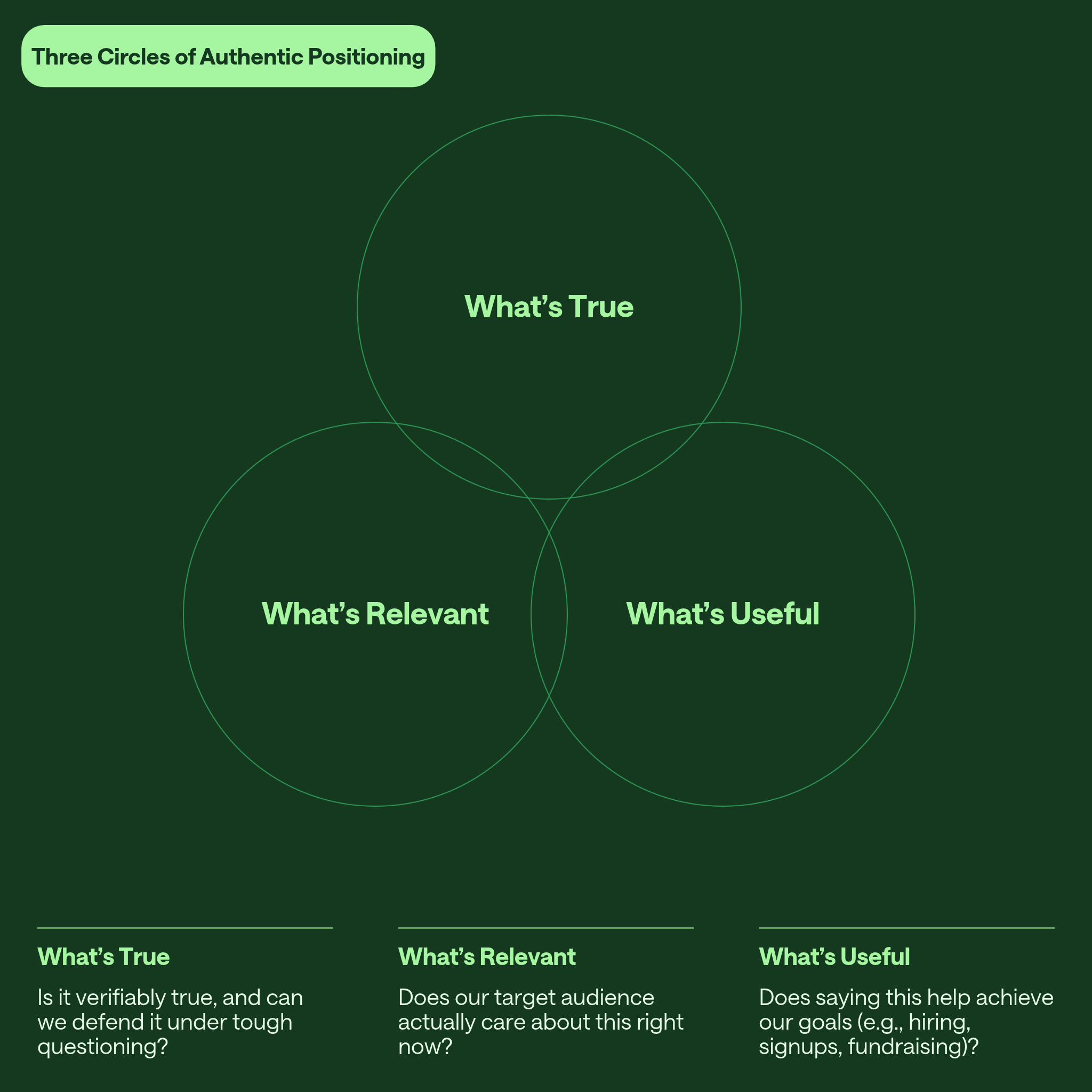
The ideal messaging falls right in the middle.
Build the messaging foundation
The next step is to create a reusable messaging kit:
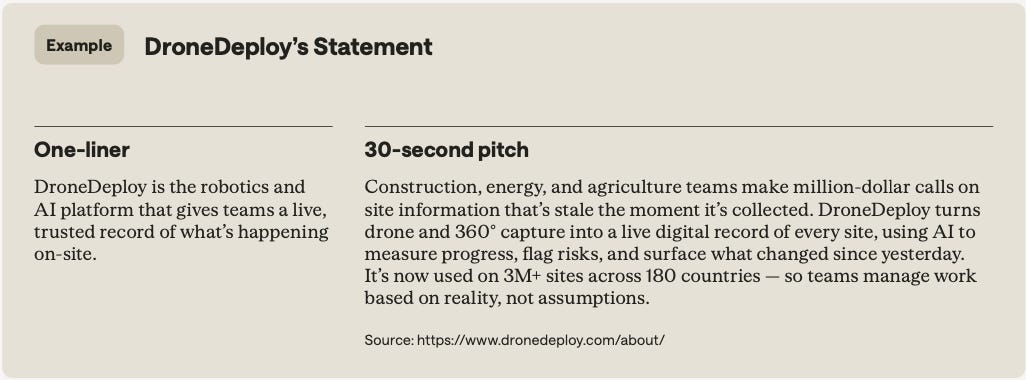
The one-liner (10 words or fewer), not to be confused with your tagline. It’s the plain-spoken answer to “what do you do?”
The 30-second pitch (3 sentences)
Three message points that hit what you want the market to believe about your company
Positioning statement (for internal use)
None of the above are meant to be polished copy for your website or press releases. At first pass, don’t overthink it; just get your ideas down. Then spend the majority of time refining it. The more clear you can make it, the better it will resonate. If you don’t have an emotional reaction by the end, you’re not there yet.
The point of honing the foundation is to get really good at telling your cohesive story so that it sticks and helps you stand out.
Taglines and marketing copy will come later.
Take Action
To put this framework into practice, complete these concrete steps:
Complete the Phase 1 Worksheet: Download the playbook to access the full worksheet. Answer the three core narrative questions: Why Now (what changed in the world), Why You (your secret/earned insight), and Why This (naming the enemy/broken status quo).
Build your core messaging kit: Draft your one-liner (10 words or fewer), 30-second pitch (3 sentences), and positioning statement. Define your three core message points and ensure each point is supported by at least two defensible proof points (customer metrics, quotes, product demos, or credentials).
Apply the Three-Circles Filter: Test every claim to ensure it is verifiably True, directly Relevant to your target audience, and Useful toward your launch goals. Cut any message that fails any of these three tests.
Get feedback: Pitch your one-liner to 10 individuals in your Ideal Customer Profile (ICP). If they cannot accurately repeat it back after hearing it once, rewrite it. Pay close attention to their initial questions to discover what is missing or unclear.
Kristina McMillan is an Executive-in-Residence at Scale Venture Partners, where she works with portfolio companies on integrating AI in GTM strategy and execution. She is a long-time GTM thought leader, early-stage founder advisor, and advocate for female founders. Her work can be found at Hopelessly Ambitious.
Sydney did a ton of research on the topic and did an amazing job aggregating best practices on the topic. What's incredible right now is the success startups are having with their launch bc of social. It's changed the game.