

The content contained in this post is based on an ongoing series around annual planning by M.G. Thibaut, CFO Exec-in-Residence at Scale Venture Partners.
Last year, my annual planning session at Scale Venture Partners focused on building the financial model. This year, AI is fundamentally changing how quickly we can get that work done.
But building the model was never the most important part of annual planning. The real value of Finance is in helping the business make better decisions about where to invest, what to prioritize, and what tradeoffs to make.
A model can tell you what happens if your assumptions hold. It can’t tell you which bets are worth making or what you’re willing to give up to fund them. That’s where Finance earns its seat at the table.
The opportunity with AI isn’t to make Finance less relevant. It’s to free us up to focus on the work that matters most: driving strategic decisions, aligning the executive team, and building a plan that can actually guide the business.
Below is the framework I walk CFOs through, from the first executive conversation to board approval and throughout the year.
Start with strategy, then build the model
If you think of your annual plan as a forecast, it’s time to reframe that.
Anyone who has talked annual planning with me has probably heard this at least once: 100% of plans are wrong. The pressure test for your annual plan should be how useful it is when reality diverges from your assumptions.
A good annual plan isn’t about predicting the future. It’s about giving the business a framework for making decisions as conditions change.
For this reason alone, instead of starting with a model, I like to begin with a simple (but very important) question for execs:
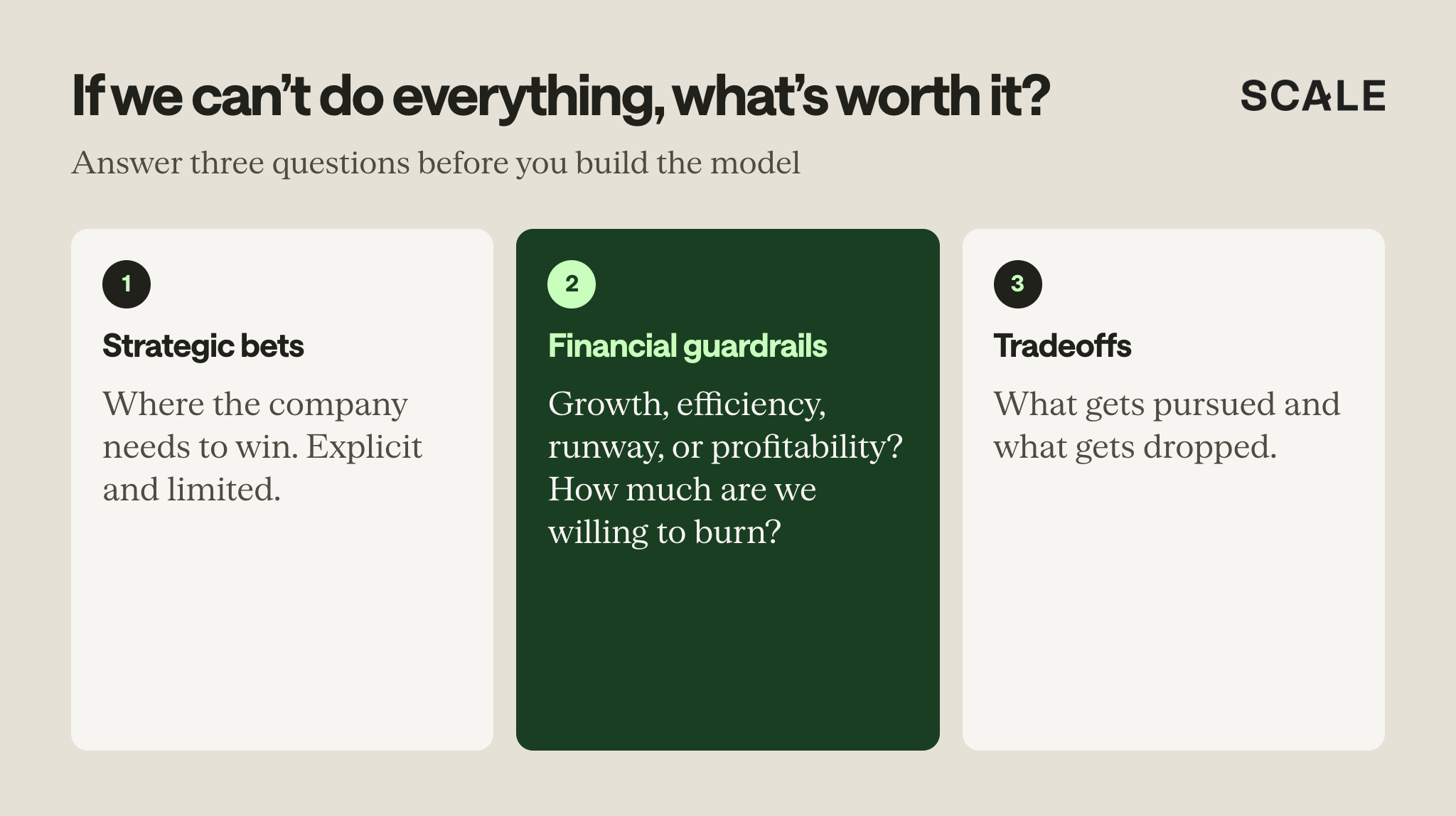
If we can’t do everything, what bets are worth making? The answers should come in three parts:
1. Strategic Bets: This is where you lay out the areas where the org needs to win. Maybe it’s launching a new product or building a new AI capability. Whatever those priorities are, they should be explicit and, importantly, limited.
2. Financial guardrails: What are we solving for: growth, efficiency, runway, or profitability? What does our financing timeline look like? And how much are we willing to burn to accomplish those strategic priorities?
3. Tradeoffs: Every functional leader can chime in with a compelling suggestion, but adding up everyone’s wishlist is not a strategy. This is where finance needs to jump in and build an explicit case for what needs to be pursued and what needs to be dropped.
Allocate capital with run, grow, bet
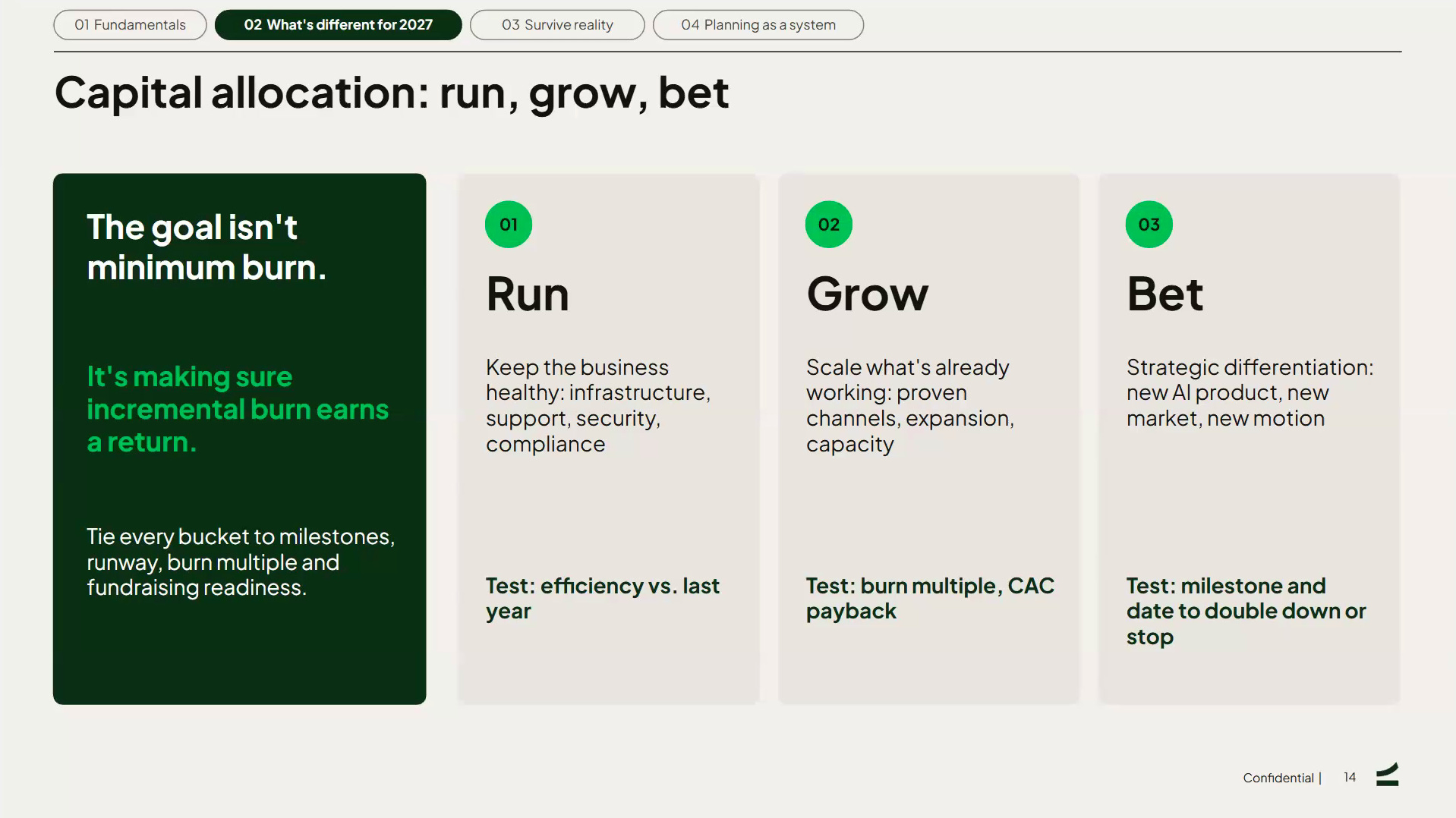
Next comes the inevitable burn conversation. Burn shouldn’t be the number that falls out after budgets are submitted. Set it deliberately, up front, and make sure every incremental dollar of burn earns a return.
To make that concrete, sort your spend into three buckets, each with its own test:
1. Run: Keep the business healthy, from infrastructure and support to security and compliance. Test: Are we more efficient than last year?
2. Grow: Scale what’s already working, such as proven channels and expansion. Test: burn multiple and CAC payback.
3. Bet: Fund strategic differentiation, like a new AI product or a new market. Test: Set a milestone and a date to decide whether to double down or stop.
Then check the total against your balance sheet. Every bucket should tie back to a milestone, and together they should leave you enough runway to be ready for your next raise.
Your annual plan isn’t finished until every material investment gets an owner and a measurable outcome with a deadline.
Rethink the assumptions AI is changing
Most annual plans start in the same place: last year’s financials and some assumptions about next year’s growth. The trouble is, several ratios we’ve leaned on for years are shifting.
Before you build anything, ask: What does an incremental engineer produce now? What about an incremental AE? What does it cost to serve a customer? And what happens to our margins as AI adoption grows?
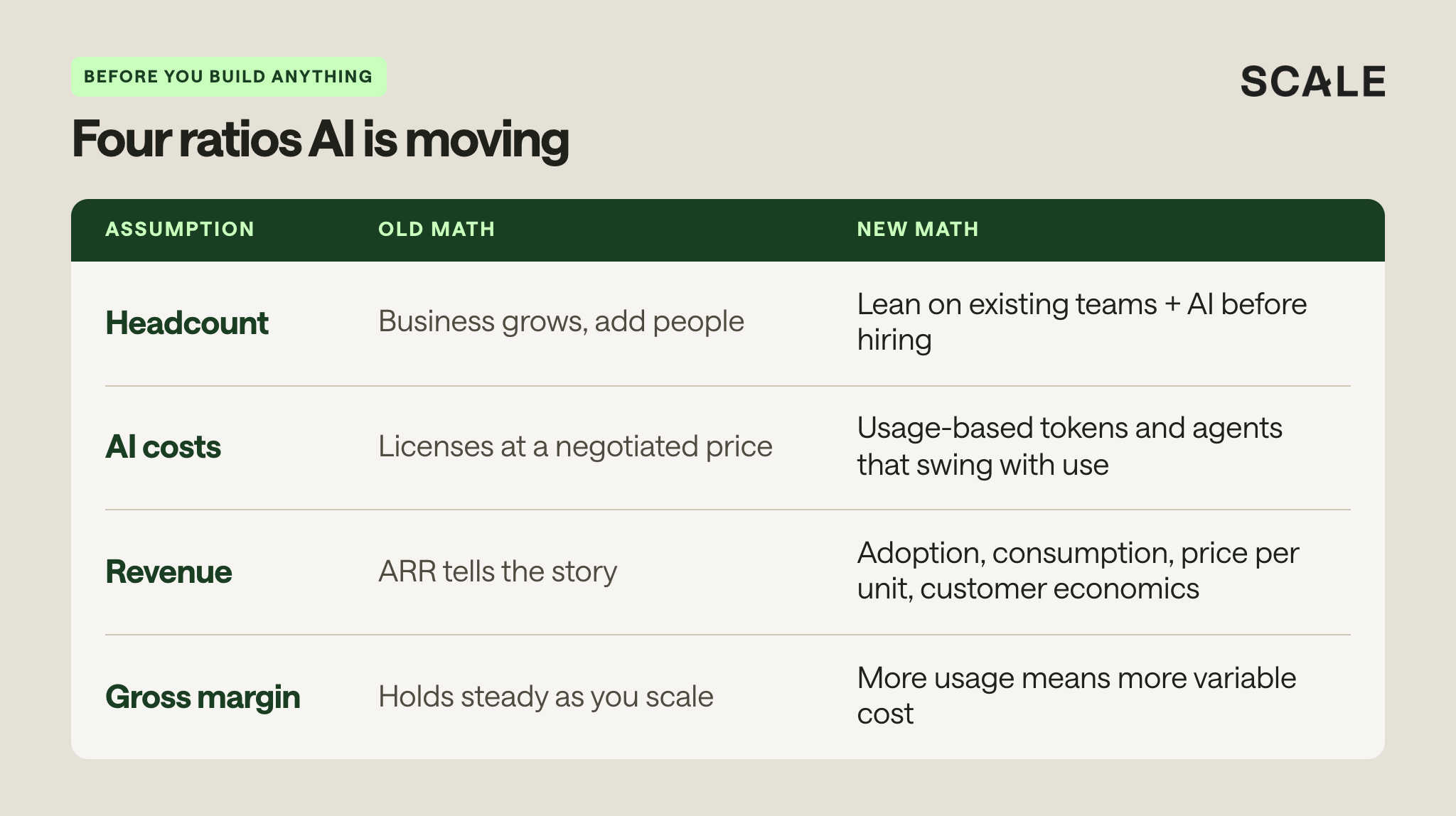
I’m not suggesting every assumption is wrong. But I see AI moving four of them pretty significantly:
1. Headcount and productivity: In the past, when a business grew, we expected to add people. Now we’re leaning on existing teams + AI before automatically hiring.
2. AI costs: Licenses at a negotiated price have given way to usage-based pricing for tokens and agents, so costs swing with how your people and customers use the product. More on this in the next section.
3. Revenue: If you’re moving away from seat-based pricing, ARR alone won’t tell the full story. Track adoption, consumption, price per unit, and customer-level economics. (Fynn Glover and Pete Giordano dig into this in Pricing to win in the AI era.)
4. Gross margin: For AI-heavy products, more usage means more variable cost. If AI COGS rises from 8% to 16% of revenue and your other COGS hold steady, gross margin drops 8 points. Figma’s GAAP gross margin fell from 89% to 84% year over year in Q2 2026, and on the earnings call, management explained that the company was absorbing inference costs for AI features still in beta, before those features generated consumption revenue. It’s a good illustration of why CFOs need to understand how AI costs, adoption, and pricing interact.
Budget AI by use case, and expect to re-forecast
AI spend is moving faster than the finance playbook. At a recent Scale roundtable, one finance leader described the day their Claude bill passed their AWS bill.
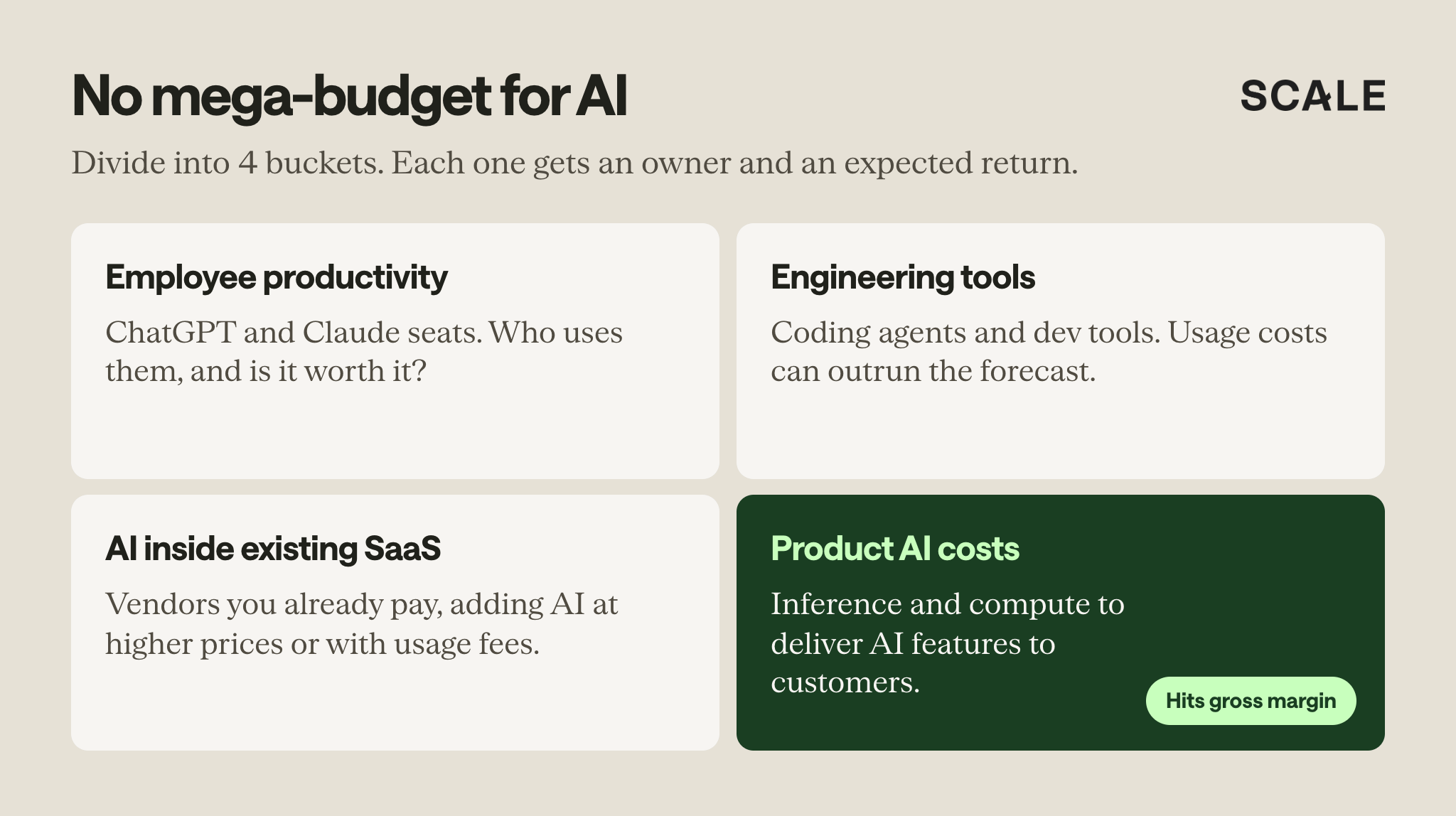
Avoid creating one giant AI budget. Break the spend down by use case, because each one behaves differently:
1. Employee productivity tools: Your ChatGPT and Claude seats. Check who uses them regularly.
2. Engineering tools: Coding agents and other dev tools, with usage-based costs that can outrun your forecast.
3. AI inside your existing SaaS contracts: Vendors you already pay are adding AI features, often at higher prices.
4. Product AI costs: Inference and compute behind your AI features. This bucket hits gross margin, so watch it closely.
Name an owner and an expected return for each bucket.
Then budget AI on a shorter cycle than the rest of the plan. Finance leaders at the roundtable said their forecasts drift after three or four months, even with careful models. Put guardrails in early, like per-person caps with an ROI conversation before anyone gets more. One company cut spend 15–20% month over month after telling employees they didn’t need “the Ferrari to go to the grocery store.”
Plan for capacity before you open a req
For most software companies, headcount is the biggest line on the P&L. Traditionally, we look at what a department needs to accomplish, then decide how many people to hire. Now we need to flip that. Before you open a new req, ask:
1. Can software or an AI agent do this work?
2. Can your current team do more of it with AI?
3. Does the work need to exist at all?
Once you’ve answered those, talk about where you need more capacity.
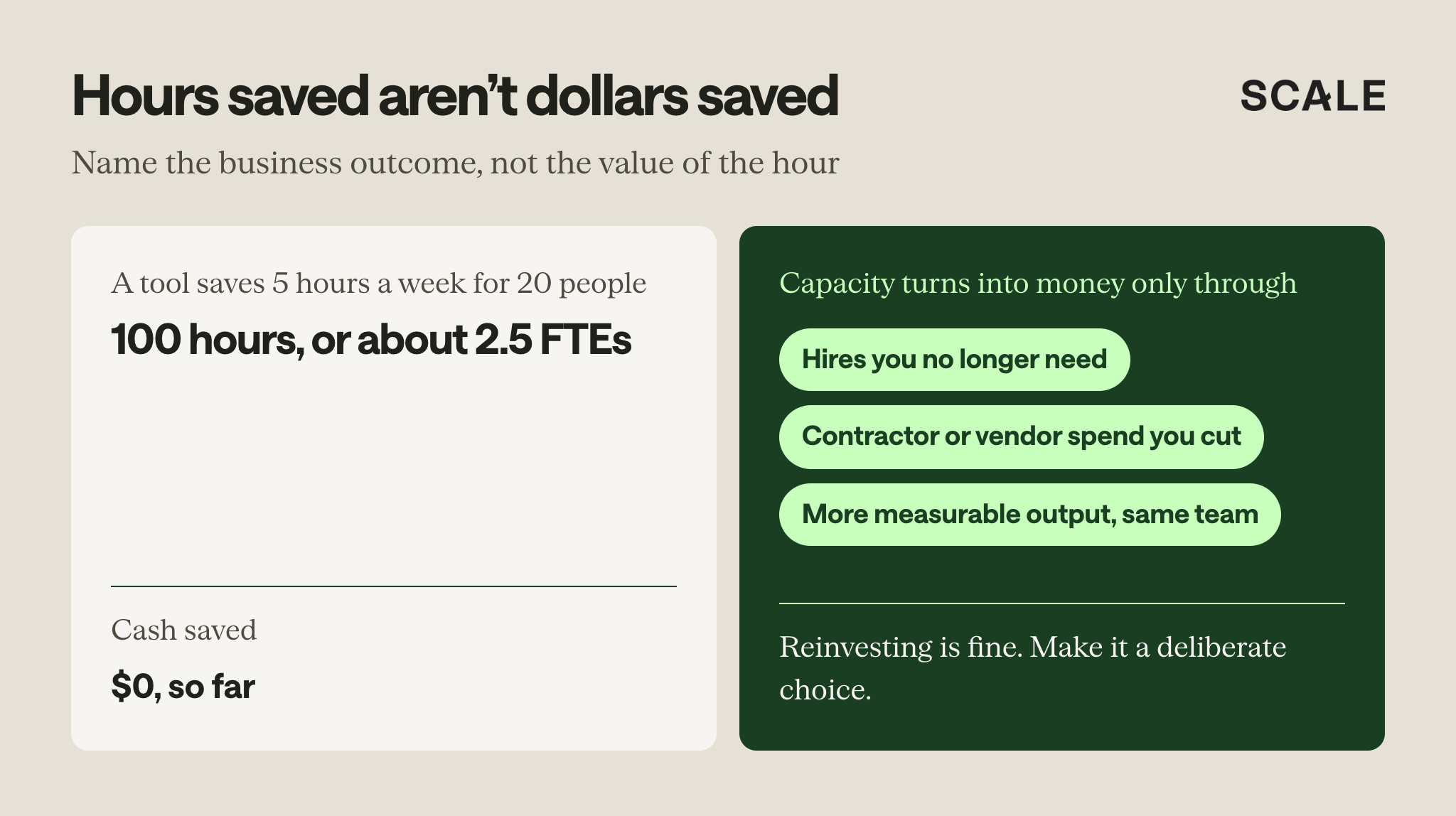
Be careful how you count the gains. Say a tool saves 5 hours a week for 20 employees: 100 hours, or about 2.5 FTEs. You haven’t saved any cash yet. Capacity only turns into money in three ways: hires you no longer need, contractor or vendor spend you cut, or more measurable output from the same team. Name the business outcome instead of putting a dollar value on the hour saved.
One finance leader at our roundtable saw this play out. As AI coding use ramped, the team realized it needed about a third of the engineers in its start-of-year hiring plan to ship the same output.
If you tell your board AI will make the company more productive, show where it appears in the headcount plan. Reinvesting the capacity instead of hiring less is fine. Make it a deliberate choice.
Build scenarios that trigger decisions
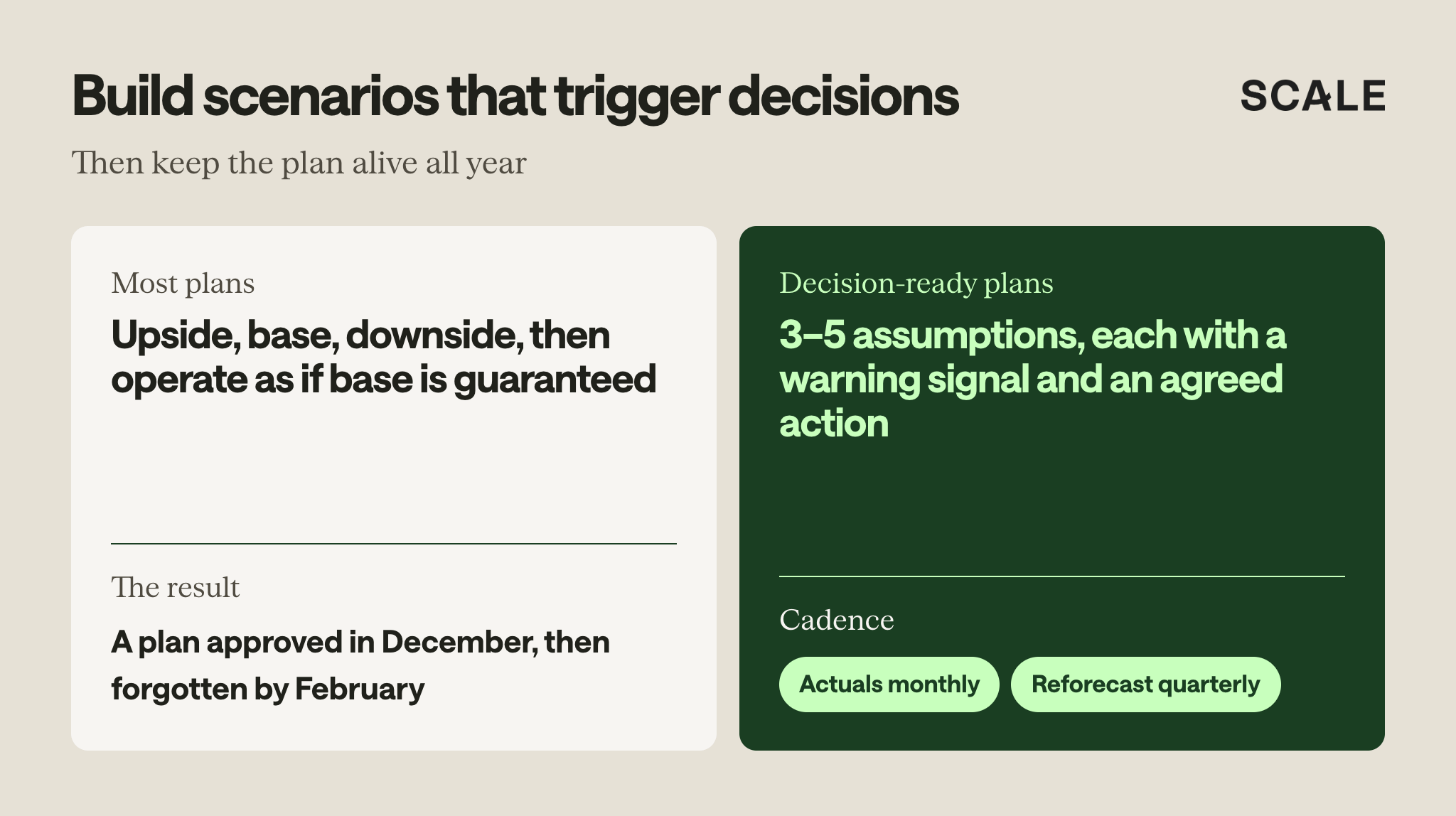
Most companies build three versions of the model: upside, base, and downside. Then they operate as if the base case is guaranteed.
Instead, pick the three to five assumptions that could materially change your business. For each one, define the early warning signal and agree in advance on what you’ll do if it shows up.
Say your plan assumes AI makes your AEs more productive. If you don’t see it after Q1, slow hiring or shift go-to-market spend before the revenue miss becomes obvious. Or say a new AI product is growing faster than expected, but inference costs are growing even faster. Decide now when you’ll revisit pricing or set usage limits. Scenarios without actions are just alternate spreadsheets.
Frame it, challenge it, align it
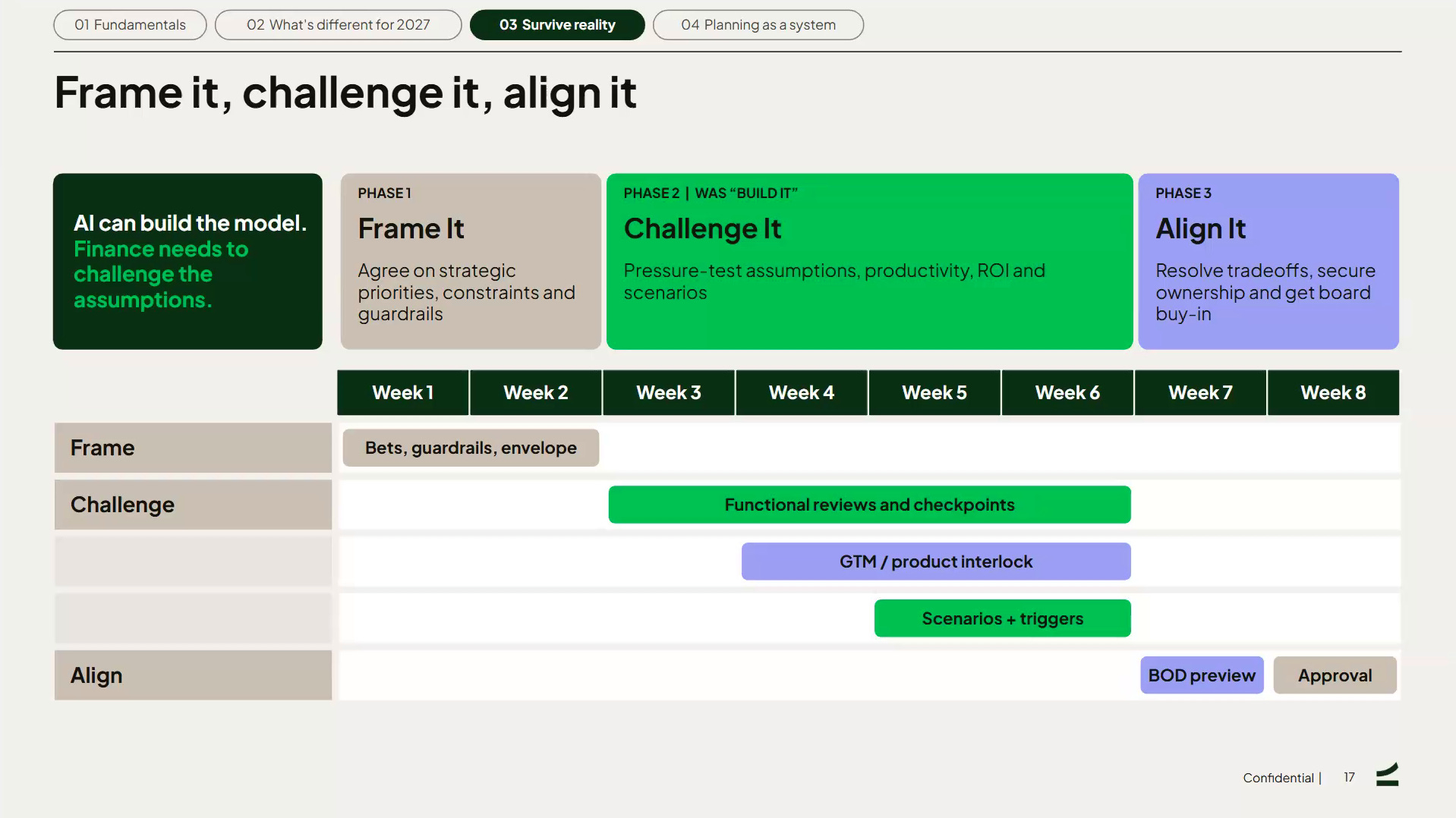
AI can dramatically accelerate model building, so I’ve renamed the middle phase of my planning process from “build it” to “challenge it.” Finance’s time now goes into pressure-testing the assumptions behind the model.
For most growth-stage companies, I’d organize the process into three phases over roughly eight weeks:
1. Frame it (weeks 1–2): Get the exec team aligned on strategic bets and guardrails, and set the overall spending envelope.
2. Challenge it (weeks 3–6): Run functional reviews to pressure-test each team’s assumptions on productivity and ROI. Midway through, bring GTM and product together so their plans connect. Finish by building scenarios and triggers.
3. Align it (weeks 7–8): Resolve the remaining tradeoffs and confirm who owns each investment. Then preview the plan with your board before final approval.
Because AI handles the first draft, most of those eight weeks go to the conversations that shape the plan.
When the plan goes to the board, show the decisions behind the numbers. Lay out what you’re investing in and the outcomes you expect, flag the biggest risks and tradeoffs, and be clear about what you need the board to decide. Keep the financial section to five slides, move the detail to the appendix, and preview the plan with key board members before the meeting.
Run your plan as a management system
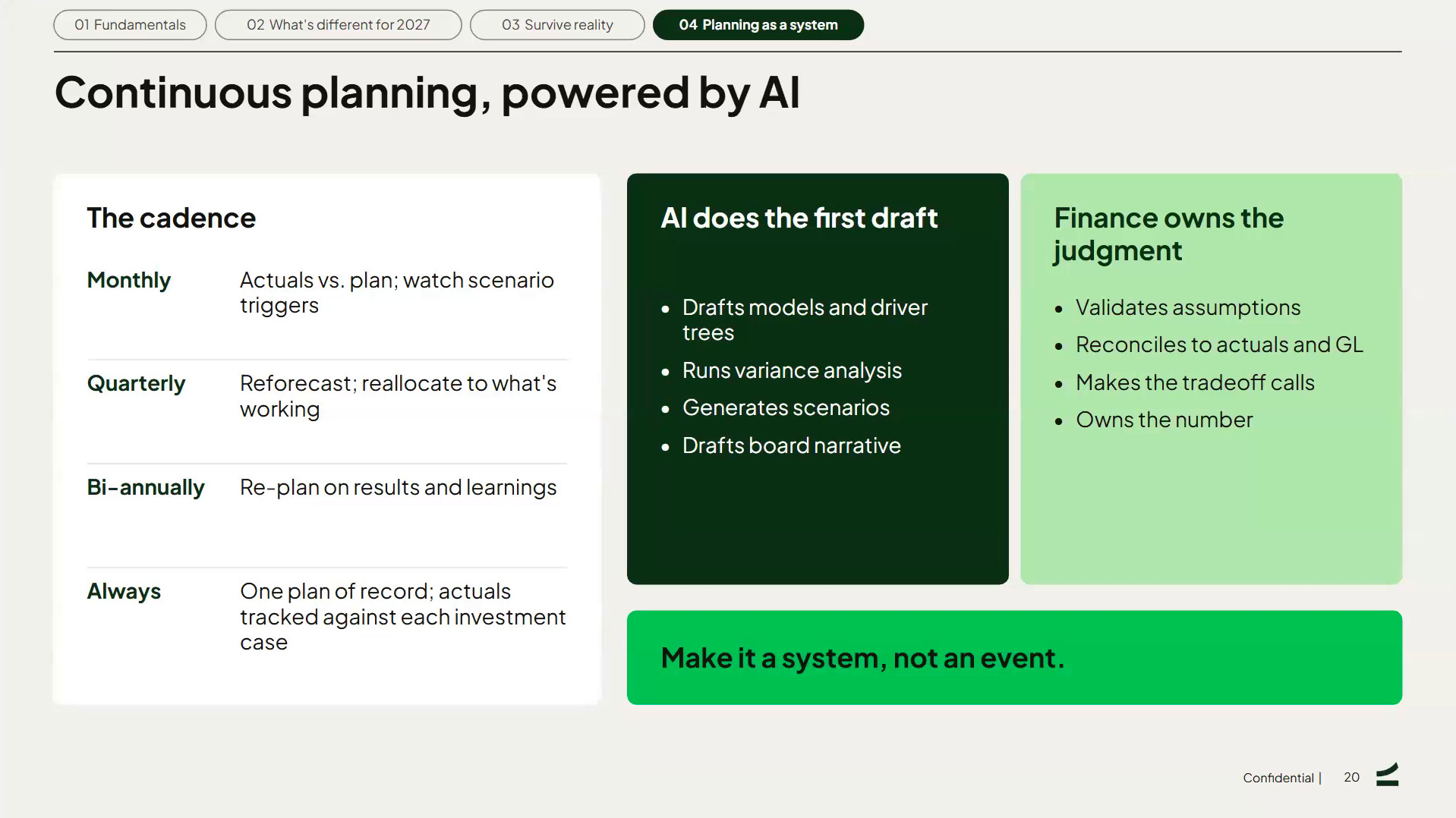
Most annual plans get approved in December and sit untouched until the next cycle. Run yours as a management system that drives decisions all year, on a set cadence:
1. Monthly: Compare actuals against the plan and watch your scenario triggers.
2. Quarterly: Reforecast, and move money toward what’s working.
3. Twice a year: Re-plan based on results and what you’ve learned.
Keep one plan of record through all of it, and track actuals against each investment case.
AI makes this cadence realistic even for early-stage finance teams. Let it handle the first draft each cycle, from driver trees to the board narrative. It can also run your variance analysis and generate new scenarios when a trigger fires.
Finance still owns the judgment. Your team checks what AI produces against actuals and the GL, then makes the tradeoff calls and owns the number.
Five questions to ask before your plan goes to the board
Before you sign off on the plan, ask:
1. Does our plan reflect how AI will change our business, beyond adding an AI budget line?
2. Are we planning headcount on the capacity we need, or on the old ratio of growth to hiring?
3. Can we state the expected return on our biggest investments and who’s accountable for it?
4. Which three or so assumptions are most likely to break the plan, and what will we do if they don’t hold?
5. Will this plan guide decisions all year, or will we approve it in December and forget it until the next cycle?
Every annual plan will be wrong somewhere. The goal isn’t to predict the future perfectly. It’s to make better decisions about where to invest, recognize when your assumptions aren’t holding, and adjust before it’s too late.
AI gives Finance an opportunity to spend less time building spreadsheets and more time leading those decisions. That’s where the real value of planning has always been.
Watch the full council here:
Kristina McMillan is an Executive-in-Residence at Scale Venture Partners, where she works with portfolio companies on integrating AI in GTM strategy and execution. She is a long-time GTM thought leader, early-stage founder advisor, and advocate for female founders. Her work can be found at Hopelessly Ambitious.