

Glean went from $100M in ARR in January 2025 to $300M by May 2026. Plenty of things have to go right to triple revenue that fast, and one of the most important is quality pipeline and lots of it.
If you understand your target ICP, outbound has traditionally been one of the fastest and best approaches to generating pipeline. There is one problem in today’s environment – according to the rest of the market, “outbound is dead.” Then we heard what was happening at Glean. They’ve combined traditional SDR best practices like enablement with AI-first ethos, and they do it better than anyone. The result: pipeline and lots of it.
We brought two of the people behind that motion to Scale Venture Partners’ Sales Development Council. Joey Lopez (former SDR leader, Glean) and Colette Cornish (SDR team lead, Glean) walked us through how Glean’s sales development team operates, from their innovative daily training process and knowledge-sharing approach to how they use AI to make their reps better.
1. Pipeline generation kickoff
Every Tuesday morning, the whole sales floor at Glean gathers in one room for a ritual called Pipeline Generation Kickoff. The goal is to get everyone on the same page and ready to hit the phones with “one sound, one effort,” as Joey put it. AEs and SDRs pair up with someone from the other team they haven’t worked with before and get into two things: which accounts they’re targeting and what’s working for them, and where they’re getting stuck.
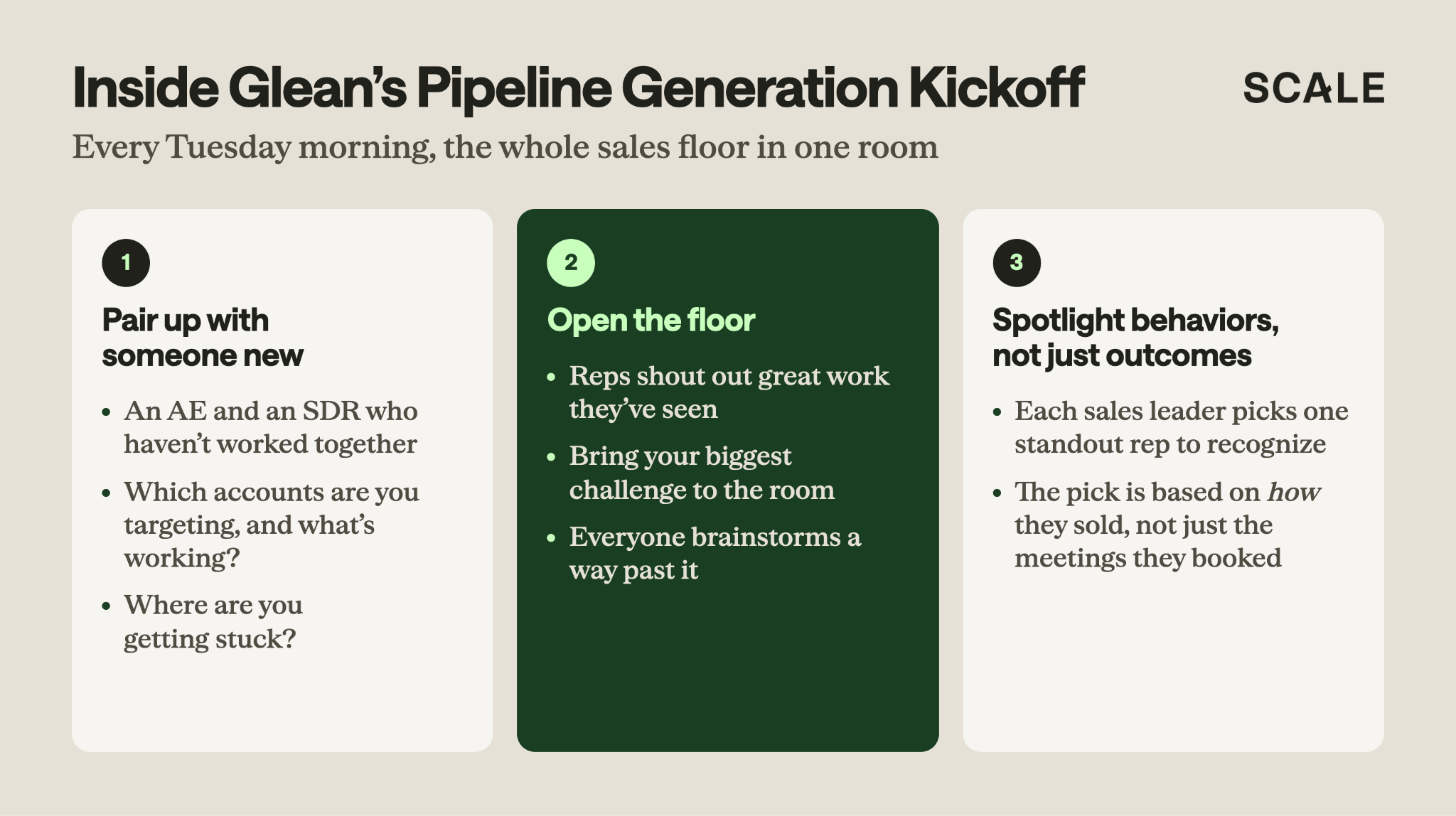
After about five minutes, reps shout out great work they’ve seen and bring their biggest challenge to the open floor, and the whole room brainstorms ways past it. To close, every sales leader presents a slide on the rep who best showed the behaviors the team trains for. Why behaviors and not just outcomes? As Joey said, “sometimes bad sales motions can actually land a meeting. But not always land them in the way that we want.”
Every week, the youngest reps on the team get to learn from the most seasoned sellers, and Joey says it runs the other way too: some SDRs teach AEs the newer discovery techniques they’re being trained on. By the end of the year, every AE gets to know every SDR, and SDRs and AEs build a level of collaboration that, in Joey’s words, “otherwise doesn’t exist.”
2. The SDR newspaper
Glean pulls its first-party intent data into a “Last Interesting Moment report”: website visits, downloads, past conversations with the account, and people at Glean who know someone there. With the AI space moving this fast, Colette says first-party data is the most valuable data Glean has for generating pipeline. But a new rep won’t know where to look in a data source this big. So the report is the foundation for Glean’s research agents, which turn it into what they call an “SDR newspaper,” shrinking three to four hours of digging to three to four minutes. Reps (especially new ones) get a clear list of who to go after and why, without scrolling through endless data. The payoff: SDRs are productive within the first 30 minutes of the day, while the reps they compete with often aren’t ready to go until about lunch.
3. Cold calls don’t need to start cold
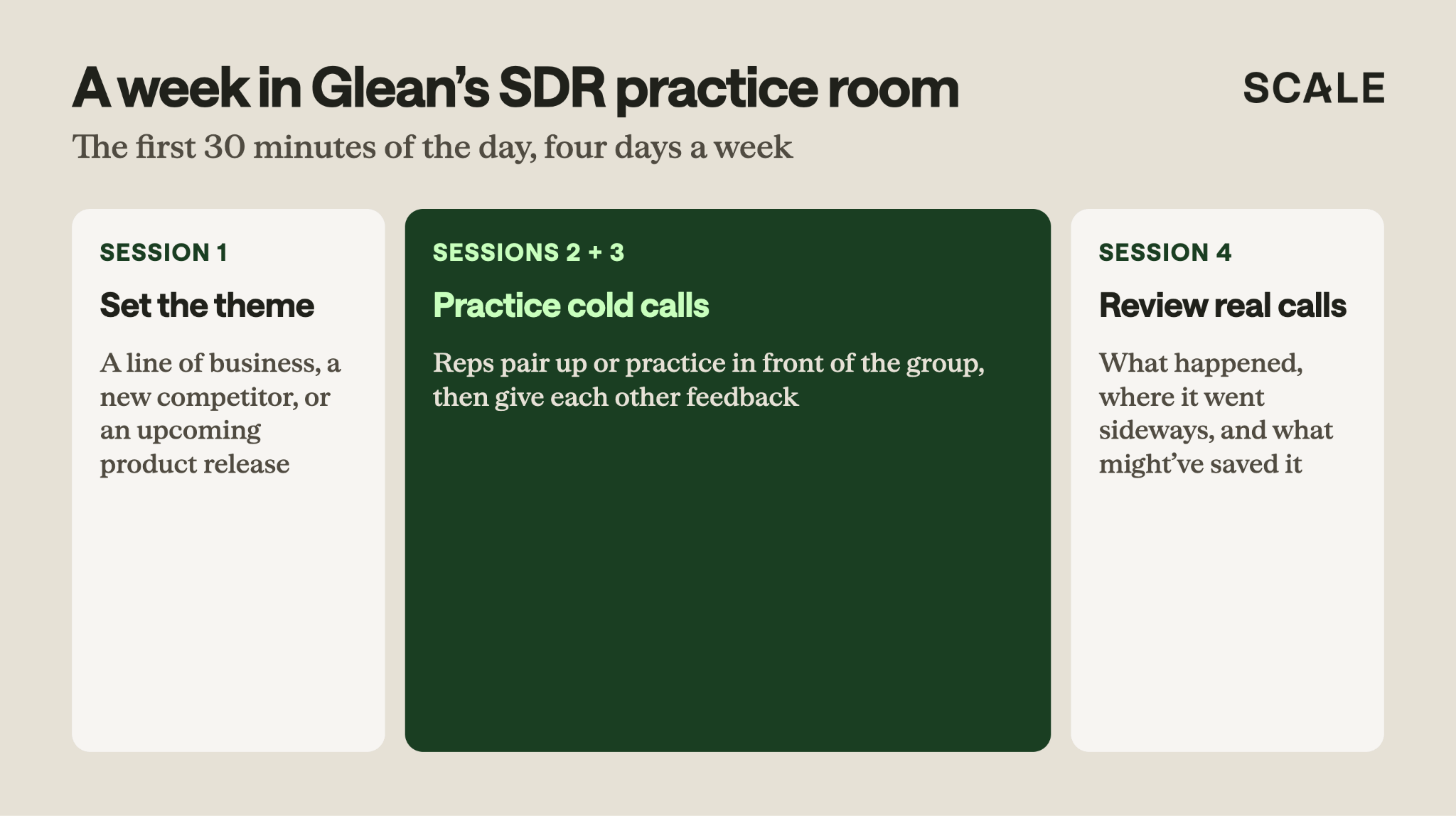
At Glean, SDRs don’t have to learn cold-calling lessons the hard way, one awkward prospect conversation at a time. Four days a week, they spend the first 30 minutes of the day in a mandatory practice room. The first session sets the theme for the week, whether it’s a specific line of business like supply chain or engineering, a new competitor, or an upcoming product release. The next two are dedicated to practicing cold calls, with reps pairing up or practicing in front of the group and giving each other feedback. The final session brings in actual call recordings for the team to review what happened, where things went sideways, and what might’ve saved the conversation. It’s better to make mistakes before the prospect is on the line. As Colette put it, reps get them out of the way without “losing one of the only pickups you get that day.”
Glean also uses AI practice bots from Hyperbound. Each bot plays a prospect with a set line of business, company size, and pain point, and scores the call against Glean’s metrics. Colette still wants live practice in the mix, because reps are quick to pick up the patterns the bots favor.
The practice room also surfaced Glean’s next team lead. Joey picked Colette because in those sessions she was the one going around helping other reps, the kind of coaching an SDR needs before moving up to AE.
4. Hack the busywork
As Colette put it, Joey has been “really great at getting our team to be constantly learning.” One way he did it was an SDR hackathon to get reps building AI agents around the tasks eating up their time. SDRs map out the processes they handle throughout the week, identify where AI could help, and build agents to take on those tasks. Sometimes it starts with writing down what you did one day and asking which parts AI could handle.
Glean’s reps have built agents for account research, AE call prep, and turning Gong recordings into updated Salesforce opportunities. Some of them were inspired by the hackathon. One SDR built an agent that turns their account context into a presentation for an AE, so returning from vacation doesn’t mean scrambling to pull everything together.
The bigger payoff was ownership. Even the most junior reps got to scrutinize the process and propose fixes. They were empowered with a mechanism to create a solution for it. When people get to improve the systems they use, they buy in, and as Joey said, they “actually follow it.”
5. Do not disturb: dialing
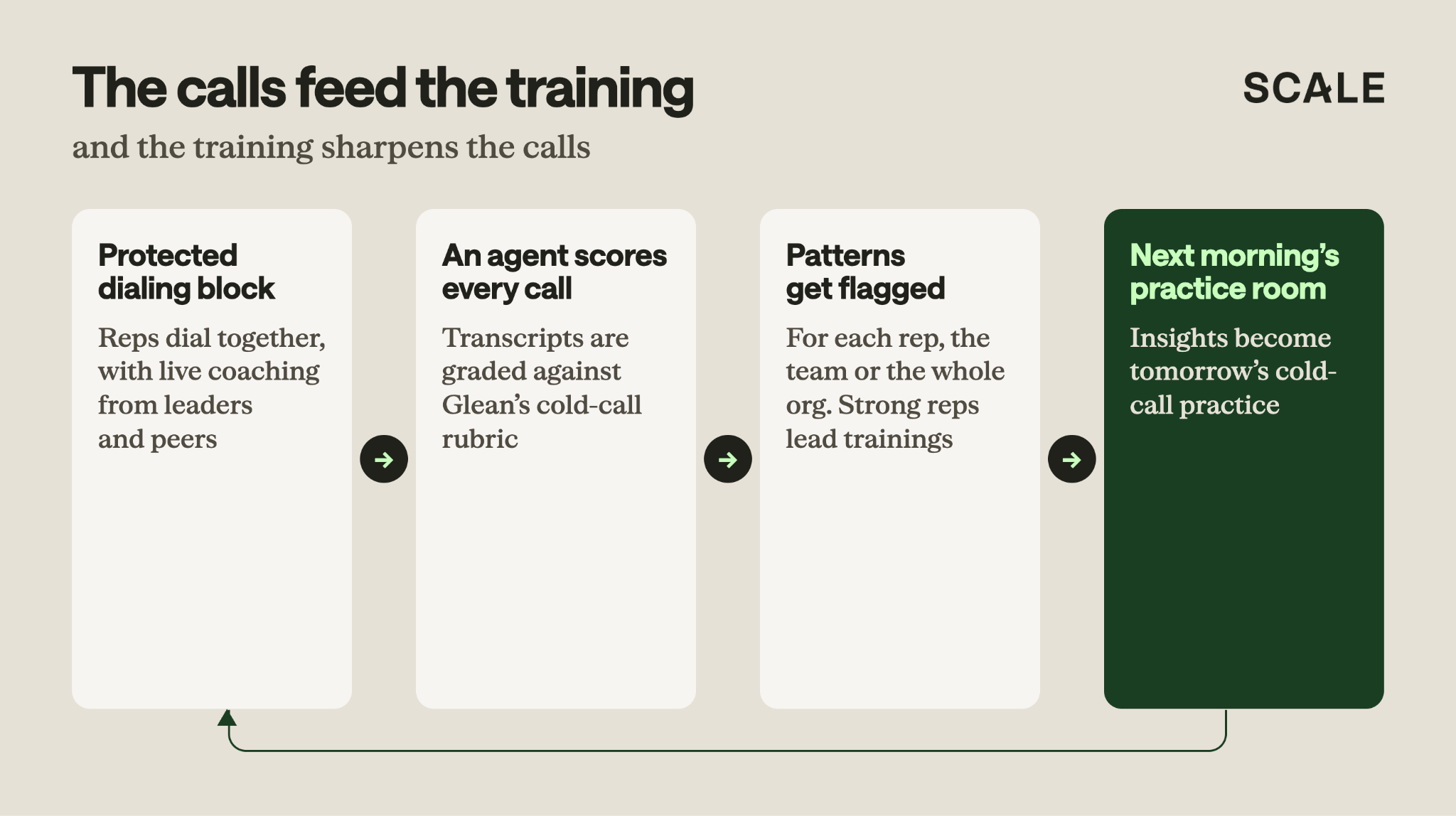
At Glean, the dialing block is sacred. SDRs have dedicated time on their calendars to call prospects, and the rest of the to-do list can wait. Internal meetings, lunch, even other types of prospecting: none of it gets to muscle in on call time. When possible, reps dial together in the same room, where leaders and peers can jump in with live coaching. Newer reps might get a target like 100 dials before the block ends.
The calls also feed back into training. An agent scores call transcripts against Glean’s cold-call rubric and flags patterns for individual reps, the team, or the whole org. Reps with strong habits get tapped to lead trainings or to dial next to newer reps in the call block. Those insights then make their way into the next morning’s practice room. The calls feed the training, the training sharpens the calls, and the loop continues.
In practice
Every SDR outreach at Glean starts from a value hypothesis. In Colette’s words, it’s “our best guess on how we can support your business.” Agents build it from first-party data first and fall back to third-party data when nothing has changed, and it sits in a Salesforce field that keeps updating as conversations happen.
Live calls feed it too. Joey’s example: if Colette has a call with someone at Scale, the recording goes to the agent, so whoever calls the next person at Scale already knows what came up. When a rep can tell a VP what their colleagues have already said, the VP can tell it isn’t made up.
Colette said the goal is “either for them to correct us” or “for them to agree with us.” Either way, the SDR learns what the buyer cares about.
Takeaways: the conversations Joey wants you to have
Kick off your own version of the daily practice:
Work with your SDR leaders, your sales leaders, and your enablement, and tell them you want to invest in your people with your own version of daily practice. In a time when AI is taking jobs away from people, you want to invest in having the best people working at your company. Enhance your team, course-correct the areas that are holding you back in a real-time, ongoing way.
Find a GTM engineer who can be your sales buddy:
Find your savviest go-to-market engineer and schedule weekly or biweekly syncs with them. Discuss the biggest opportunities for agents you can build to push your business forward. AI is not going to replace all humans. The people who use AI masterfully, in every form of their work, will replace people who don’t.
Run your own weekly pipeline kickoff:
The most important part of the pipeline kickoff is that it gets the entire company together focused on a common goal: generate pipeline by delighting prospects. You can find the format that works for your teams, as long as it feels like everyone is pulling together in the same direction of growth.
For founders building a first SDR team, you can do this without a big budget. Start with a 30-minute practice block and a protected call block, and give your reps a way to enhance the way they work.
Watch the complete session here:
The detail that stuck with me: the practice room is also how Joey found his next team lead. Colette stood out because she was the one helping other reps in those sessions. The training loop doubles as a way to spot who can coach, which is not what most teams are watching for.