

Personalization + relevance are the “holy grail” of outbound messaging. But forced to choose, John Barrows picks relevance every time.
John Barrows, founder and CEO of JB Sales, joined Scale Venture Partners’ pipeline council session to talk about what’s working in outbound messaging.
He would know. John trained every rep at Salesforce from 2010 to 2018, and he still does his own prospecting. In 2023, when Silicon Valley Bank collapsed, JB Sales went from $6 million in revenue to zero in about two months. He prospected his way back with about 70 meetings booked in a single quarter. So when he talks about outbound, I listen.
If your sales messaging isn’t landing, here’s how he’d fix it.
1. Use AI to be more rigorous
For most sales teams, AI has only been a chaos multiplier. Copy the first answer, slap a logo on it, and hit send. What lands in prospects’ inboxes is BLATANT AI slop. Our inboxes are overflowing with it. But for curious, high-performance teams, AI is a force multiplier. With the time saved, they go three rabbit holes deeper and collect better signals. If you use AI as a free ticket to be lazy, you are never going to realize the gain of AI.
2. Reevaluate your ICP before you feel the need to
And this time, tighten it beyond the point it feels comfortable. Put a name to it. Industries are moving at lightning speed. Last quarter’s priorities are history now. Even CIOs in healthcare and manufacturing don’t have much in common beyond their title. Generic personas like “Sarah’s in marketing, she likes to be creative” have lost steam. Get specific, down to what their day looks like.
3. Set up the triggers
Grab your top 10 customers getting the most value out of your solution. Dissect their accounts. What’s common? Go to LinkedIn Sales Navigator and use the “Past Company” filter. Plug in those accounts. Now, if someone leaves one of those companies for another company that fits your profile, you get an alert and a much warmer lead. They may already know your product and understand its value.
4. Familiarity beats the odds
Best believe not every trigger event is a signal. Look at the point above. Besides the trigger event, the other qualifier was “know your product.” “Cold anything right now is brutal,” as John put it. If there’s no familiarity, there’s no leverage. So construct familiarity. Build a personal brand. Show up in front of them. Give them a chance to interact with you first. Then shoot your shot.
5. Get the process down cold
Here it is in plain terms: Nail down your ICP personas + industry, let’s say VPs of Sales in SaaS → research their top priorities → identify the trigger events relevant to your solution → decide which component of your product aligns with that trigger or priority. There you have all the ingredients for your message.
In practice
He dissected this email and explained why it worked on him:
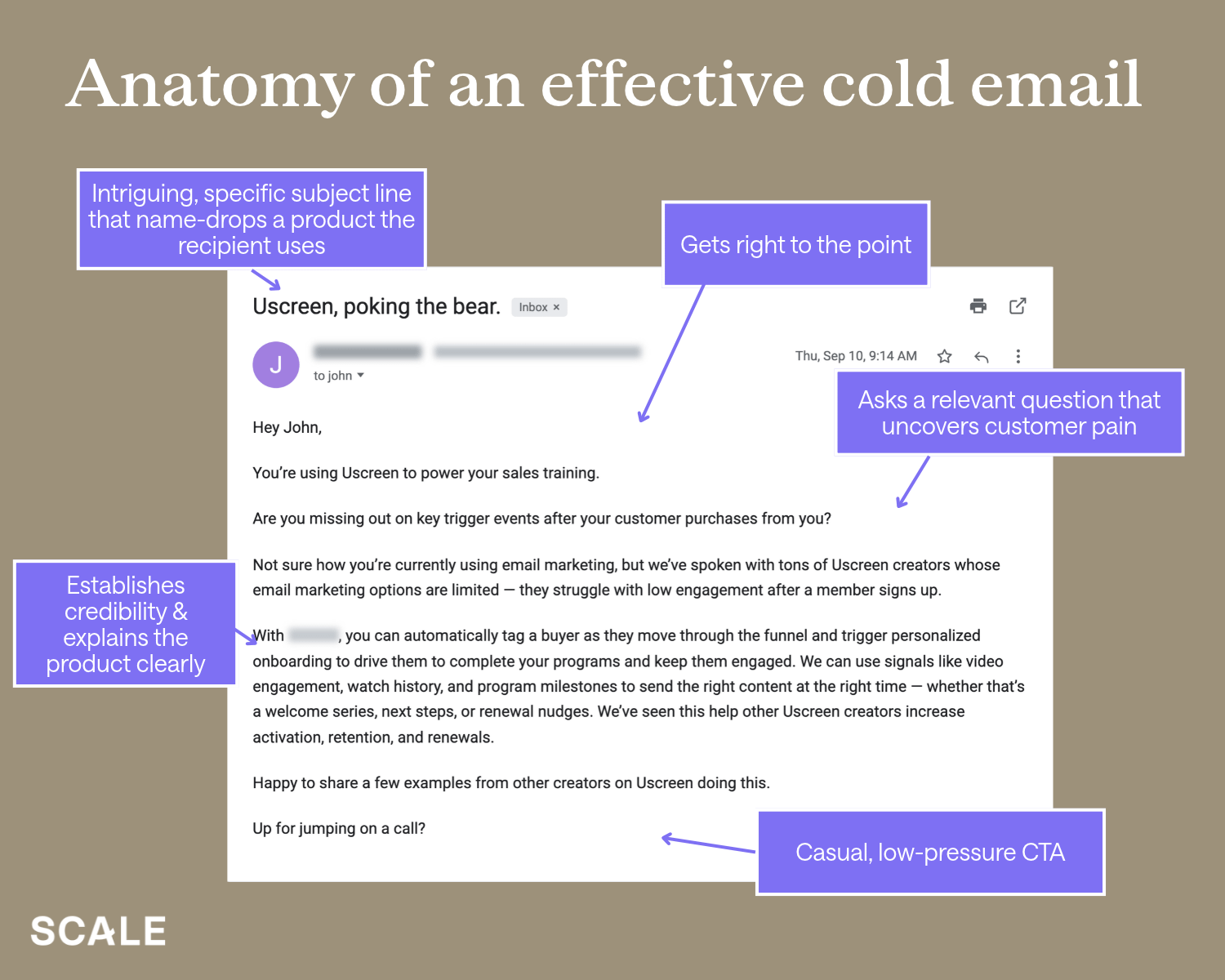
1. Relevance starts in the subject line. “Uscreen, poking the bear.” Uscreen is the platform that hosts his on-demand sales training. It’s clear the rep has done their homework.
2. The sender opens with a statement, then goes straight at a pain John recognizes: “Are you missing out on key trigger events after your customer purchases from you?” For a membership business like his, engagement and renewals are a vital piece of the cycle.
3. Credibility comes next: he mentions the other Uscreen creators they’d spoken with. A plain value prop and a casual CTA closed it out, and the whole pursuit was 2 emails and a call. John says the data now points to 5 or 6 touches as the sweet spot. Reach out 17 or 18 times and he is calling the police on you.
What makes this work is what John calls the “give-a-shit factor”: a rep who put in the work to understand the prospect’s business, poking until something strikes a nerve. No fake personalization anywhere in it. Data shows the higher you go up the org chart, the less personalization matters and the more relevance does.
Takeaways
John closed the session with his own short list:
“AI amplifies your inputs, so make sure the inputs are good.”
“Personalization is not relevance. Relevance is more important.” The higher you go on the org chart, he said, the less personalization matters: “up here, it’s about the business.”
“The rep who understands the why behind the output is the one who’s gonna win.”
For founders doing their own selling, this is good news. You don’t need a big team or a clever tool. You just need to know your buyer better than anyone else in their inbox that week.
The full session, including John’s SVB story, is here: