

Buyers are increasingly turning to LLMs to research solutions, scrambling the SEO best practices marketers have rested on for decades. In G2’s March 2026 survey of 1,076 software buyers, 51% said they start research with an AI chatbot more often than with Google, up from 29% a year earlier. Figuring out how to show up in LLM results has become one of the hottest GTM topics for early-stage founders and GTM leaders.
Part of what makes this hard is that the ground keeps shifting. Models are updated every few months, and each release changes how a model searches, what it searches for, and which sources it trusts. A tactic that gets you cited today may not apply in the next update, and nobody can tell you how long it will last.
See our AEO playbook, developed by Scale EIR Sydney Sloan.
Getting on the shortlist has always been the hardest part of selling to strangers. Before AI, a shortlist came from analyst reports, review sites, peers, and whichever vendor’s rep got there first. Forrester’s 2024 buyer research found that 92% of buyers start with at least one vendor in mind, and 41% have already picked a single favorite before formal evaluation begins.
If the shortlist is mostly set before a buyer talks to anyone, and AI is increasingly where it gets set, the question is how to make it on the shortlist. A new study by Obility answers that for Claude.
Obility ran over 10,000 B2B software-buying prompts through Claude’s API, logging every search it ran and every URL it reviewed.
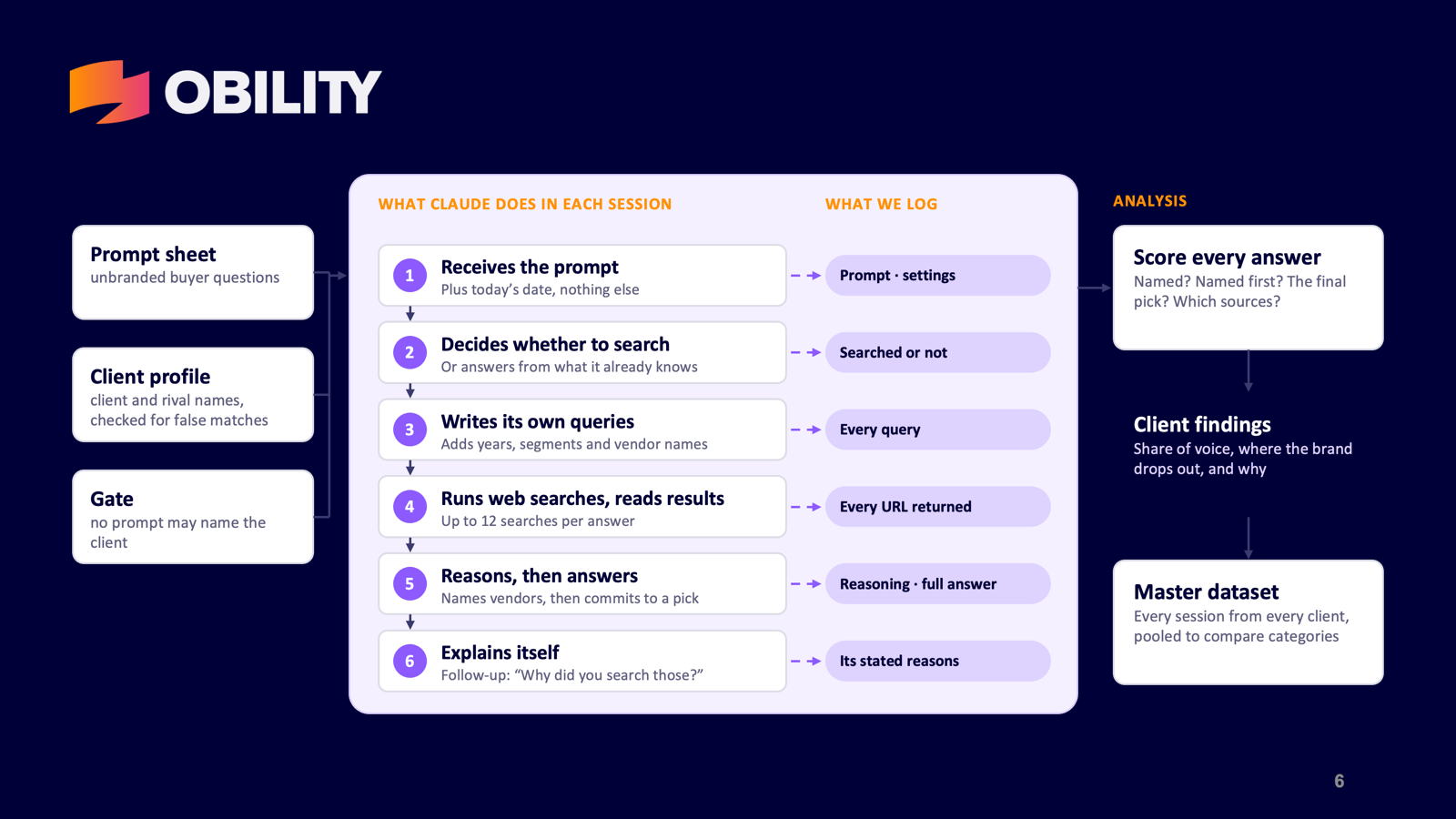
While many AEO platforms have data on when a vendor is mentioned or cited, Obility’s approach is unique because it follows the breadcrumbs from the prompt type, through the researching process, and all the way to the shortlist results. For example, they showed that when a specific brand is searched by name (e.g., Abacum), it appeared in 86% or more of its final answers. But when a general category was searched (e.g., AI-native FP&A solutions), without naming specific vendors, that same vendor came up less than 52% of the time.
If you’re an early-stage company trying to make the list, here’s what the data says to do.
1. Get listed on vendor category lists
The way a buyer phrases their search affects the results Claude returned. Obility’s research found that 22% of the buyer prompts were answered from training data. This was especially true when the buyer prompts were phrased with “How do I” or “Explain” prompts.
This was less true when buyer prompts pointed to a specific vendor category. Nearly half (47%) of Claude’s searches looked for “best” or “top” vendor lists, when the buyer prompt was something like “best GRC platforms enterprise 2026 compliance automation.” Only 10% of prompts were answered with training data when a single vendor was searched, suggesting that brand recognition and buzz are increasingly important.
Obility also showed that “best X” queries reliably return roundup articles naming a dozen vendors at once. When Claude was asked to explain its justification, it recognized that many of these roundup style articles were written by vendors who rank themselves first, but it used them anyway.
Most GTM teams have treated these listicles as SEO filler, but now the roundups set the candidate pool for everything Claude does next. If you’re not in the pool, Claude won’t include you in the subsequent research.
Review sites play the same role. G2 is a top citation source for B2B software across LLMs. Additionally, where you rank in search matters too. Anthropic hasn’t officially named its search provider, but a September 2026 analysis found that nearly nine in ten URLs Claude retrieved were highly correlated with results from Brave (a free, open-source web browser), suggesting that Brave’s search results shape which roundups Claude reads.
AEO in Action
Map the lists. Run “best [category] for [segment]” in Claude monthly and log every URL it opens. Monitor those lists.
Develop your own roundup content. Find the relevant roundup articles in your category and pitch their authors to include you. Or develop your own roundup articles, listing all of the relevant players in your space. Be sure to cover the key details LLMs look for: the segment you’re best for, your starting price, customer proof, and how to find more information.
Get indexed on Brave. Search yourdomain.com on Brave and submit any key pages that are missing.
Fill out your G2 profile. Complete your description and integrations, and request reviews after onboarding and at renewal. Check out Sydney Sloans council on best practices for G2.
2. Make relevant information easily discoverable on your website
Once Claude develops its shortlist of candidate vendors, it switches to researching those vendors one by one, checking pricing, industries served, and technical details.
The last fifteen years of B2B marketing best practices have taught GTM teams to gate the most useful information behind forms. This made sense for buyers—if they wanted pricing or a security overview, they had to talk to you first. This gave GTM teams an opportunity to make their case for value delivered.
This breaks down when AI is doing the initial research. Gated content cannot be accessed and cited by LLMs. If Claude can’t find the information freely available on your website, it either assumes it doesn’t exist or (worse) tries to estimate it based on third-party (potentially inaccurate) sources.
Further, Obility’s data showed that Claude has a recency bias in how it searches. In 43% of the searches done for the study, Claudde inserted the current year to narrow sources, with 91% of those searches including the current year, 2026. Older sources were used when prompting referenced them specifically.
AEO in Action
Un-gate your pricing. Publish your pricing structure and starting tier in plain text, and provide this information in your G2 listing.
Make integrations clear, in text, on the product page.
Publish a first-call FAQ. Answer the top ten questions your AEs hear most, in the buyer’s own words, on your product and pricing pages.
Test your results in LLMs. Ask Claude what you cost and what you integrate with, and fix any first-party source pages that aren’t clear.
3. Create a comparison page
Obility’s research found that Claude added “vs” or “alternatives” to its query process in 13% of its searches without the buyer asking, looking for points of difference to bring back to the buyer.
For an early-stage company, a comparison page that puts your name next to the other commonly known names in your space, helps build context and are among the most-cited content in LLM answers.
A caution to marketing teams, while comparison content on public “us vs. them” pages is referenced by LLMs, that content is compared alongside G2 reviews and Reddit threads. Biased content that isn’t supported by third-party user experiences loses credibility with LLMs.
AEO in Action
Create a comparison page. Title the page “[Leader] alternatives for [your segment],” with the current year in the title and H1, but not in the URL.
Be objective about where competitors rank. Include an honest pro/con table and a “Not a fit if...” section.
Update positioning quarterly, including whenever either product changes pricing or ships a major feature.
4. Use your buyer’s compliance language
Obility also found that specificity across buyer types is beneficial for showing up in LLM results. When a prompt mentions a buyer’s industry, Claude often added additional criteria around that industry’s standards and systems:
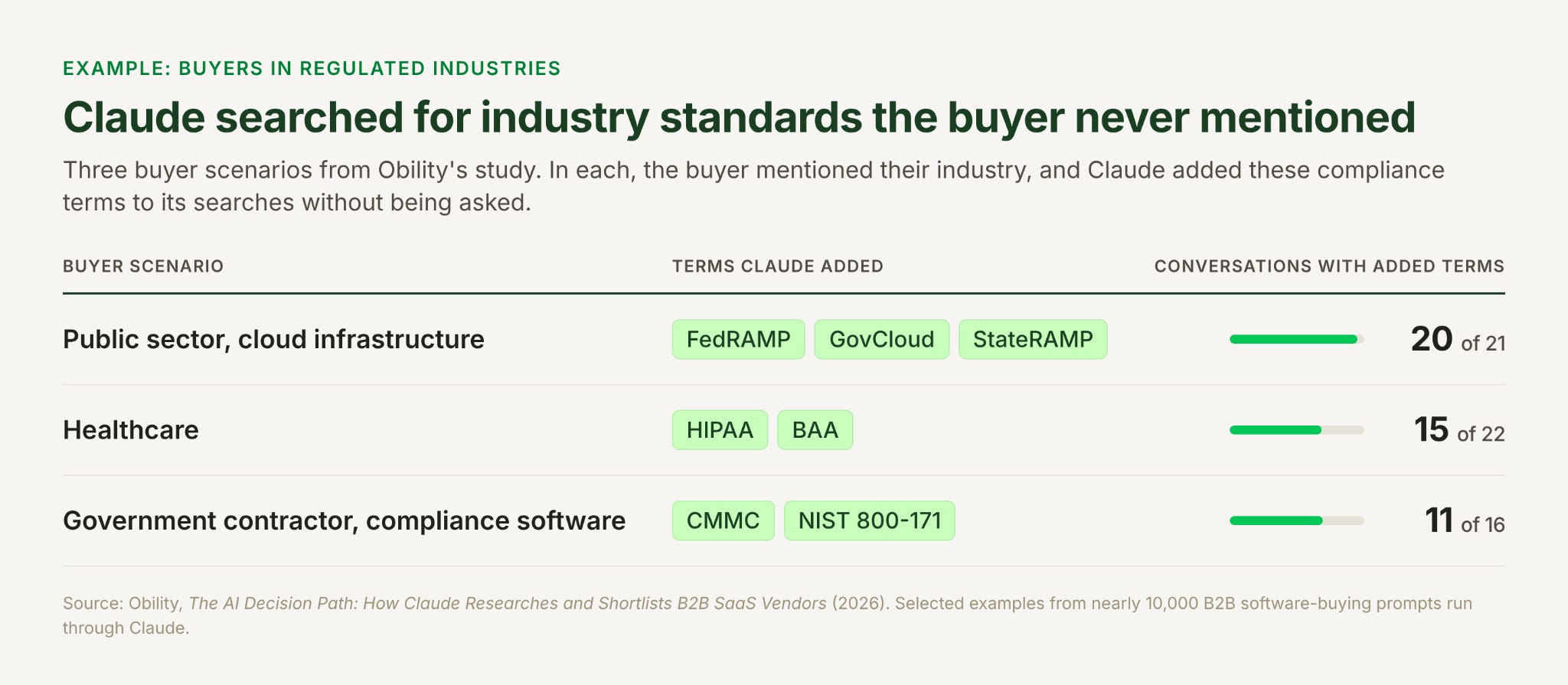
For an automotive supplier shopping for compliance software, Claude searched “TISAX compliance automation platform automotive suppliers.” The buyer’s requirement form the search query, and your page needs the same level of specificity.
This benefits marketers who create highly targeted content for the different buyer types and industries they serve. G2’s 2026 Buyer Behavior Report found IT security review is the biggest source of delay (39%) between choosing a vendor and completing the purchase. A page that answers compliance questions gives the LLM what it needs for that review.
AEO in Action
Create industry-specific content. Develop content that addresses the standards, certifications, and systems that come up in security reviews and RFPs. Swap “enterprise-grade security” for specifics like “HIPAA-compliant, and we sign BAAs,” and name the systems those buyers run.
Publish an ungated security page that answers standard questionnaire items in plain text, with certifications written out rather than shown as badges.
5. Get your name into the training data
Revisiting the data point from section one above, Obility found that Claude answered 22% of buyer prompts from its training data without searching. “How do I...” questions went unsearched 58% of the time, even when the buyer was clearly shopping. When Obility asked where those answers came from, Claude most often pointed to third-party analysts.
This is the hardest gap for an early-stage company to close, because training data lags. When Obility asked Claude where its memory-based answers came from, it most often pointed to third-party analysts. So it still behooves vendors to get in front of those analysts and influencers to educate them on how they are differentiated.
Another way to do this is to develop first-party thought leadership based on your own proprietary data. We covered how to do this (and Founder Branding in general) in Why no one cares when your company comes out of stealth. With executive thought leadership driving much of what gets cited from LinkedIn, it’s worth the level of effort. For now, LLMs don’t distinguish paid placement from earned, so a newswire release or a byline in a trade publication counts.
AEO in Action
Find Claude’s sources. Ask Claude the “how do I” questions your buyers ask, and note the analysts and publications it credits.
Earn mentions there. Brief those analysts, pitch trade press with your first-party data or a customer story, and guest on podcasts.
Issue a quarterly press release with customer results and an FAQ section.
Have your founder post two to five times a week about the problem you solve and thought leadership relevant to your buyers.
In practice: Implementing AEO best practices
Run three prompts. Ask Claude for the best tools in your category for your segment, for alternatives to your category’s leader, and the question your buyer asks before they know you exist. Note which URLs Claude reads.
Un-gate your content. Identify the pieces buyers ask about most, such as pricing structure, security overview, or integrations. Take them out from behind forms and publish them as plain-text pages, so LLMs can read them .
Create a comparison page for the top competitors in your space. Start with the ones your best customers switched from, include where that competitor wins, and add area where you are not a fit so the page reads as fair.
Set up an AEO tracker before you change anything. Load your top 10 to 20 buyer prompts into an AI visibility tool to see where you show up today, then recheck after each fix to see what changed. Paid options include Profound, AirOps, and Semrush’s AI Visibility Index. HubSpot and Webflow offer free AEO graders if you want to start there.
For early-stage companies, this is good news. AI search puts a lot of companies on roughly the same starting line, and a Series A company can show up in the same answer as the market leader.
What makes Obility’s study useful is that it shows the path for getting on LLM shortlists. Read the full report, The AI Decision Path, before you decide where to spend your next marketing dollar.
Kristina McMillan is an Executive-in-Residence at Scale Venture Partners, where she works with portfolio companies on integrating AI in GTM strategy and execution. She is a long-time GTM thought leader, early-stage founder advisor, and advocate for female founders. Her work can be found at Hopelessly Ambitious.